And now, another tradition of Buddhism called "Theravada"

By Dr. Tan Kheng
Khoo
Nothing
whatsoever should be clung to as “I” or
“mine”.
The deluded, imagining trivial things to be
vital to life, follow their vain fancies and never attain the
highest knowledge. But the wise, knowing what is trivial and what
is vital, set their thoughts on the supreme goal and attain the
highest knowledge.
The Dhammapada, verse 11.
I have gone
through many rounds of birth and death, looking in vain for the
builder of this body. Heavy indeed is birth and death again and
again! But now I have seen you, house-builder, you shall not build
this house again. Its beams are broken, its dome is shattered:
self-will is extinguished; nirvana is
attained.
The Dhammapada, verse 153-4.
Even the gods
emulate those who are awakened. Established in meditation, they
live in freedom, at peace.
The Dhammapada, verse
181.
<!--msthemeseparator-->

Theravada means the
‘doctrine of the elders’. The term Hinayana has also been used for
this form of Buddhism, but it is a misnomer. This term has been
used by the Mahayana Buddhists, who reckoned that they were
followers of the ‘greater vehicle’. The Mahayanists to
differentiate themselves from the Theravadins called the latter
Hinayana, the lesser vehicle. In the pre-Mahayana period there was
truly a collateral sect called the Hinayana, but this sect is not
the Theravada of today. This confusion was unfortunate, and
therefore, it is better to avoid the term Hinayana altogether. Any
attempt to label two different forms of Buddhism as ‘greater’ and
‘lesser’ is odious.
Buddhists take refuge in
the Three Jewels: the Buddha, the Dhamma and the Sangha. Buddha means awakened or
enlightened, and in the context of this essay it refers to Gautama.
He was the last of a line of many Buddhas, who on their own
realised the Truth which is eternal. Many have tried, but only once
in a long while can a Bodhisattva realised this Truth to become a
Buddha. He was human and not divine. Dhamma means the Truth or Doctrine
pertaining to the universe. It covers all things conditioned and
unconditioned and it includes this phenomenal world as well as all
spiritual states. Thus it is the Law of Reality, as well as the
realms of duality and non-duality. Dhamma is also what Buddha
taught.
The conventional meaning
of Sangha is the community of
ordained monks, whether living in a monastery or wandering in the
nearby forests or villages. The three main countries of Sri Lanka,
Thailand and Myanmar (Burma) have at least one monastery in every
village. The other two references of Sangha are 1) all those who have
accepted certain Buddhist doctrines and have taken the Three
Refuges. 2) Rarely does it only refer to those who have become
Stream Enterers. Nobody uses this term under this context anymore.
For the first 1500 years, there were nuns and novices in the
Sangha. Early in the last
millennium (1000 CE) the female ordination was lost i.e. the last
nun died without any living nun surviving. However in all Theravada
countries, there are female novices living in the monasteries,
behaving like nuns observing ten precepts. Cloistered and ethical
as their lives maybe, they are still not accepted as members of
the Sangha.
The entire Buddhist
religion is called Sasana, the Teaching. So, it can be
said that Gautama Buddha founded this Sasana.
Theravada Buddhism came to
Ceylon from India in or around 250 BC. For more than a thousand
years it stayed in Ceylon and Southeast India. In the eleventh
century it went over to Burma. Thence in the next two hundred years
Buddhism spread over to Thailand, Laos and Cambodia. Buddhism in
these countries is mostly Theravada, but there are minority
communities, which are non-Buddhist. For the most part Theravada
Buddhism also enjoyed state patronage and official status. It has
now moved on to Malaysia, Singapore, Indonesia, Nepal and Vietnam.
Lately Theravada monasteries have also been established in Europe,
N. America and Australia.
Pali is the main sacred
language used and it depends on the Pali Canon for its practice. In
Pali, the texts that are crucial in the teaching are called the
Tipitaka, which are in three parts. These three are 1) Vinaya
Pitaka, the rules and disciplines of the Sangha. There are 227
rules governing the monks. 2) Sutta Pitaka, Buddha’s sermons,
poetry and miscellaneous texts. 3) Abhidharmma Pitaka, systematic
philosophy, which consists of scholastic analysis of doctrines and
the working of the mind. Then associated with the Tipitaka, there
are the commentaries, most of which came about after Buddha died.
An ancillary work by the monk Buddhaghosa, the Visuddhi Magga,
(The Path to Purity) is a classic commentary. It was
written in the 5th century and it is read more
frequently than the Tipitaka.
The Buddha
Buddha was born around 566 BC. He was born as
Gautama, a clan name, which was used before his enlightenment. His
father also gave him a personal name as Siddhartha. Retrospectively
the name Shakyamuni was bestowed on Buddha as the sage of the Sakya
people. Buddha is a universal name for anybody who is enlightened
or awakened. Tathagata is synonymous with Buddha, and it means
“sovereign freedom over one’s personal destiny”. Gautama lived for
80 years, and he died about 486 BC. As an only son of a wealthy
king, he was very sheltered and pampered. He had the best of
everything: clothes, food, education, servants and all sorts of
entertainment. He was so sheltered that he knew nothing of the
suffering in illnesses, old age and death. One day he was
confronted with the reality of all of them. The suffering that
arose with these events of a human being makes life precarious and
transient. Where is the perpetual happiness? Actually after he was
enlightened, he realised that these events were points of sorrow
only if one clung on to them as ‘I’ and ‘mine’. After seeing these
events this conundrum plagued him thereafter. Until he saw a monk
whom he was told could release him to liberation. With this
knowledge, he decided to walk the homeless path and decided to give
up the throne waiting for him. He had learnt that power and wealth
are of temporary use in this life of sorrow and suffering. He
decided to forego the pleasures of his luxurious home and the power
of a king.
He renounced the world at 29 years old and
wandered all over the valley of the Ganges River for six years.
During this time he apprenticed himself to two well-known teachers
and learnt all that he could learn from them. But nothing in the
teachings could relieve him from his underlying sorrow and
discontentment. Then he left to search for liberation on his own.
He tried all forms of austerities but failed. So he began to
nourish himself in order not to die of starvation, and this worked.
One day sitting underneath a Bodhi tree in Bodh Gaya he became
enlightened. His meditation was deep with mindfulness. Four stages
were described in his meditation. The first was that thought
started to arise and he followed the thoughts through his mind.
This gave him joyful elation. Secondly, all his thoughts were
allowed to subside and no new thoughts were allowed to arise. He
now experiences tranquillity with his one-pointedness. Joy is still
present. Thirdly, rapture and bliss are allowed to subside to be
replaced by equanimity. Mindfulness is still steadfast. He was then
in the fourth jhana in full control and awareness. Next came the
three kinds of knowledge.
The first was at the first watch of the night
when he recollected all his previous lives. He remembered thousands
of his own lives and how he arrived to where he was with karma and
rebirth. He knew who he was!
The second knowledge came at the second watch.
Here he could see the coming and passing away of all sentient
beings of the universe. He was able to know the conditions of all
of them: whether they are well or miserable, good fortune or bad
according to their karmic deeds.
The third knowledge was
achieved at the third watch of the night. He was finally free. It
meant that he had ‘Knowledge of the destruction of the cankers.’
The three cankers are: sense-pleasures, rebirth and ignorance. In
other words the four noble truths. At last, no more rebirths. He
was now able to realise Nibbana at will.
Buddha realised that he was
awakened by his own human ability. He was human and not a God. And
that means he is no more accessible to us. However, seeing that he
was human, it also gives us great encouragement with our own
search. By the same token, it is useless to pray to him for help.
We must be a lamp unto ourselves.
After being persuaded by the god, Brahma, which
probably meant in his cosmic vision, he reluctantly agreed to teach
other people the way and the path to liberation. He was reluctant
because he thought that the knowledge and experience would be
almost impossible to come by. But after casting his prescient eye
all over the world, he saw that some sentient beings already had
their eyes partially opened. So he agreed. Thence, he wandered all
over the region for about forty five years, teaching all and
sundry, the poor and the rich, royalties and commoners, intelligent
and stupid. He also did not distinguish between his students. He
kept no secrets from them: he taught them with an open hand.
However, he taught according to the spiritual level of his
students.
Thus, Buddha wandered
around the Ganges valley teaching his new found wisdom. He was most
active in the two kingdoms of Kosala and Magadha. The Sakya people
were living mainly around Kapilavastu, in the lower foothills of
the mountains of Nepal.
The Dhamma
In this 21st
century we seem to be still suffering from confusion, insecurity
and lack of faith. There is a constant underlying discontent and
unsatisfactoriness in our lives. The reason appears to be our aims
in life: desire and craving for assets (money), status, power and
security. At the back of our mind, we know that ill health, ageing
and death will take away what we already possess. Without the right
path we are bound to remain confused and discontented until we die.
Twenty-five hundred years ago, Buddha discovered the solution
himself. His answer is in the following Four Noble
Truths.
It was in the Deer Park at Benares (Varanasi)
that he gave his very first discourse of the “Four Noble Truths” to
the five ascetics that started the search with him. These five
deserted him when he gave up extreme asceticism and embarked on the
middle way.
Looking at the scientific prescription of
Buddha, one must not take Buddhism as a belief system or a faith
with principles and tenets. Buddhism is a way to look at Reality.
This is the ‘teaching of the awakened’. Buddhism is really
not a religion. It is a practice to see things as they are in the
here and now. One must directly perceive Reality itself. But a
belief can also obstruct the Truth. It is only with direct
perception that one can really see Reality. The Zen practitioners
call it experiencing Buddha-nature. When you see you know
immediately. It is an awakening or satori. You are already well
equipped now to be awakened. Nothing more is
needed.
In the First Noble Truth it is
stated that life is full of suffering because of birth, illness,
old age and death. One also suffers when what one loves is taken
away, and what one detests is nearby. One also suffers when one is
unable to obtain what one wants. However, life is still not all
suffering. There are times and days when life is good. Few people
remember the good times, but most people complain about the bad
times. The unpleasant things one remembers vary from the trivial to
the very serious, always not realising that one’s life is so very
temporary. There is never any satisfaction.
On top of that there is this constant fear,
anxiety and worry. We are too frightened to go out for a short
journey to the supermarket in case of mugging. Fearful of going for
a picnic as it may rain or storm. The car is too old and we are
afraid of a breakdown on the way to church. The priest is covertly
watching me: is my guilt so transparent? These and innumerable
other concerns constitute the perennial problem,
which has been plaguing the human race for thousands of years.
Buddha called it the ‘eighty four problems’, the eighty-fourth
being ‘not to have any problems’.
Buddha used the word Dukkha,
which is generally interpreted as suffering, but this is only a
partial explanation. Dukkha includes discontentment,
unsatisfactoriness and not at peace. There is always a constant
turpitude, an underlying smouldering of dis-ease in the
subconscious. Dukkha means all these and more. Generally, one can
classify Dukkha into three categories:
1)
Pain,
both physical and mental. As long as
we have a body, we cannot avoid pain and suffering due to injury,
accidents, sickness and death. These physical episodes naturally
translate into mental pain, which in a worrier can be exaggerated
to unbelievable proportions. Then there is real mental pain itself
without the physical component. This comes from real worries and
anxieties in our daily living. Especially in a city, life is
competitive, intricate and full of machinations. There is sexual
and asexual harassment. There is that grouchy boss who insists on
perfection in the shortest of time. Then living in a home within a
small budget together with the travelling in a crowded city
constitutes a problem. Also the bringing up of children up to
adulthood is far from easy. All these may mean dukkha to some, but
not to others. In running away from dukkha may in turn bring more
dukkha. One of the most frequent causes of dukkha is worrying of
what the future may bring: pessimistic expectations of future
losses of jobs and assets or worrying of our own and children’s
health. Are the children able to study and what schools shall we
put them in? Throughout one’s life, there is always something to be
anxious about. There is never any peace or contentment. The above
is a litany of woes in an ordinary family. What about a broken
family or a family where crimes are habitually committed? There is
no end.
2)
Change.
Taoism uses this reality as the
central pillar of its philosophy. The minute one is born, one’s
body and mind are subjected to change. The blood chemistry, skin,
muscle, bones and all the organs are changing every second through
wear and tear or through growth. Our thoughts change even faster.
Nothing in this world exists without changing. Everything is in
constant flux. We do not like change. We would like to remain
static or young forever. We do not want our children to grow up. We
do not want our houses or cars to grow old. We do not want to grow
old ourselves. We do not want our money to dwindle as we spend. In
order to control the situation, we try to take charge to prevent
these changes. Quite often this attempt to control makes things
worse. Occasionally we succeed, but only for a short while. Thence
the deterioration resumes. The most constant thing in the world is
change. If one does not accept that, then one
suffers---dukkha.
What does one do? Just sit down and contemplate
on it. The change could be for the better. As change is inevitable
accept it with grace and dance with it step by step. Nobody can
change or control his or her G-plan. There is no where to escape
to. Suicide will make it worse as one will remain earth-bound for
the remaining years of one’s expectant life and the next life will
be much worse.
The only remedy is to see the situation in
context within the whole world-----to see the Reality of the
moment.
3)
Being.
The dukkha of being is not easy to
see. If you are in duality and see your-self as a separate entity
from the rest of the world, you will continue to be in dukkha until
you breakthrough to non-duality. The suffering and depression will
not subside. One needs to meditate more on this subject. One is
never totally separate. One’s connections with all the other
entities are obvious as well as invisible. The workers in the
supermarket need your custom. The restaurants also depend on you to
survive. The most obvious conditional fact is your family's
dependency on you. So are your co-workers in your office. The
lumberjack is dependent on you because you’ve bought a desk and a
house made of wood. The workers in the waterworks and electrical
plants owe you a living. So if you sit down to work out all these
details, you will find that you are also dependent on the rest of
the community for your living. Then the most important questions
are ‘who am I?’ ‘why am I here?’, ‘ is there a purpose in living?’
and ‘what happens when I die?’
That is why the most constant teaching of all
religions is that we must all learn to love others as ourselves.
When you hurt someone else you hurt yourself. When you succour
someone else you help yourself. This is because every person,
animal, vegetable and mineral is part and parcel of an integral
whole. Nobody or nothing is separate. You kill an insect in one
part of the world, the entire world is affected by that killing. If
you become enlightened, the whole world is affected. So you are not
and never separate.
2nd
Noble Truth of the arising of
Suffering
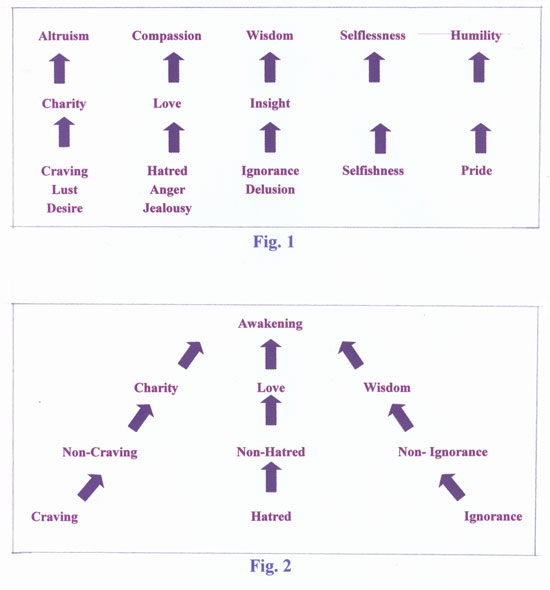
Craving or desire is the cause of dukkha,
suffering. Craving for sense-pleasures, craving for further
existence and craving for dis-becoming are the main components.
Dis-becoming is craving to opt out of living, e.g.
suicide.
Craving for sense pleasures is very common for
all human beings, no matter rich or poor. Besides the physical, we
also desire intellectual stimulation and satisfaction. So all in
all, most of our cravings are mental.
Most of us, who are healthy and not in poverty,
do not want to die. So we crave for existence. Even those who are
in the throes of death do not want to die. We want to live
forever.
However, rarely one of us who is in pain or
afflicted with a terminal illness may want to die because the
suffering is too intolerable. Similarly the mentally depressed due
to a variety of causes would also desire to opt out of life. Of
course these instances are rare but nevertheless
relevant.
These three forms of desire and craving cover
all the causes of dukkha. That is why our daily pre-occupations
center on acquisitions of money, assets, fame and status. This
pursuit itself causes pain and suffering. When we are thwarted in
acquiring these objects we suffer more dukkha. After these objects
are in our possession, we do not want to lose them. In fact, we
want more. Or our cars and houses begin to age. Both situations are
undesirable and therefore dukkha again.
During a lifetime, there are bound to be bad and
good periods. When the going is good, we boast that we are clever
and astute. When the time is bad, we suffer dukkha and blame
everything and every body. There is no controlling of our G-plans.
What one has to do is to see that there is a roller coaster of
events in our lives (G-plan). One cannot control or influence our
G-plans. If one can attune to this, where we are totally helpless,
then we are beginning to ‘see’ the totality of the situation. Once
we see it dukkha is partially eradicated. Lastly, we suffer when
one has to choose. Choices always lead to suffering. We don’t
suffer if there is no choice. An awakened one lives choicelessly.
And of course, when one has an intention that is choice to begin
with.
3rd
Noble Truth of Cessation of
Suffering
When one gives up craving, one ceases to
suffer.
One can see that everything that rises will also
subside. That means dukkha with the correct seeing will also cease.
Cessation of dukkha means Nibbana, which is a state of the unborn,
uncreated and the unconditioned. So Buddha was offering an escape
route. This 3rd Noble Truth is freedom form suffering.
It is emancipation, liberation from continuous dukkha. Nibbana is a
supramundane state in which the yogin has achieved through his
arduous practice of the Four Noble Truths. Being in non-duality
this extinction of thirst is quite ineffable: words are inadequate
to express this state of Absolute Reality. It is the result of the
extinction of desire, the extinction of hatred and extinction of
illusion. The greatest of all illusions is the existence of a self.
In his Anatta doctrine he denies the existence of self. Buddha had
heard the signs and symptoms and diagnosed the disease. He is now
pronouncing the extinction of the disease with the prescription to
follow in the 4th Noble Truth. The Anatta doctrine is
used by opponents to blame Buddha for preaching nihilism. Being in
non-duality, there is no way to describe Absolute Reality, which is
inexpressible in words.. Some hint of this Reality can be gotten
from deep meditation. The deep meditation brings out the wisdom
with its realisation that every single thing in this world is
relative, conditioned and impermanent. Therefore it is not worth
while to cling to anything in this world. Without clinging, there
is no anxiety. Without anxiety, calm and tranquillity are the
mainstay of the person’s character. He is already on the way
towards Nibbana. At this stage when he experienced a sensation,
whether pleasant, unpleasant or neutral, he is unattached to that
sensation. He knows that the sensation will pass, so why cling? He
now sees the Absolute Truth due to the extinction of
dukkha----Nibbana. This truth also tells us that there is no
unchanging, everlasting, absolute substance like Self, Soul or
Atman within us.
Nibbana is not the result of the extinction of
desires. It is not the result of a cause or effect. Nibbana
just is. It is beyond cause and effect. The 4th
Noble truth can lead to realisation of Nibbana, but it is not the
result of the path. Nibbana is simply there for you to realise.
Seeing that Nibbana is the ultimate truth, there is nothing beyond
Nibbana. There is also no question of ‘entering into Nibbana’. When
a person realises Nibbana while alive, when he dies, he ‘fully
passes away’, or is ‘fully blown out’ or ‘fully extinct’, as he
will not be reborn after death. There is no answer to the question,
‘ what happens to an arahant after his death?’ The five aggregates
(body, sensation, perception, mental activities and consciousness)
of an arahant are totally destroyed, never to rise
again.
The famous saying of Buddha: “Within this
fathom-long sentient body itself, I postulate the world, the
arising of the world, the cessation of the world, and the path
leading to the cessation of the world.” This sentence explains a
great deal. It means that there is no Self or Atman who realises
Nibbana. Everything devolves down to the five aggregates. There is
no thinker: it is the thought that thinks. Similarly, it is wisdom
that becomes enlightened: there is no one that became enlightened.
Put it in another way, dukkha arises because of craving and it
ceases because of wisdom. Craving and wisdom are within the five
aggregates. And after the death of an arahant, the five aggregates
become extinct: there is also no more self to be reborn! Unlike
other religions, in Buddhism one can be in Nibbana while still
alive. In other religions, one has to die before entering
heaven.
After realisation, the arahant is in a wonderful
state of happiness, full of joy and peace. He has no more worries
or anxiety, but is filled with compassion, love, kindness,
equanimity and sympathetic joy for others. He is in a non-dual
state all the time, and whatever he does is for others, as he is
purely selfless. We will now embark on the path of the Fourth Noble
Truth.
4th
Noble Truth is the Prescription for the Cessation of
Suffering
This is the middle path between the two extremes
of pleasure of the senses and asceticism.
Wisdom
Morality
Meditation
Right
view
Right
speech
Right effort
Right
thought
Right
action
Right mindfulness
Right
livelihood
Right concentration
This Noble Eightfold Path is the main essence of
his entire teaching. For forty-five years his ministry in
discourses, teachings, lectures etc evolve around this Eightfold
Path. This Eightfold Path must be practised all at once together
and not one after another. As one can see this middle path is a
practical one. It is a way of life and not theoretical doctrines to
be studied in a cell. The word ‘right’ needs some explanation. It
is not right versus wrong. It is more in the line of ‘appropriate’
with regards to the wholeness of Reality. There is no duality
implied in this term.
Morality
Buddha’s teaching is based on compassion and
wisdom. The ethical section on morality is to keep the individual
harmonious and law-abiding in society. It is based purely on love,
compassion, charity, kindness and tolerance.
Right speech means to abstain from 1) telling lies, 2) from
slander and assassination of character and sowing seeds of
disharmony, 3) from harsh, rude and abusive language and 4) from
worthless and idle gossip. In the end it boils down to having to
say the truth. Careless speech promotes bad kamma. If there is
nothing to say, keep quiet.
Right Action means that one should abstain from killing, from
stealing, from dishonest dealings and from illegitimate sexual
intercourse. One should lead a peaceful, moral and honourable life
to promote harmony in society.
Right Livelihood means one should abstain from a profession that
harms others like trading in arms, intoxicating drinks, poisons,
killing of animals and cheating. One should take a profession that
is honourable, blameless and beneficial to
society.
Meditation
Under the heading of
Meditation, we have Right Effort, Right
Mindfulness and Right Concentration.
Right Effort means we have 1) to prevent evil and unwholesome
thoughts from arising, 2) to eradicate these states that have
already there, 3) to stimulate good and wholesome thoughts and
states of mind to arise and 4) to bring to perfection these good
and wholesome states already there.
Right Mindfulness is to be aware and mindful of 1) all movements
of the body, 2) sensations and feelings, 3) activities of the mind
and 4) ideas, thoughts, concepts and planning. This subject is
fully covered by my articles in my website on Insight Meditation
(Vipassana) and on Mindfulness (Four Foundations on
Mindfulness----Satipatthana-sutta).
Right Concentration.
This topic is discussed in two
articles in my website: 1) Meditation and 2) Progressive Stages of
One-pointed Pointed Concentration.
Wisdom
Under Wisdom, we have
Right Thought and Right
Understanding.
Right Thought or Intention
includes renunciation with
detachment, love, compassion and non-violence, which are extended
to humans, animals and minerals. There should not be any thoughts
of selfishness, ill will and violence in all spheres of life.
Sometimes it is also called Right Resolve. These two words of
intention and resolve are probably more accurate in that if we do
not resolve to walk the path, we will dilly-dally and get no where.
If we have no intention or determination we are sure to
fail.
Right Understanding or View
means basically the Four Noble
Truths. This is to see and understand situations as they
are----Suchness. It means to so see Ultimate
Reality. But one cannot see Reality with concepts, beliefs, ideas
and opinions. In order to truly understand one must see the
Wholeness of the situation, which is always in a state of flux. One
cannot freeze a scene and say that’s it. That one scene is ever
dynamic and moving all the time. That one scene is also attendant
and conditioned by numerous factors, and therefore in order to see
and understand a situation, one truly needs a highly advanced and
mature wisdom to visualise the whole scene. In Buddhism there is a
superficial and a deep understanding. Superficial understanding
denotes general knowledge with its attendant memory and grasping of
the subject from the data given. Deep understanding includes
percipient penetration into the true nature of a situation without
naming. One just sees and understands with a purified mind through
deep meditation (Vipassana).
From the above, it can be seen that this ‘middle way’ is an
individual effort of self-development and purification of the mind
through meditation. Prayers, rituals and ceremony are useless.
Worshipping of the Buddha or Deities is a waste of time. It is pure
hard work by the self to realise Ultimate Reality. Rituals,
ceremonies, worship and prayers will not bring anyone nearer to
realisation.