http://www.vajrasana.org/vision.htm
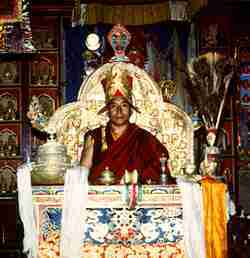
Deep Vision of
the Non-differentiation of Samsara-Nirvana
His Eminence Ngor Ewan Phende Rinpoche
The "Deep Vision of the Non-differentiation of
Samsara-Nirvana" is a teaching which His Eminence Ngor
Ewan Phende Rinpoche gave when he was in Singapore in 1982. We are
grateful to him for so kindly providing us with an English
translation of the text for publication in One Vehicle
when he was back in France. Lama Jamguene Ngawang Lepa is the
famous author of the following text.
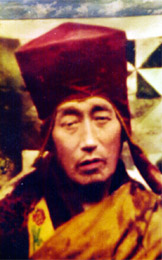
"HERE IS CONTAINED THE ESSENTIAL SUMMARY OF THE VIEW OF
NON-DIFFERENTIATION OF SAMSARA-NIRVANA, CALLED THE ESSENCE OF
NECTAR FOR GOOD MERIT"
Prostration to Lama JAMPAYANG, who grants us the
Wisdom View of Knowledge in all things' Essence.
If we summarize all the apparently diverse opinions
concerning the Masters of the Middle Path, we obtain the outer and
approximate Middle Path and the inner, precise and subtle Middle
Path.
The first category is the view of the Prasangikas who
hold for real everything that is perceived by their senses. At the
time when all treatises of the Sastras were explained and
during the great debates that ensued this view was held.
The second category is the view that considers that all
external appearances end up in the mind which is finally placed in
its own nature, free of all manifestation. In their training of
Yoga, the adepts practise mostly this view in a solitary place.
Relating to this, Atisa has said:
"During all the contradictory debates with
non-Buddhists at the time of the debates
concerning the Great Treatises of commentaries, it was said to
be the Middle Path.
And, at the time of the training to the true sense in the
practice of Yoga, it is the Subtle
Middle Path which is practised and constitutes the essential
oral Teaching."
Greater details are to be found in Atisha's dBuma
Rinpoche'i sGronMe along with the sources of his commentaries,
as it is said in the Legs bShad Gon-Ma'i dGons rGyan.
Thus, it is said that our own Tradition of the view of
non-differentiation of Samsara-Nirvana agrees with the
second Tradition.
Concerning the way of meditating:
First of all, it is indicated in the explanatory
Teachings, all the dharmas of the phenomenal world of
Samsara (cyclic existence) and of Nirvana, are
only reflections of mind itself.
This lack of existence of the smallest
dharma outside the mind is asserted by:
a) references to quotations,
b) logical deduction, and
c) the Essential Teachings.
a) THE QUOTATIONS
It is said in the mDo sDe Sa bCu Pa:
"Oh, Sons of Buddhas, in the end the three Spheres
are nothing but Mind."
In the rDorje Gur:
"Outside the Precious Mind, there is neither Buddhas
nor beings, nor any object external
of consciousness."
In the Chad Ma Rigs gTer:
"In truth, appearances are Mind itself and do not
exist outside of it; they are classfied into
true or false according to tendencies being long-lasting or
not."
It is also explained by numerous other quotations.
b) LOGICAL DEDUCTION
"A unique object able to appear manifoldly is
actually devoid of all reality." So it is said.
Thus, a cup of water will appear differently to the six
types of beings and in that way, we'll know that appearances are
devoid of all external reality. It is by experiencing that external
appearances are devoid of all external reality that this will come
to truth.
In the past, a great adept of the 'Path and its Fruits'
(Essential Teaching of the Sakyapas) had a sensation of thirst
caused by his winds and channels. Unable to find any water in a
well, spring, or river, and totally puzzled, he hung his monk's
clothes on a tree on the other side of the river and went to sleep.
The next morning, waking with his sensation of dryness gone, he
realized that water was flowing as it did before in the well,
spring and river. He was then forced to use a small craft to get
his clothes back.
Another time, in India, a son who had a lot of respect
for his old mother, left the country to do business. Upon leaving,
he told his wife to please take care of his mother and to be sure
to feed her good and pure food.
During the son's long absence, the old lady caught an eye
disease which made the rice she was given appear to be full of
hairs. This, in turn, made her very weak due to a swollen
stomach.
Upon returning, the son asked the old mother if she had
been well taken care of.
"After you left, your wife never gave me good food,
except this rice full of hairs which
now made me sick with a bad stomach."
The son reprimanded his wife, who in turn
answered him:
"I have only given her good food, but it seems that
she has an eye disease. Go and bring
her food yourself."
So, the son brought perfectly clean rice to his old
mother who said:
"In older days, you had a lot of respect for me, but
it seems that now you're under your
wife's thumb. This rice is full of hair!"
Understanding that her eyes were bad, he told her to keep
the rice and called upon a doctor. After having been treated, he
asked his mother to look at the rice. And since there wasn't any
hair in the rice, the old lady understood that her disease was the
cause, and thought:
"How can my stomach be sick if I've not swallowed a
single hair?"
Reassured, her stomach problems disappeared as the
rainbow vanishes in the sky. So it is told.
c) THE ESSENTIAL TEACHINGS
Concerning the assertion from the spiritual instructions
given by each of the Lineage's Lamas, it is said:
"Sickness and disease numb and deceive the mind like
a disease veils the eyesight or
like a blazing point swirling rapidly."
Having thus thought about this truth which is asserted by
the above three quotations, arguments and spiritual instructions,
all appearances will be perceived as Mind.
For example, when salt absorbs itself in water, it
becomes one with water. In the same way, we should understand that
no existing dharma is different from Mind.
And lastly, we'll even doubt an external existence
(different from mind) of our own body. But, concerning the
authentic fusion of Mind-Perception, it is said that it does not
appear until the Eighth Land is reached.
Although the fusion of Mind-Perception of the preceding
Land is not really the authentic one, it still appears as an
experience during the practice of Yoga.
Those who wonder if the realization of appearances of
Mind-as-such, is not precisely the Prasangikas' Tradition of the
Middle Path, are in fact totally wrong.
In fact, Klu-sGrub, 'Phags-Pa Lha and ZLa Ba Grags-Pa
have all three asserted that perceptions are only Mind, and who
dares say that they do not understand the Prasangikas' view?
The great Savant Mi-Pham rGya-mCho has explained it thus
in his dBu-Ma rGyan-'Grel:
"To realize that all perceptions are Mind-as-such is
the essential characteristic of the
Buddhist Path's holders; true situation of all objects, it is
the sacred point of the Essential
Teachings relating to meditation. To destroy the illusion of
phenomenal existence, it is
the essential hint, just as it is essential for the butcher to
know the animal's vital point
in order to kill it, or for the lumberjack to know where to
plant his nail in order to dry
out the tree.
If we can hold it (the essential point) due to
skilful means, it is also the heart of the
Essential Teachings pertaining to the Ultimate rDorje
Vehicle."
And so are the numerous writings praising the realization
of perceptions as Mind.
To say that appearances are Mind means that they are Mind
perceiving itself. In fact, Mind never perceives an external
object.
Relating to this subject, the Omniscient dKon-mChog
Lhun-Grub has said:
"As distinctive object to our own manifold perceiving
mind, our own mental investigation
finds nothing but an illusive being. The chain of
interconditioned production of the never
ceasing duality between 'me' and 'other' (appearing and resting
on conditions and causes)
is empty of an own-self. Look at the own-face of the Sphere of
the Inexpressible and
Spontaneous."
Therefore, if we investigate mind with mind, we'll
experience an unceasing Light which is called the Mind's
characteristic.
By its own Essence, this same Light is devoid of birth
and empty of primeval cause. In an intermediary stage, it does not
dwell in anything and is devoid of a distinctive essence. Finally,
since it is unceasing, it is empty of the Fruit of annihilation.
Mind has no form or color. It does not dwell inside or outside the
body, nor in between. No matter which way we look for mind, it
cannot be found. Whichever way we investigate mind, we cannot find
anything in which it would realize itself (not having any
distinctive essence). Although not having any distinctive nature of
its own, the trick of various perceptions nevertheless appears
incessantly since the beginning, therefore we never experience its
lack of existence. Since this trick of various perceptions appears
constantly and we cannot find any true nature, neither can we
experience its existence.
This nature of Emptiness in which we have never
experienced any existence, and this characteristic of Light in
which we have never experienced any non-existence, have always been
dissociable. Mind is Pure Light in its perception of itself, Empty
in its own Emptiness, and Perfectly conscious in its own
investigation. All this is only a purpose of experience for the
Transcendental Wisdom of our own investigation.
But, in reality, there is no distinctive essence to hold
in the Primeval Nature of the Absolute Truth. Nothing that mind
should grasp, nor words to express it. But, nevertheless, in order
to dissipate ignorance, the Absolute Truth is called the relative
Truth of language: 'non-dual', 'Union of the Two', 'inexpressible',
and 'essence of Primeval Mind'.
Although this natural state comprises Samsara
and Nirvana, those who ignore their true essence are said
to be in Samsara, while those who know their true essence
are said to be in Nirvana. The designations of
Samsara and Nirvana are thus attributed according
to the understanding or the lack of understanding (of their true
essence).
From the true point of view, there is no bad
Samsara that should be rejected nor any good
Nirvana that should be realized. If this is correctly
perceived, we have then obtained what is called the understanding
of the view of non-differentiation of Samsara and
Nirvana.
In brief, there is nowhere to concentrate outside of the
non-seizure of Mind's Emptiness-Light. The relaxed mind should
constantly be in this state where there is nothing to meditate
upon, free of quest and artifice.
In the Songs of the Venerable Grags-Pa rGyal-mChan, it is
said:
"How could there be a cessation and a distinctive
essence in a mind which is devoid
of original birth? To think that there is neither birth nor
cessation is also an obstructive
thought; Give it up! You should also renounce the idea of
giving up, since giving up is
also a thought!"
"That which is limitless goes beyond the realm of the
expressible. The designations
'Middle', 'Mind only', etc. . . are only words and
manifestations, while their mental
representations are only conceptualizations."
However you think of it, if you have not perceived the
Natural and Spontaneous State of Mind, and if you have not trained
in the essential Teachings of non-grasping, you'll be caught
grasping even with the thought of non-grasping.
Understanding that this unceasing Emptiness-Light is the
Natural State of Union.
rJe Sa-Pan has also said:
"Existence, non-existence, etc. . . ., there is
nothing similar in the Natural State of things.
There is no object to meditate upon, nor a subject who
meditates, nor the act of meditating.
Mind being devoid of a distinctive essence, how could you
explain that Essence? By passing
the realm of the expressible, there is nothing to
say."
Coming out of this equanimous meditation, we'll then
realize that all the forms belonging to the visual field as well as
everything that is seen, are, as soon as perceived,
Perception-Emptiness, which is nothing else but the
undifferentiation of Samsara-Nirvana.
In the same way, all the sounds of the audio field are,
as soon as heard, undifferentiation of Audibility-Emptiness, of
Samsara-Nirvana.
And, lastly, all the discursive thoughts pertaining to
the mental field as well as all that is thought are, as soon as
they appear, undifferentiation of Mind-Emtpiness, of
Samsara-Nirvana.
Everything that appears is an Activity of the
Dharma Body.
All perceptions having appeared as expressions of the
non-differentiation of Samsara-Nirvana and without having
to look anywhere else for a meditation object, like a businessman
finding himself in a country full of gold, it will be possible to
leave the mind on everything that appears without trying to
transform it.
Some wrongly affirm that appearances, sounds and
thoughts, that we have just explained above as being
non-differentiation of Samsara-Nirvana, constitute the
meditation and not the view. In the two texts of the lJon Chin
Chenmo and the Dag lDan, the Great rJe-bCun
affirms:
"The 'holder of dharmas' (phenomena) is Samsara.
Dharma itself (its essence) is
Nirvana and their undifferentiation is the undifferentiated
Samsara-Nirvana."
'Jam-dByans dKon-mChog Lhun-Grub has also said:
"That which is devoid of a distinctive essence is
only perception; the nature of all
objects is the Dharma of Samsara-Nirvana; dharmas and 'holders
of dharmas' are
in truth undiffrerentiated. Realize this view of profound
meaning free from all limits!"
Thus, by examining the various quotations, doubts
concerning the view of the non-differentiation of
Samsara-Nirvana will disappear.
In summary, the Dharma Body at the moment of the
path is to put in practice the method consisting of leaving Mind
Itself in its natural and non-transformed state.
Thus, we obtain the Dharma Body of the moment of
Fruit which is to recognize Mind Itself free of artifice. And it is
That which is called Buddha.
If, outside of mind, there were a place where another
Buddha could be found, we could not hold it, and even if we could,
the fusion with Buddha would be difficult.
In brief, we'll know that those who didn't realize their
Essential Nature are called sentient beings while those who do are
called Buddhas.
Although we call them View, Meditation, and Action, those
different labels take a specific name in the continuum of the
practitioner according to the moment. They are in fact the unique
View of the non-differentiation of Samsara-Nirvana.
As the Lamas' Lineage has put it: First obtain the
certainty that all perceived objects are summed up in mind. Then,
perceive that all mind's perceptions are illusory and understand
that this illusion only appears because of the supportive links.
After having perceived that the meaning of those supportive links
are separated from all expressible limits, realize the certitude
not relying on anyone regarding the Natural State; so is the
View.
Having first started with the three preparatory
Dharmas, we'll remain in the Equanimity of the Profound
View with the help of the three basic Dharmas. Then, we'll
meditate by using as final ornament the three conclusive
Dharmas. So is the Meditation.
At each moment and without letting go our steadiness of
watchful conscience of the View, we'll meditate on three demons
(gDen) of external obstacles, on the three diseases of
internal obstacles, on the three perturbating poisons of secret
obstacles, on the eight mundane dharmas; in brief, on the
erroneous thoughts of passion-aversion by applying the vision
seal.
Just as fire gets higher with the abundance of wood, no
matter how violent the mental and dualistic perceptions of
subject-object such as obstacles and bad causes, if we're never
separated from the key of the View, those perceptions will be
perceived as the blissful Sphere of Dharma, just as ice
cubes melting in water. A greater advantage will then result
concerning the View.
Thus, a correct experience of this Profound View being
born in our mind, it will become the antidote to all our disruptive
forces (Klesas).
Generally, although our great compassionate Master, the
Buddha, taught the aspect of repulsive meditation as an antidote to
desire, the Samadhi of love as an antidote to anger and
hate, the meditation of appearance in relation to the supportive
links an antidote to ignorance, the charachteristics of the varied
inclinations and temperaments as an antidote to pride, the
meditation of the similarity between oneself and others as an
antidote to jealousy, and so on . . . the repulsive aspect is only
beneficial to stop desire but unable to appease anger and hate but
has no effect on desire.
If the unshakable certainty appears towards this Profound
View, it then becomes the antidote to all disruptive forces.
For example, just as inside Samsara, the remedy
called 'the unique benefactor' is the antidote o all diseases, if
one perceives correctly the perfect meaning of Emptiness, this
understanding will then become the antidote to all disruptive
forces.
It is said by Kun-mKhyen ChosKyi rGyalpo:
"Although the water of repulsion (ugliness) can wash
the stains of desire, it cannot
destroy the rocky mountain of anger; although the fire love can
burn the bushes of
anger, it is unable to wash the stains of
passion-desire.
"With the ability to perceive as Unity Emptiness and
everything that appears in relation
to the supportive links, one can totally cut the tree of self's
view with its numerous branches
and leaves of actions and disruptive forces and its fruits of
birth (namely, existence)."
Thus it is explained.
If we gathered all the Doctrines of the Way, we'll find
that they are all concentrated in the six Paramitas (six
Perfections). And those appear easily to the one who perceives
perfectly the essential point of this View.
In the sPyod-'Jug, from the beginning:
"abandoning the miserable beings", to the end: "they wander without
a reason", it is meant in those nine slokas (stanzas) that
the six Paramitas do not exist by relying on body and
external speech but that we must find them relying solely on the
inside mind. Thus, the spirit of giving which comes from the heart
is Giving; the total victory over the spirit of ill-will is Moral
Discipline; the total victory over the spirit of anger is Patience;
a mind rejoicing in practising virtue is called Zeal; a mind which
remains firmly on any object is called Meditation; the knowledge of
the Nature of Mind is Wisdom.
Those virtues will be born in the mental continuum of the
one who will possess the perfectly Pure View. Jo-Bo rJe (Atisa) and
Milarepa have both said it. The victorious Yan dGonpa has also
said:
"To know the nature of virtue is the most excellent
of all virtues. To know the nature
of non-virtue is the most excellent of all
confessions."
Just as it has already been explained, the wisdom of the
nature of virtue being an inexhaustible virtue, it becomes the
cause of Perfect Awakening. The wisdom of the nature of non-virtue
is the most excellent of confessions and it is said in the
Tharpa Chenpo Phyogs Su rGyas-Pa'i mDo:
"If you want purification, firmly contemplate the
Pure View. When it appears,
the Perfect Liberation will also come. This is said to be the
most excellent of all
purifications."
The Master, Arya Deva, has also said:
"Even those who has accumulated little merit will
have no doubt concerning this
Doctrine. If they did, they would have to wander in cyclic
existence (Samsara)."
For it to be born rightfully in our mental continuum, we
must exert ourselves with great strength in Purification and
Accumulation.
Having understood that the Lama was the Essence
concentrating all Buddhas, it is very important to pray to him with
perfection concentration, aspiration and immense veneration.
It is said in the rNal-'Byor-Ma Kuntu sPyod-Pa'i
rGyud (bDe mChog's commentary Tantra):
"Prostration to the Feet of the One whose kindness
allows the Great Bliss to appear
in a flash. Prostration to the Lama whose Body is similar to
the Jewel possessing the
Dorje."
Sakya Pandita, the Lord of Dharma, has also
said:
"For the one who faithfully relies on You, that
person immediately receives Infinite
Mercy and becomes in one instant a Perfect Buddha and realizes
all the Perfect
Accomplishments."
In the Tantra, it is said:
"Due to a constant veneration and aspiration, the
rank of Dorje Chang can be obtained
in six months."
'Brom-sTon once asked Jo-Bo rJe (Atisa):
"Have the Doctrines I practised in the past been
transformed in the Way or not?"
"Those where you served your Jetsun Lama did, the
others, no," answered Atisa.
'Brom-sTon asked again:
"Although we have many meditations adepts in Tibet,
none has obtained the distinctive
Virtues. Why is this?"
"All the qualities, great or small, of Mahayana can
only take birth by relying on the Lama
and since you, in Tibet, only consider Lama as an ordinary
being, how do you expect the
Qualities to be born?"
It is said that to see the clean face of the Profound and
Natural Situation of all dharmas, there is nothing more
excellent than the practice of Guru Yoga. By practising this Guru
Yoga with regularity, not only with the mouth but also with the
heart, an unbearable strength of veneration and aspiration will
burn from the inside, just like a great fire. There is nothing else
than to think and recall the Lama.
We'll understand that all Buddhas and Bodhisattvas of the
ten directions are incarnated in our own Lama. And by seeing or
hearing the marvellous biographies of holy and realized Lamas of
India and Tibet, we'll also know that our Lama is their
Incarnation.
Having established the certainty that the Essence of the
Lama concentrates without exceptions the Three Jewels, and in order
to honour Him, not even being satisfied with the offering of our
flesh and blood, by thinking of Him, we will pray to Him with
veneration songs, pouring tears similar to a rain shower.
If we're able to pray to Him with such great strength,
there will be no doubt of reaching the Perfection rapidly.
If we're satisfied by saying a few prayer words such as:
"The Lama knows" while only thinking of Him of time to time, then
we'll never obtain the benefits of the Profound Guru Yoga practice.
That is why we must exert ourselves to a pure practice.
The most excellent of all incarnation, the Omniscient
'Jam dByans Kun-dGa' Bstan-Pa'i rGyal-mChan has said:
"Know that all Refuges are the Essence of the Lama.
See all virtuous practices as the
Way of the Lama, and know that Samsara and Nirvana appear as
Manifestations of
the Lama.
"Grant us Your Infinite Mercy so that the phenomenal
world appears as the Lama!"
If what has just been said is realized, it is said to be
the true and faultless practice of the Guru Yoga of the Profound
Path.
This text was composed at the repeated request of
Thartse Shab Droung Rinpoche Byams-Pa Nam-mKha' Kun-bZan BStan-Pa'i
rGyal-mChan and other listeners of the Lam 'Bras (Lamdre). They
asked the monk of Sakya Thouppa, Nag dBan Legspa, to record the
authentic account of the stages of the view that he possessed. And
it was written by the incarnation of sDe gZung Lun-Rig, namely,
Kun-dGa' BsTanpa'i Nyima.