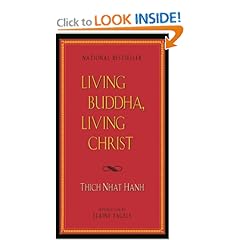
I know of Christians who also learn Dharma, practise Insight
meditation and reaps result so I think it is possible.
You should look into the Christian and Catholic contemplative
and mystical literature. (See: Christian Mysticism). You will find much
similarities in experience with the Eastern contemplative
paths.
Mysticism and contemplative path aims to realise the oneness
with the divine, and beyond. As former Carmelite nun and a
contemplative in the Catholic tradition, Bernadette Roberts says:
"The realization of oneness with God does not mean that we
are the historical Jesus or the incarnate Christ -- of whom there
is only one -- rather, it means that at this point we see Christ as
"that" mystery of our being which is truly one with God, one with
the Father. Though we may equate this mystery with the unknown
"true self," it basically goes beyond this. This specific
revelation of Christ is not the revelation of God within (God as
immanent), nor the realization of our oneness with God; rather,
this revelation is over and beyond the unitive realization of
oneness with God."
-----
BTW the blog in which I posted Bernadette Roberts' article is
run by me and our moderator Thusness. It is a good interview that
spoke of her contemplative journey and how she chanced upon
Buddhism and found an experiential account by Buddha that
corresponded to her experience. (She is still a Catholic
however)
In Christian Mysticism, union and oneness with God (It is no
longer I who live, but Christ lives in me - Galatians 2:16-20)
is the first major achievement in the contemplative path. But what
is special about Bernadette is that she also spoke of the "beyond
union" as she experienced No-Self and that "the Christian
revelation breaks through self to a revelation of our Resurrection
in the Body of Christ and Ascension to our Heavenly estate beyond
self".
Also, in Sunyata by A.H.Almaas, a Islamic Sufi
Contemplative and also a Buddhist practitioner, wrote:
If love leads the devotee to the point of the extinction
of personality in the fire of truth, awareness can lead him to the
point of seeing that ego does not really exist, and hence achieve
the same goal of selflessness. Love melts the lover into the ocean
of truth, there remain no traces of an I. Awareness, on the other
hand, cuts through the illusion of a separate identity. It exposes
the lie of ego: that it exists as a reality. Love melts ego away,
while awareness is like turning on the light and seeing that there
is nobody there. The outcome is the same in both cases, but
the flavor of the path is different. One is more emotional, the
other more insightful. The vocabularies of the two paths differ as
a result. The path of
love seeks union with the Beloved, while the path of awareness
seeks the seeing of naked Reality. Just as prayer is the
central practice in the path of love, meditation is the central
practice in the path of awareness... (continued in the
URL)
and as I wrote before:
...when we're talking about the core of religions, it's the
mystics/contemplatives that are the 'highest level'
practitioners... who seek to understand the truth of their
religions not just by belief, theories or even feelings/emotions
(common religious seekers may have powerful life-changing
experiences or encounters with the divine force/spirit, or
miracles, but Spirit/God will always seem to be "separate" from the
"seeker" until they realise union/its true nature) but by complete
union with the true essence of god.
But for the mystics, its a direct experience of the UNION
with the Divine Presence of God, or in Hinduism they call it the
realisation of the (true) Self, which is a non-personal Self, its
the true self, the God-self. "God-consciousness". It's a complete
dissolving of any sense of individuality into God/true-Self, a sort
of non-dual experience (but not the kind of non-duality in
Buddhism) and realising the true identity of luminous pure
consciousness as God....
And that, incidentally, is also known as Born of the Spirit. And
also Born of Water: Water here means purification from, and
crucifiction, of the old egoic identity. This 'sinful' (deviated
from God) egoic identity cannot enter the kingdom of God and is
crucified. And this, Jesus said, was the way to enter the kingdom
of God.
John 3:5: Jesus answered, "Truly, truly, I say to you,
unless one is born of water and the Spirit, he cannot enter the
kingdom of God."
There's another video related to mysticism: http://www.youtube.com/watch?v=SUNlpyfT2LU
The Catholic theologian Karl Rahner famously said "the
Christian of tomorrow will be a mystic, or not a Christian at all."
Few people have impacted Christianity in this regard as has Fr.
Thomas Keating. A Cistercian monk from St. Benedict's Monastery in
Snowmass, Colorado, Fr. Thomas has spent a lifetime in deep
Christian practice, and in sharing the fruits of this contemplation
with countless others. We were enormously blessed to host a
dialogue with Fr. Thomas and Ken Wilber in April of 2006. In
today's featured video, Ken presents some of the foundational
concepts of Integral spirituality.
And also:
http://www.youtube.com/watch?v=04gdsFt_zDY&feature=related