Here's a write-up in one of the Korean English papers:
Seoul, South Korea --
Around 200,000 Buddhist monks and laypeople rallied in downtown
Seoul on Wednesday protesting against what they said was religious
bias and constitutional infringement by the Lee Myung-bak
administration. Police estimated 60,000 Buddhists took part in the
rally in front of City Hall.
 << Tens of thousands of South Koreans, including
7,000 monks, gathered at City Hall in Seoul to protest against what
they say is a pro-Christian bias in President Lee Myung-bak's
government. BBC picture
The protesters issued a resolution saying a series of
expressions of religious bias by public servants in the
administration and President Lee Myung-bak’s tacit tolerance of
such practices have undermined national harmony and the
Constitution, which stipulates the prevention of religious
discrimination and the separation of government and religion. They
called on the president to break down the walls separating
religious, social and regional groups and lead them to unity.
A survey by the National Statistical Office in 2005 showed that
24.97 million Koreans or 52.8 percent of the population adhered to
a particular religion. There were 10.72 million Buddhists, 8.61
million Protestants and 5.14 million Catholics. There were also Won
Buddhists and followers of “Chondogyo” as well as Confucians. It is
simply a shame to see members of our largest religious group having
to hold such a protest rally in the middle of the capital.
In June and August, a computerized public transport information
system operated by the Ministry of Land, Transport and Maritime
Affairs and a digital map created by the Ministry of Education and
Science omitted information on Buddhist temples. The same company
was responsible for making both programs.
In March, it appointed as its vice president a person who had
served as a senior advisor to the presidential Transition
Committee. Buddhists not surprisingly raised suspicions of
favoritism as this company went on to win two more large-scale map
projects form the government, even after the Buddhist temple issue
had created controversy.
The poster advertising one sermon held by a large Protestant
church in June to convert police officers showed Police
Commissioner Eo Cheong-soo standing side by side with the pastor of
that church. It was placed on all notice boards at police stations
across the country. There are more incidents that have angered
Buddhists.
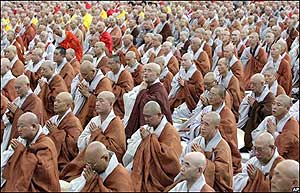 Religious tolerance is prized in South Korea.
Buddhism is the oldest religion but officials say Christians make
up about 29% of the population compared to the Buddhists' 23%.. BBC
picture >>
The government must set up a team to investigate exactly what
triggered the anger among Buddhists. If such acts were intentional,
then the people involved should be punished, and if they were
unintentional, they should be clearly explained and measures taken
to prevent them from happening again.
On Monday, President Lee ordered public officials to be careful
not to damage “religious harmony.” Ahead of the rally, Buddhists
said they hoped the gathering, which aimed at voicing hope of an
end to religious division and a beginning of unity, would not end
up becoming a gathering to sever ties with the Lee administration.
Countries around the world suffering from endless strife and
violent clashes between different religious groups are said to be
envious of our country, where so many different religions coexist
without problems.
To preserve this intangible asset of our society, the government
must waste no time to listen to the voices of the Buddhist
community, rectifying what needs to be rectified and resolving any
misunderstandings. Buddhists, too, should consider what the Korean
public is worried about at this moment.


