Ever start reading a really cool looking
meditation book only to find that the picture on
the cover is the only thing that makes any sense?
Have you ever wondered why the author or
translator never bothers to tell you what those
weird words mean, "Samahadi...",
"Vipassana...", "Dukka..."
Have you finished a meditation book and
understood about half of what was talked about and
figured that half is better than none? (a very 'enlightened'
but often frustrating outcome
especially when these books aren't cheap)
This little known book seems to have addressed
and solved all those problems and more. It is a book
written for people who have no clue how to
start meditating and for those who have started, but
don't know where to look for the answers to
questions that come up during their practice.
The best thing about this book is in
its title,'plain English'.It seems to gently
lead one by the hand through the mystery and
confusion of meditation with a sense of humor
and patience rarely given to the subject.
I have been meditating for nine years now and
have built up a small library of books on the
subject. When friends ask me about meditation
I dig around in all the books with great
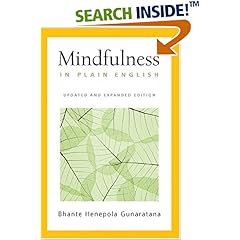
covers and reach for "Mindfullness In Plain
English" every time.
The introduction gives a brief look at the roots of the practice
and tells the reader that meditation is intrinsically experiential
so the best way to get started is to just sit and try it. In the
following chapters, Gunaratana helps the reader to understand
exactly what meditation is and what it isn't. From there he goes
into more detailed instructions as to what your mind and body
should be doing while you meditate. This is accompanied with useful
tips on dealing with problems that may arise in your practice,
including the 5 major hindrances that nearly all meditators face.
The book wraps up with a more in depth look at exactly what
"mindfulness" is and how to "take it from the cushion" and
integrate it into our daily lives.
I found this book very easy to read and understand and feel it
would be an excellent guide for people just getting into Buddhism
and meditation. Already being the owner of a collection of books on
Buddhism, this book didn't offer any new revelations but I was
extrememly pleased with the sections on mindfulness and have
already used some of the author's suggestions on integrating it
into daily life. The main reason I did not give the book 5 stars is
because it offers much more for the new reader than it does for one
with more experience.
If you buy this book and still feel like you could use more
detailed instructions on meditation, I recommend you also purchase
"Change Your Mind: A Practical Guide to Buddhist Meditation" by
Paramananda (ISBN: 0904766810).
In "Mindfulness" you will gain an understanding of what
mindfullness is, how to cultivate it both during sitting practice
and the rest of the time, tips on how to sit and how to overcome
some of the most common distractions (including your feet going to
sleep and your back hurting), and what to look for and what to
avoid. I have not been practicing meditation for long, and this
book was of enormous value in helping me identify the things I was
doing that served as barriers to effective insight meditation, as
well as giving me ideas on how to enhance the effectiveness of my
meditation.
This is an extremely practical book for the western
practitioner. It draws heavily upon the Buddhist paradigm, but the
techniques for effective meditation cross all sect boundaries, and
the beginning practitioner of any faith will find this book of
enormous benefit. I would strongly encourage the reader to
suppliment this book with "The Miracle of Mindfulness" by Thich
Nhat Hahn. The two together are a delightfully easy to read but
complete and well rounded introduction to the practices of Insight
Meditation. If you want to know how but don't want to hire a Yogi
to translate, this book is the place to start.
http://www.urbandharma.org/udharma4/mpe.html
- Mindfulness In Plain English -
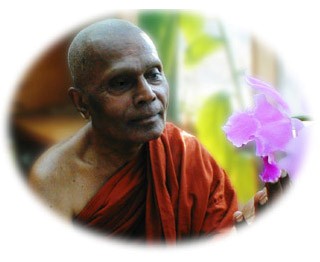
Ven. Henepola Gunaratana
From the
introduction:
The
subject of this book is Vipassana meditation practice. Repeat,
practice. This is a meditation manual, a nuts-and-bolts,
step-by-step guide to Insight meditation. It is meant to be
practical. It is meant for use.
There are
already many comprehensive books on Buddhism as a philosophy, and
on the theoretical aspects of Buddhist meditation. If you are
interested in that material we urge you to read those books. Many
of them are excellent. This book is a 'How to.' It is written for
those who actually want to meditate and especially for those who
want to start now.

Mindfulness In Plain English - Now In PDF - Free
Download Here
(File/PDF - 637
KB)
Preface
Introduction
Chapter
1 ...(Meditation: Why Should I Bother?)
Chapter
2 ...(What Meditation Isn't)
Chapter
3 ...(What Meditation Is)
Chapter
4 ...(Attitude)
Chapters
5 ...(The Practice)
Chapter
6 ...(What To Do With Your
Body), General Rules, Clothing, Traditional Postures
Chapter
7 ...(What To Do With Your Mind)
Chapter
8 ...(Structuring Your Meditation), Where To Sit, When
To Sit, How Long To Sit
Chapter
9 ...(Set up Exercises), The Threefold Guidance,
Universal Loving-Kindness
Chapter
10 ...(Dealing With Problems)
Chapter
11 ...(Dealing With Distractions, I)
Chapter
12 ...(Dealing with Distractions, II)
Chapter
13 ...(Mindfulness - Sati)
Chapter
14 ...(Mindfulness Versus Concentration)
Chapter
15 ...(Meditation in Everyday Life)
Chapter
16 ...(What's in It for You)
Distribution
Agreement
(Please Note: Links open a 'New' window, to return to this
page close the new window.)