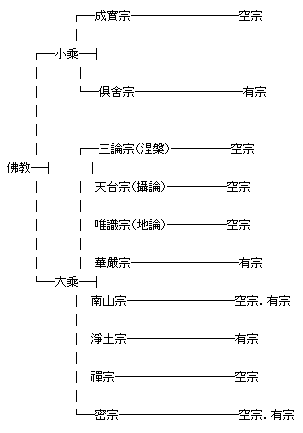
All teachings in the Tripitaka
(Buddhist Canon) are tools to induce sentient beings to sever
attachment. To those attached to Emptiness, Buddha Sakyamuni taught
Existence to break that grasp. To those attached to Existence, He
taught Emptiness so as to loosen that grasp. To those grasping at
both Emptiness and Existence, He taught "neither Emptiness nor
Existence" to break that grasp. Lastly, to those grasping at
"neither Emptiness nor Existence," He taught both Emptiness and
Existence to break that attachment. (1)
In short, the purpose is to draw all sentient beings away from
attachments. That is the Buddhist teaching of salvation. There is
no other way to return to the source [the Mind], though there are
many different expedient methods. We Buddhist students and
practitioners should not become attached to these methods. When
thoughts arise in our mind discriminating between what method is
right and what method is wrong, that is against the purpose of the
Buddhas and is a deviation from the Buddhist path.
For example, when Buddha Sakyamuni taught the Dharma of Emptiness,
His message was not that it was the opposite of Existence, but
rather that it was Truth and Reality. What are Truth and Reality?
Let me quote the T'ien T'ai Patriarch Chih I:
When one dharma is empty, then all dharmas are empty; there is no
separate Non-Emptiness. Without Non-Emptiness to contrast with
Emptiness, Emptiness itself is unattainable [i.e., does not
exist].
Similarly, when Buddha Sakyamuni taught Existence, this was not the
opposite of Emptiness, but was rather to say:
When one dharma exists, then all dharmas exist; there is no
separate Non-Existence. Without Non-Existence to contrast with
Existence, Existence itself is unattainable.
We should understand the true meaning of Emptiness and Existence.
Nothing we say about Emptiness or Existence is attainable (i.e.,
truly valid). And since this is so, why are we still attached to
them?
The Great Master Han-Shan thoroughly understood the goal of the
Buddhas. In tune with the minds of the Patriarchs, he spread the
Dharma (teaching), grasping at neither Emptiness nor Existence,
neither Non-Emptiness nor Non-Existence -- thereby manifesting the
Middle Way. Thus, he promoted the cultivation of both Zen and Pure
Land, pointing to the non-duality of Emptiness and Existence. That
teaching is "Wonderful Enlightenment" (see Glossary).
When practicing Zen, at the beginning of cultivation the expedient
of Emptiness is used. But Zen does not mean Emptiness, nor does it
mean Existence. Pure Land uses the expedient of Existence at the
start of practice, but Pure Land does not mean Existence nor does
it mean Emptiness. When Sakyamuni Buddha spoke of Emptiness and
Existence, it was to reach human beings of different capacities.
The Dharma itself transcends Emptiness and Existence. All methods
taught by Buddha Sakyamuni are like prescriptions; since people
suffer from different diseases, they need many kinds of
prescriptions. It does not matter whether the medicine is expensive
or cheap. As long as it is effective, it is a good medicine .
Those who practice Zen or Pure Land should all understand this
truth: "all Dharma methods are equal and none is superior or
inferior." No one who really understands the deep meaning of the
Dharma can have the kind of obstinate prejudice that sees
inferiority and superiority between the various Buddhist methods.
No one with that kind of obstinate prejudice can gain any real
benefit from the Dharma.
http://www.ymba.org/han/hanfrm.htm