In the Scottish Lowlands, Europe's
first Buddhist monastery turns 40
AFP, May 10, 2007
By a river at the foot of wooded
hills in the Scottish Lowlands, yaks imported from Tibet graze idly
in fields near steps that lead to a temple topped with a golden
pagoda.
ESKDALEMUIR, Scotland -- Summoning monks and nuns
to morning meditation, heavy gongs echo through a sprawling
compound where two giant golden Buddhas, one with a cobra coiled
above its head, stand by a fountain and gardens. Welcome to Samye
Ling, Europe's first and biggest Buddhist monastery.
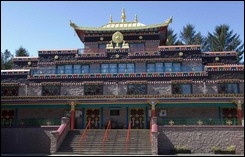
A detail of the Samyeling Tibetan temple, Europe's first and
biggest Buddhist monastery
© AFP/File Brian Stewart
A picture of bucolic tranquility several miles outside the village
of Eskdalemuir in southern Scotland, the monastery is celebrating
40 years in which it has not only survived but thrived in an alien
setting.
Increasingly open to westerners, the monastery has also established
centres in more than 20 countries, including Belgium, Ireland,
Poland, South Africa, Spain and Switzerland.
(GAD}The monks and nuns, their heads shaved and wearing
orange or burgundy robes, hurry up the small steps that lead them
to the temple -- the first built in the West.
But there are not just monks.
Doctors, artists, students, therapists and the occasional celebrity
also turn up at the temple, built in the 1980s along Tibetan
specifications.
It stands two stories high, with a roof in the form of a pagoda,
while at the altar inside, stands a Buddha, immense and
golden.

Monks walk across a bridge in the Samyeling Tibetan temple,
Europe's first and biggest Buddhist monastery
© AFP/File Brian Stewart
"Don't let all the gold blind you when you enter the temple. Did
you take your sunglasses?" former monk Josep Soller, a Spaniard,
told a visitor.
Soller told AFP he was a Buddhist monk for 12 years but has
remained at the monastery where he now works in the kitchen. He has
been here 20 years.
During this period, he shut himself off completely from the outside
world for several years, living in silence among fellow monks in a
secluded building at the monastery.
"You enter the retreat, the door closes behind you and you cannot
hear another voice, nor know anything about what is happening in
the world," Soller said. "After this, you know yourself very
well."
In the breakfast room before meditation, the monastery's abbott
Lama Yeshe, who holds the honorific title Rinpoche, said his
brother Akong Rinpoche and another monk Chogyam Trungpa Rinpoche
founded the monastery here in 1967.
The two men, who were part of a group that had fled
Chinese-occupied Tibet in 1959, eventually ended up in Scotland and
headed to a hunting lodge here called Johnstone House where another
Buddhist monk lived.
The original monk emigrated to Canada, but Akong and Chogyam stayed
on at the lodge to found a community which they named Samye Ling
after a temple in Tibet.
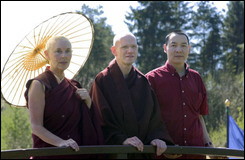
Monks pose in the Samyeling Tibetan temple, Europe's first
and biggest Buddhist monastery
© AFP/File Brian Stewart
In the following years, the place became a pilgrimage site,
attracting "hippies", artists and musicians like Leonard
Cohen.
"People from around here told me that in the sixties they would see
sometimes John Lennon and Yoko Ono walking around," said Joanna
Mackintosh, who lives in a nearby village and was visiting the
Tibetan tea room, which is open to the public.
But nobody in the monastery remembers Lennon here. "Maybe he was
here, I don't know", said a nun at Samyre Ling, Ani Rinchen
Khandro.
The abbot's story is also the stuff of legend.
When he came to Britain, he was 18 years old, and he lived the
experiences of any young Westerner: he would ride a motorcycle and
listen to the music of Jimi Hendrix, indulging in drink and
drugs.
"He had kind of a wild time, but then he decided to turn a new
leaf", said Ani Rinchen Khandro.
He was ordained in 1980, and went into long solitary retreats. In
the 1990s, he became abbot while his brother Akong spent six months
a year in Scotland and the other six in Tibet.
"He has about 150 projects in Tibet, including the charity Rokpa",
explained Ani Rinchen Kandro.
The Dalai Lama, the exiled leader of Tibet, has visited Samye Ling
on two occasions, in the 1970s and 1980s, said the nun.

A detail of the Samyeling Tibetan temple, Europe's first
and biggest Buddhist monastery
© AFP/File Brian Stewart
Today Lama Yeshe can be seen every day, leading meditation,
teaching Buddhist classes or strolling among the Buddhas,
fountains, residences or through a room with hundreds of candles
lit to plead for world peace.
Near him a nun, Ani Lhamo, said Lama Yeshe, now 64, had decided to
travel back to Tibet. "We worry because of his health, Tibet is
very high," she said.
But Lama Yeshe only smiled.
"He always does what he wants," Josep said.
In 1991, he even raised the money needed to buy an island off the
coast of Scotland, Holy Island, that holds retreats and offers
courses in meditation, yoga, vegetarian cooking.
Meanwhile, in the little tea room, visitors and monks shared a
quiet time.
One of the visitors, Judith, had come to take a course in
meditation. Eric and Lucie were on a Tai Chi retreat and Anne was
there to take a course in thangkas, Tibetan painting.
The temple is adorned with magnificent thangkas by the great
Tibetan artist Sherab Palden Beru, who lives in the monastery.
"They are masterpieces, like the Mona Lisa", said Ani Rinchen
Kandro.
After four decades the monastery has become a part of the stunning
lowland scenery.
"Before, the neighbours had a lot of distrust.. but it has changed.
They accept Samye Ling... now it's peaceful coexistence," said
Mackintosh.
"The only dispute that I know about happened when some of the yaks
went into the fields of one of the neighbours," said Soller. "But
that was a dispute between neighbours, it had nothing to do with
religion or distrust towards the monks."