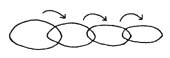
Strictly speaking, we should not say we "have" a soul. Rather,
we are a soul and the soul "has" a body it has aquired and is
working through. Part of our task is to become aware of this
truth.
Again, this is wrong, and is founded by a false belief in an
Atman or an inherently existing Self. In reality no such Self can
be found -- and the realisation that there is No-Self is
Enlightenment.
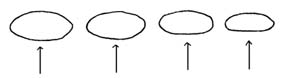
This is the right way to understand it: Each moment (Self1, Self2,
Self3) is complete and entire of its own. Self1, Self2, Self3, each
arise in a Spontaneous and Disconnected fashion... and each arising
of a Self1, Self2, this is Arising, re-Birth, etc. There is no
fixed entity 'Self' at all -- there is no self to be found, apart
from Self1, Self2, Self3, Self4, Self5, etc, arising in a
spontaneous and disconnected way. There is no
movement in changes -- movement implies that Self exists
in a connected way. No. No such Self can be found -- all things
including your Self is empty of inherent existence.
Moments of mental states always
change as Iron darts hit:
Observing the abrupt Change of all States discloses their discrete
nature:
When continuity is disrupted means, when it is exposed by
observation of
the perpetual alteration of states as they go on occurring in
succession.
For it is not through the connectedness of states, that the
characteristic of
impermanence becomes apparent to one who rightly observes rise and
fall,
but rather the characteristic becomes properly evident through
their discrete
disconnectedness, regarded as if each moment were iron darts,
hitting in on
reality one by one separately, instead of as a continuous flow of
slow change.
VismA. 824
However, due to karmic propensity, the habitual momentum to act,
correlate, and chain in a linear way, we see 'Self' as an entity...
and furthermore we see in a dualistic way, as if there is an agent,
doer, and experiencer in the world. This must be dissolved through
insights.
Please read:
http://www.shambhalasun.com/index.php?option=com_content&task=view&id=1677
...A somber day, isn't it? Dark,
cloudy, cool, moist and windy. Amazing, this whole affair of the
weather!
We call it weather, but what is it really? Wind. Rain. Clouds
slowly parting. Not the words spoken about it, but just this
darkening, blowing, pounding and wetting, and then lightening up,
blue sky appearing amid darkness, and sunshine sparkling on wet
grasses and leaves. In a little while there'll be frost, snow and
ice covers. And then warming again, melting, oozing water
everywhere. On an early spring day the dirt road sparkles with
streams of wet silver. Sowhat is weather other than this
incessant change of earthly conditions and all the human thoughts,
feelings and undertakings influenced by it? Like and
dislike. Depression and elation. Creation and destruction. An
ongoing, ever-changing stream of happenings abiding nowhere.
No real entity weather exists anywhere except in thinking
and talking about it.
Now, is there such an entity as me or I? Or is it just like the
weatheran ongoing, ever-changing stream of ideas, images,
memories, projections, likes and dislikes, creation and
destruction, that thought keeps calling I, me, Toni, and thereby
solidifying what is evanescent? What am I really, truly, and what
do I merely think and believe I am?
Are we interested in exploring this amazing affair of myself from
moment to moment? Is this, maybe, the essence of this work?
Exploring ourselves attentively, beyond the peace and quiet that we
are seeking and maybe finding occasionally? Coming upon an amazing
insight into this deep sense of separation that we call me and
other people, me and the world, without any need to condemn or
overcome?...
-----------------------
Here's another good read: http://www.budsas.org/ebud/mahasi-anat/anat04.htm
THE STORY OF THE BHIKKHU SATI
At the time of the Blessed One there was a disciple named Sati who
mistook consciousness to be self, and clung to the wrong view of
self. The monk Sati declared that he had understood and grasped
what the Buddha had taught thus:
Tadevidam vinnanam sandhavati samsarati anannam.
"It is this same consciousness that has been transmigrating and
wandering about from existence to existence, no other."
This was his understanding of the Buddha's teaching. He based his
views on the Jataka stories such as King Vessantara, Chaddan the
elephant king, and Bhuridatta the Naga king, who were said to be
some of the Buddha's previous existences. In his last existence as
Buddha, there were no material aggregates of King Vessantara, nor
of the elephant king or the Naga king, but Sati believed that the
consciousness of the last existence as Buddha was the same that had
existed previously as King Vessantara, the elephant king and the
Naga king; it had remained undestroyed, enduring, and stable
throughout the rounds of existence. This was how he understood and
transmitted the Buddha's teaching. His belief was simply nivasi
atta, clinging to consciousness as a continuous self.
The learned disciples of the Buddha tried to explain to him that
his view was wrong, but Sati remained adamant, believing that he
knew the Dhamma better than the other monks. It is not easy to
point out the true Dhamma to those holding wrong views. They are
apt to look down on their well-wishers as antiquated and behind the
times, unlike their leader who innovates a new interpretation. As a
matter of fact, anyone claiming to be of Buddhist faith should
ponder well to see whether his or her views are in accordance with
the teaching of the Buddha. If we hold onto views which do not
accord with the Buddha's teaching, we are then outside the
dispensation.
Having failed to persuade Sati to abandon his wrong views, some of
the monks went and reported the matter to the Blessed One, who then
sent for Sati. When asked by the Blessed One, Sati repeated his
views: "Based on the Jataka stories as recounted by the Blessed
One, I see that the present consciousness is the same as that one
which had existed in previous lives. That consciousness has not
reached destruction but passed on from existence to existence. This
is how I understand."
The Buddha asked him what he meant by consciousness.
He replied, "Lord, consciousness is that which expresses, which
feels, which experiences the fruits of good and bad deeds (now
here, now there) in this existence, in that existence."
"To whomever, you stupid one, have you heard me expounding the
doctrine in this manner?" remonstrated the Blessed One. "I have
explained consciousness as arising out of conditions; that there is
no arising of consciousness without conditions. In spite of that
you have wrongly interpreted my teaching and attribute that wrong
view to me. You have caused the arising of many bad deeds; your
holding this wrong interpretation of my teaching and so talking
about it will cause distress and suffering to you for a long time
to come."
Sati, however, refused to give up that view. Dogmatic views are
frightening. Sati was a monk, a disciple of the Buddha. He followed
the Buddha's teaching and claimed to have understood it. Yet we
find him obstinately refusing to give up his wrong views even when
exhorted by the Buddha himself, which of course amounted to not
having faith in the Buddha. Nowadays, too, there are some
"religious teachers" teaching that there is no need to keep the
five precepts or to practice meditation. They say it is enough just
to understand the teaching. When wellintentioned learned people try
to point out the true teaching to such "teachers," they are said to
have replied scornfully that they would not abandon their views
even if the Buddha himself came to teach them.
There are many instances where non-Dhamma is being handed around as
Dhamma. It is essential to scrutinize any such teaching so as to
weed out what is not the teaching, a concise statement of which is
given below: (continued in URL)