Templo Mision Budista: Taiwanese
pride in Ecuador
By Erika Wang, The China Post, Feb
26, 2007
Guayaquil, Ecuador -- Twelve years ago, the first
Buddhist masters to visit the Catholic nation of Ecuador planned a
short one-week stay. Fast forward to the present, and not only are
they still living there, but will soon move into one of the largest
Buddhist temples in South America.
Taiwanese Buddhist nuns Kuan-ting and Yi-ting had little idea they
would ever take up residence in the Spanish-speaking country when
they accepted the invitation to visit the small community of
Taiwanese expatriates living there.
Neither had ever been to South America before they embarked on
their two-day journey from Yuan Heng Temple in Kaohsiung City to
Ecuador's coastal city of Guayaquil.
On the day before the end of their trip, their master Pu-miao asked
them to stay, because "he felt there was a need to bring Buddhism
to the country," explained Yi-ting. "My reaction was: 'how can
expatriates live in this foreign environment?' I was very curious
to find out. Could I be able to stay as well?'
Suddenly transplanted halfway around the world to an environment
vastly different from their own, they found themselves in the same
situation as many other expatriates before them, struggling to
overcome the language barrier.
"We didn't know any Spanish. We didn't even know where to begin...
One expatriate suggested we drink more Ecuadorian water, so that
our tongues would become more flexible (to roll the Spanish 'r's)
and speak the language," joked Kuan-ting.
Now they possess more than a good grasp of the language, though
they are the last ones to admit it. "We are still learning Spanish
every day," humbly added Yi-ting, who just moments before held a
conversation with a couple of local vegetable vendors and even
managed to haggle for a good price.
But unlike any expatriate to move to Ecuador before, their peculiar
appearance -- shaved heads and Buddhist robes -- only added to the
challenges in making their transition to a place where, to this
day, just about any foreigner stands out.
As expected, many locals were taken aback by their presence at
first, but in time, a growing number of them have grown accustomed
to them, and have even joined their weekly prayer sessions. "Our
neighbor used to come every day for about a month to pray with us
when he was in between jobs," Yi-ting offered as an example.
Finding a suitable new home was no easy task either, but thanks to
the help of the expatriate community, they were able to settle in a
few months' time in a simple three-story residential house, which
they renovated to accommodate an altar and prayer room on the top
floor. Although their current home is regarded as a Buddhist
temple, neither its facade nor the interiors have any of the
architectural features typical of a Buddhist temple.
Soon that will change as they move into one of the largest Buddhist
temples in all of Central and South America, comparable in size
only to temples in Costa Rica, Argentina and Brazil, according to
master Hsin-ting, who is temporarily living in Guayaquil to help
oversee the project.
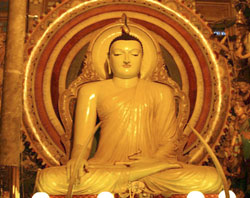
Perhaps their greatest endeavor yet, the Templo Mision Budista
(Buddhist Mission Temple), is a 3,600-square-meter complex designed
as a smaller version of the Yuan Heng Temple. The temple took over
four and a half years to build --almost double the
originally-expected construction time -- and cost between
NT$100-200 million, which was entirely donated by locals,
expatriates, and the Yuan Heng Temple in Taiwan.
"The main problems with the temple's construction were the lack of
a unified design and the lack of available materials that had to be
shipped in from Taiwan instead," according to Liu An-li, a Chinese
expatriate and chief construction supervisor.
The main building, which has six floors with high ceilings, is the
equivalent of 10 stories. The main hall alone is 30 meters tall.
Side buildings have four floors with 18 rooms and can accommodate
up to 300 people.
Its most noticeable feature, an arched red roof typical of Buddhist
temples in Taiwan, can be seen from a distance, resting atop a sea
of two-story buildings and making it a rare sight in Guayaquil's
urban skyline.
Once completed, the new temple will offer a variety of classes and
activities, including Chinese, etiquette, Buddhist prayers,
vegetarian cooking, drawing, and morning exercises, among others.
There is already much interest to sign up for the classes from
locals and expatriates alike, explains Yi-ting.
When asked about the reason for building the temple in Ecuador,
Kuan-ting candidly replied that it is merely a reflection of the
support from the community, both local and expatriate, that feels
the need to connect through Buddhism. "We do not actively preach
the religion. We have grown in Ecuador solely through
word-of-mouth."
Yi-ting agreed, and explained, surprisingly, that "a lot of
Taiwanese expatriates start learning about the teachings of
Buddhism and practicing the religion only after having migrated to
another country."
Chen Tzu-cheng, who has lived in Ecuador for the past six years, is
one such case. "I've only been learning about Buddhism and
practicing the religion for the past four years."
"Buddhism has changed my view of life. It has made me more humble
and more compassionate," he says.
The Buddhist Mission Temple of Guayaquil stands today as a symbol
of the indefatigable spirit that has driven expatriates the world
over not only to survive in the most inhospitable and foreign
environments, but to thrive in them.
As for whether Yi-ting has been, in her earlier words, "able to
stay," not only has her doubt been cleared, but she has now lived
in Ecuador for the longest time of all the places she has lived in,
even including her own childhood home, where she lived for only
five and a half years.
For Lin Hsiu-chih, a temple committee member and native of Taiwan's
southern county of Chiayi who has lived in Ecuador for the past 25
years, the temple is home.
"The temple is our pride and joy. To be able to have a piece of
home in our adopted home of Ecuador is very comforting. It makes us
feel less distant from our relatives back in Taiwan," Lin
said.