New Zealand's Buddha
Boom
By Vanessa Walker, New Zealand
Herald, July 21, 2007
Auckland, New Zealand -- Thousands of New
Zealanders from all walks of life have one thing in common: they
are followers of Buddhism. Twenty-four years ago, Charlotte
Wrightson used to thrash around angrily in an Auckland punk band
called The Plague, making a commotion about the evils of private
property, capitalism and conformity.
Around the same time, in Hong Kong, businessman Scott Wong had a
recurring dream that led him to question the monks at a monastery
he would visit during business trips on the mainland.
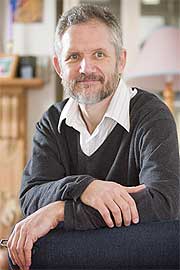
Simon Harrison
Going back further, to the mid-1970s, Simon Harrison was studying
pure mathematics at Oxford University and living in a
"free-thinking" house in Britain when he met someone who changed
the course of his life.
Today these seemingly disparate people are connected by a faith
that is growing quietly in New Zealand. According to the latest
census 52,394 people identified themselves as Buddhist - an
increase of nearly 11,000 since 2001. That's small compared with
the 2 million-strong Christian population, but deduct the 37,590
Buddhists who brought their beliefs with them when they migrated
here, mainly from Asia, and it emerges nearly 15,000 New Zealanders
have converted to Buddhism, a faith with which they have little
evident connection. Buddhism is the largest religion apart from
Christianity and Hinduism (nearly 64,000), and outsizes all the
religions that attract more attention, such as Islam (approximately
36,000), Brethren (18,000) and Scientology (357).
And many more are curious about its fundamental message. When one
of Buddhisms most visible adherents, the Nobel-prize winning Dalai
Lama, last month made his fourth visit to New Zealand, 10,400
people who filled Aucklands Vector Arena and 4300 in Wellingtons
TSB Arena paid to hear him talk. Peel back the numbers and it
transpires New Zealand hosts the gamut of Buddhist traditions; from
monks living in semi-silent solitude in a forest valley in
Wellington, to Zen adherents trying to penetrate their innermost
consciousness using koan (paradoxical questions that cannot be
answered by the discursive intellect), to outwardly ordinary people
taking up meditating and seeking instruction from Tibetan lamas on
how to liberate oneself from the cycle of birth and death.
There are small thriving nunneries that, in style and substance,
are indistin-guishable from their counterparts in Asia, but there
are also Buddhist groups such as Friends of the Western Buddhist
Order who have attempted to modernise Buddhism and indigenise their
centres with kauri and puriri trees. Auckland has the countrys
largest Buddhist temple, an ornate 3.6ha complex that resembles a
small town and provides almost as many services as such to its
thousands of attendees.
What unites these groups are the five ethical tenets: not killing,
not stealing, refraining from sexual misconduct, not using harmful
speech and not taking intoxicants that cloud the mind. Further
pledges include not gossiping about the faults of others; not
praising oneself and disparaging others; not to withhold spiritual
or material aid but to practise generosity: not to become angry but
to practise forbearance and to uphold the Buddhist way.
Buddhists believe not in divine intervention but in the law of
cause and effect (karma), in rebirth, and that the path to
enlightenment is achieved through an individuals thought
transformation. For the New Zealanders who have converted to
Buddhism, it is less a religious label than a cohesive set of
principles to help them navigate life.
pg1


