Here are some quotations from
Nondual Thinking and the Mahayana Deconstruction of Time,
please read the entire article of 'non-dual thinking' to
understand more deeply.
...In Ch'an, the fifth of Kuo-an
Shih-yuan's Ten Oxherding Pictures describes a stage of
enlightenment in which thoughts too are not to be rejected:
"Enlightenment brings the realization that thoughts are not
unreal since even they arise from our True-nature. It is only
because delusion still remains that they are imagined to be
unreal". [2]
The problem is not thoughts per se but more specifically a certain
type of thinking, variously called "reasoning", "conceptualizing",
"dualistic thinking", etc....
...The etymologies of vijnana and prajna are revealing. Both have
the same root jna, "to know". The vi- prefix of vijnana (also in
vi-kalpa and vi-tarka) signifies "separation or differentiation";
hence it refers to that type of knowing which functions by
discriminating one thing from another--the most fundamental
discrimination being that of the knower from the known. In
contrast, the pra-prefix of prajna means "being born or springing
up" [8] -- presumably by itself, evidently referring to a more
spontaneous type of knowing in which the thought no longer seems to
be the product of a subject, but is experienced as arising from a
deeper nondual source. In such knowing the thought and that which
is conscious of the thought are one. One important implication of
this is that it is impossible to observe one's thoughts
objectively. The Siksasamuccaya of Santideva contains a meditation
on thought which dwells on this point:
...For thought, Kasyapa,
cannot be apprehended, inside or outside, or in between both. For
thought is immaterial, invisible,, non-resisting, inconceivable,
unsupported and homeless. Thought has never been seen by any of the
Buddhas, nor do they see it, nor will they see it. . . . A thought
is like the stream of a river, without any staying power; as soon
as it is produced it breaks up and disappears. ... A thought is
like lightning, it breaks up in a moment and does not stay
on....
Searching for thought all round, he does not see it within or
without... Can then thought review thought? No, thought cannot
review thought. As the blade of a sword cannot cut itself, as a
finger-tip cannot touch itself, so a thought cannot see itself.
[9]
But this seems contradicted by our experience. Surely thought can
review itself; doesn't this happen often, whenever we ponder the
logical implications of some thought as part of a sequence of
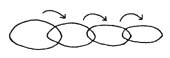
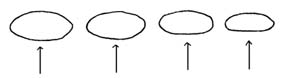
reasoning? The point of the passage must be that the various
thought-elements of such a sequence do not co-exist in the mind at
the same time. At any moment there can be only one thought; a
"review" of that thought, or any other thought that arises, is a
completely new thought. The next section will explore the
implications of this....
...The intentionality of "dualistic" consciousness is essential to
the nondualist, for this is implied by the claim that there is no
self apart from its experience. John Levy has elaborated this
concept into what is perhaps the classic argument against
subject-object duality:
When I am conscious of an object, that is, of a notion or a
precept, that object alone is present. When I am conscious of my
perceiving, what alone presents itself to consciousness is the
notion that I perceive the object: and therefore the notion of my
being the perceiver also constitutes an object of consciousness.
From this, a most important fact emerges: the so-called subject who
thinks. and its apparent object, have no immediate relation.
... the notion, I am reading, does not occur while we are thus
absorbed in reading a book: it occurs only when our attention
wavers. . . .a little reflection will show that even when we are
not thus absorbed for any appreciable lapse of time, the subject
who afterwards lays claim to the action was not present to
consciousness when the action was taking place. The idea of our
being the agent occurs to us as a separate thought, which is to say
that it forms an entirely fresh object of consciousness'. And
since, at the time of the occurrence, we were present as neither
the thinker, the agent, the percipient, nor the enjoyer, no
subsequent claim on our part could alter the position...
If the notions of subject and object are both the separate objects
of consciousness, neither term has any real significance. An
object, in the absence of a subject, cannot be what is normally
called an object; and the subject, in the absence of an object,
cannot be what is normally called the subject. It is in memory that
the two notions seem to combine to form an entirely new notion, I
am the perceiver or the thinker. [14]