Giant Buddha Foot Motif made of
84,000 lotus buds set to break record
The Buddhist Channel, May 28,
2007
The Giant Buddha Foot motif will
be displayed at the Buddhist Culture and Arts Festival 2007 (BCAF),
slated to be the largest event ever to jointly held by 38 of the
largest organizations in Malaysia
Seri Kembangan, Selangor (Malaysia) -- In
conjunction with the Buddhist Culture and Arts Festival 2007 (BCAF)
held at the Malaysia International Exhibition & Convention
Centre, the Dhammaduta Youth (D2Y) under the auspices of the
Buddhist Missionary Society Malaysia Youth Section and the Subang
Jaya Buddhist Association will be assembling a 53 feet by 38 feet
design of the Buddhas foot motif consisting of approximately
84,000 lotus buds.
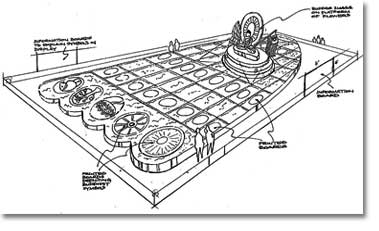
Incorporated into the huge foot motif will be several important
Buddhist symbols used to represent the Buddha and His teachings for
the past two thousand five hundred years.
It is known that for hundreds of years after the Buddhas passing,
devotees paid respects to Him in the form of the foot motif or as a
lotus flower, said Tan Siang Chye of Subang Jaya Buddhist
Association, designer of the lotus arrangement.
The human form representation of the Teacher was initiated only
after Alexander the Great made contact with the Indian civilization
of that time and shared with them the art of Greek sculpture. This
explains why the early Buddha images resembled Greek
statues.
Project coordinator, Koh Mui Han of the Dhammaduta Youth
said,84,000 is a meaningful number in Buddhist belief and the
lotus buds will be specially flown in from Thailand.
Devotees are able to sponsor these flowers, with the knowledge that
they are offering them to the Lord Buddha. Anyone interested in
making this offering should contact any one of the fifty Buddhist
organizations jointly organizing the Buddhist Culture and Arts
Festival.
Information boards explaining the meanings of the symbols will be
produced and put up near the foot motif. Mui Han added, Buddhist
culture is rich with symbols. The public will be able to learn the
meanings and understand that Buddhists do not mindlessly pray to
pictures and inanimate objects.
Members from both organizations will be on hand to assemble the
arrangement and help devotees place the lotus flowers. It is
planned that the entire lotus arrangement will be complete by
Saturday, 9 June for the public to view.
If you go
Buddhist Culture & Arts Festival 2007
6 10 June 2007
Mines International Exhibition & Convention Centre
(MIECC)
Seri Kembangan, Selangor, Malaysia
For more details on the event, kindly contact BCAF Secretariat Ms
Loh Yit Phing at 016 311 5030 or Ms Lee Hung Hui at 03 7804
9154.
Website: www.bovis.tv/bcaf
Email: [email protected]
More About The Buddha Footprint
For the first centuries after His passing, the Buddha was
represented by attributes and symbols. Early Buddhist artists
represented the Buddha aniconically i.e. He was not shown in human
form, but represented by symbols such as the umbrella, the bodhi
tree under which he attained enlightenment, the wheel, a throne and
a set of footprints
It is said that prior to His death the Buddha left an imprint of
His foot on a stone near Kusinara, the site of His passing. This
was a reminder to the devout of His physical existence. A larger
than life size footprint at Anuradhapura, Sri Lanka, has been
respected by the Singhalese people for centuries. In many other
Buddhist sites, footprint motifs can be found carved into
rock.
From the scriptures, it has been ascertained that the Buddha did
not encourage followers to be overly devoted to His physical form.
Instead He encouraged them to truly understand His teachings and
practice it, exhorting, He who sees my teachings, sees Me.
Early Buddhists had such reverence for the great teacher that they
avoided sculpting His likeness, even for purposes of veneration.
However the first human representations began to appear due to the
influence of Greek craftsmen in India.
Adoration of the footprint
The adoration of his feet, or Buddhapada became a prominent feature
of Buddhist practice. These footprints often show Dharma-wheels on
them, one of the 32 physical marks of a Buddha.
According to Buddhist belief, the body of a Buddha would have 32
distinguishing marks on it. The specific marks associated with the
feet are:
1. When the Buddha walks, He places His foot evenly on the
floor
2. The soles of his feet are imprinted with wheels (symbols)
3. He has projecting heels
4. He has long fingers and toes
5. He has soft and tender hands and feet
6. He has webbed hands and feet
7. He has arched feet
The Dhamma wheel
The Wheel symbol found on the footprints can be seen very often in
Buddhist culture. The wheel has been depicted with varying numbers
of spokes.
The Eight-Spoked Dharma Wheel or Dharmachakra symbolises the
Buddha's turning of the Wheel of Truth or Law (dharma = truth/law,
chakra = wheel) and is associated with the first sermon delivered
at Sarnath, a town near modern day Varanasi.The wheel on the flag
of India is the Asokan wheel, said to be used by the great Buddhist
emperor, Asoka.
Historians contend that the representation of the Buddha in human
form (as statues) was an art learnt from Greek craftsmen and
artisans who followed Alexander the Great on his conquests of the
East. It is seen that early representations of the Buddha bear
Greek (or European) features. In many ways these sculptures
incorporated the features of Hellenic gods, an unusual development
as the Buddha had strongly declared that He was not a
god.


