Buddhism has many principles that
fit with democracy
Kuensel Online, November 21,
2006
Timphu, Bhutan -- Dr. Robert Thurman, professor of
Indo-Tibetan Buddhist studies at Columbia University has visited
Bhutan many times since the early 90s. On his most recent visit he
spoke to Kuensel on the changes he has seen, Buddhism and democracy
and the alienation of Bhutanese youth from their cultural
moorings.
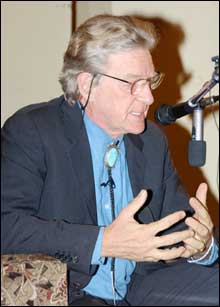
Dr. Robert Thurman gave a talk in Thimphu on Thursday. Here are
excerpts from the interview.
Q This is the sixth or seventh time you have visited
Bhutan. What brings you back this time?
A The usual thing. A group of people who want to do a pilgrimage
rather than tourism. And so we decided to have a retreat and
practice Buddhism, meditating and discussing the Dharma while
visiting the holy places in Bhutan.
Q What are the changes, good and bad, you have seen in
Bhutan all these years?
A I dont think I can see much bad because I come too quickly,
unfortunately. We hear that the young people, some of them are kind
of disillusioned and dissatisfied. But I dont get to see that much
because I go to the monk places, the beautiful monuments and then
go walking in nature, meditate on the Buddhist path. So I dont
really see the difficulties as much as I might if I was here for a
longer period. But I am sure that with the advent of television,
the growth of buildings and all the people moving from the villages
to the city, all of that brings its problems.
I am happy to see though that in the countryside you dont see
empty villages, people look pretty cheerful still, so it doesnt
seem like a disaster like it could be in some other parts of the
world. It seems things are still in a pretty good balance.
The change of government coming up with the King abdicating in 2008
and the new Crown Prince coming to be as King and the advent of
more stronger constitutional democracy, these are big
changes.
Q A lot of Bhutanese feel that Bhutans transition to
democracy is premature. What do you think?
A Last year I was here and I looked at the provisional constitution
that is being finalised now and I cant remember, I am sorry to
say, exactly but I was a little worried that the King might be
giving up a little too much power and I think it is important that
the King retain, at least for quite a period of time, some sort of
a checking power over the legislature, over the Assembly.
Thats going too quickly towards democracy, full democracy, without
having some power to check things, where people have not yet got
used to democracy and they are not educated fully for democracy it
could cause a lot of confusion. In America what we see is that the
commercial interests, the big corporations, tend to corrupt
democracy therefore there must be some strong force to oppose them
or to keep them in check. And the whole concept of Gross National
Happiness and the conservation of resources and keeping changes
towards materialistic development in a calm and gentle way I think
is very much fostered by the Monarchy.
Q Can the principles of democracy be derived from
Buddhism?
A Buddhism has many principles that fit with democracy such as
individualism, allowing people to develop their own mind to the
fullest than having to serve whatever their duty is, parents, cast
etc. This is very much in consonant with democracy. Buddhism
teaches each person to have the opportunity to develop their own
being towards enlightenment, to the fullest extent in life. That is
the highest thing in the society.
Out of that principle comes monasticism. A monk is supported by the
society to develop their knowledge and their spirituality and then
also the idea that education is so central and the idea that there
should be a welfare state and peoples basic needs should be met by
the state.
Finally the idea that the people are equal and everyone should have
equal opportunity to develop them. These are all principles of
Buddhism, which in different western countries have been
imperfectly realised throughout history. Tibet, Bhutan and Mongolia
had been the best and most successful in realising these principles
although they are not perfect.
The principles of Buddhism of enlightenment, education,
individualism, and altruism and egalitarianism all of these are
realised through democracy.
Specially, as Bhutan moves more democratically, the education
system for the lay people should include more instructions in the
main principles of Buddhism.
Buddhism as a science, as a philosophy, ethical system should be
well understood by the lay secular population. Then they see to a
good quality of democracy. This movement to democracy involves some
serious development in the educational curriculum.
Q Why is it that with modernization a lot of Bhutanese
youth feel alienated from the moral principles of
Buddhism?
A The point is how well educated is the youth in the moral
principles of Buddhism? They may feel alienated from the
traditional idea that Buddhism is going to the monasteries and
offerings or bowing to the lam. But that is just the faith oriented
Buddhism and thats good in itself but for people who are educated
in modern subjects like science and history they have to be
educated in Buddhism in a modern way to really understand what is
it about. In schools you should have courses in Buddhist
philosophy, Buddhist ethics.
Q Is it possible to attain enlightenment without being
Buddhist?
A Yes I think so. Although the Buddhist philosophy and psychology
about realistic worldview and realistic meditation I think, to be
fully enlightened, that psychology and philosophy must be fully
explored and understood.
But you could do that without philosophy without formally being a
Buddhist. In Buddhism enlightenment comes through understanding
reality and not just through believing, not just through faith. If
you think Buddhism as a religion is somehow taking refuge and
having faith then that wont necessarily produce
enlightenment.
Q Is enlightenment nirvana or is there a difference between
the two states?
A Enlightenment is same as nirvana and more than nirvana. It is
also the full understanding of Samsara because ultimately nirvana
and Samsara are same, but enlightenment is understanding the world.
That is how you attain nirvana because you have to understand that
the reality of the world is nirvana. If you believe that the
reality of the world is nirvana that could be helpful in trying to
practice but that is not going to give you enlightenment by just
believing.
Q Can Buddhism be a remedy for personal and cultural
maladies?
A In the west, the best teachers of Buddhism teaches Buddhism as a
psychology, philosophy and even therapy without insisting on the
religion side of it, but use that to develop wisdom.
Developing wisdom means doubting and being critical, it doesnt
necessarily mean believing something. So maladies have to do with
people feeling dissatisfied, angry, anxious, frightened and
Buddhism has a psychotherapy. Thats why Buddhism has been so
successful over so many centuries because it helps people live
better lives. It is the best science.
Q What stops Buddhism from being deemed a nihilistic
philosophy?
A Buddhism is critical of nihilism. The materialistic science says
that you have no former or future life and that you dont have a
mind, but a brain and that you are just a material mechanism. And
therefore, when you die you just become nothing. That is nihilism,
which means everything ultimately doesnt matter. There is no
consequences to your actions ultimately. And you could just do
whatever you want and when you die you dont exist.
Buddhism believes that as an unrealistic view and that every
something changes into something else and no something can become
nothing. Some of the religions that believed in god, in creator,
they think that Buddhism is a bit nihilistic because Buddhism
doesnt believe in creator god.
Buddhism believes there are gods but they are not creators of the
universe, they are not omnipotent.
So Buddhism can be confused with nihilism in the sense that
Buddhism says there is no self and emptiness. Buddhism itself is
very critical of nihilism. Buddhism teaches of karma, evolution,
and there is also a consequence to every act, every cause has an
effect. So that is not nihilistic.