Originally posted by neutral_onliner:
Clearing the Mind in
Comfort
By BRENDAN I. KOERNER, New York
Times, December 10, 2006
[b]New York, USA -- BUDDHISMS Noble Eightfold Path, an
ancient guide to escaping the suffering of existence, exhorts the
faithful to achieve right mindfulness and right concentration
by meditating. The precepts offer no direction, however, on the
appropriate design for meditation zafus, the cushions on which
Buddhists pursue enlightenment.
Ryan Gallagher/Dharma Communications
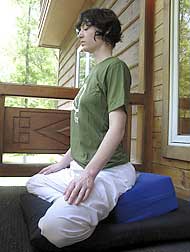
Amanda Yates uses a Tibetan Mountain Seat, a cushion that is
intended to ease physical strain during meditation.
Traditional cushions contain either kapok, which is a natural
fiber, or buckwheat, explained Ron Hogen Green, a monk at the Zen
Mountain Monastery in Mount Tremper, N.Y. There are problems with
both of them. After extended use, buckwheat and kapok stuffings
tend to develop lumps that can put stress on a meditators spine,
Mr. Green said.
About four years ago, he approached his monasterys abbot, John
Daido Loori, about creating a new cushion that would ease the
physical strain of sitting cross-legged and motionless for upwards
of 35 minutes at a time. Mr. Green says he believes that this is a
particular concern among the large number of people who took up the
religion in the 1960s and may be experiencing joint and muscle
problems as they age.
With the volunteer assistance of orthopedists, Mr. Green designed
the circular Mountain Seat, a meditation cushion made primarily
from a decidedly nontraditional material: viscoelastic foam.
Mr. Green got the idea for using this springy, artificial material
from a piece of direct mail. Around that time, Tempur-Pedic was
sending out a lot of mass mailing samples, he said, referring to
the Swedish mattress manufacturer. Though the viscoelastic swatch
that he received in the mail did not persuade him to buy any
Tempur-Pedic products, he was intrigued by how the foam reliably
snapped back to its original shape.
Mr. Green and his associates at the nonprofit Dharma
Communications, an arm of the monastery that sells incense,
meditation cloaks and other products, began obtaining hundreds of
samples of viscoelastic foam, looking for the right combination of
weight and density. Doctors and physical therapists were consulted
about how much give the zafu should have, in order to encourage the
best possible posture. The design had to be patentable, Mr. Green
said. (A patent is pending.)
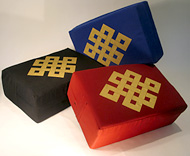
A Tibetan Mountain Seat
Monks sewed prototypes by hand, then used them for meditation and
offered feedback to Mr. Green. An all-foam model was found to be a
bit too soft, so a layer of buckwheat was added to the cushions
base. The buckwheat compartment is zippered rather than sealed, so
hulls can be removed or added to individual tastes.
The monks at the Zen Mountain Monastery approved the final version
of the Mountain Seat before its release in 2004. For a good deal
of people, their shoulder and back pain went away, Mr. Green said.
And in particular, people noticed that their legs didnt go to
sleep as much.
Money from sales of the cushions, which come in three sizes, goes
back into the monastery. Dharma Communications released a follow-up
last year, the Tibetan Mountain Seat. Rectangular rather than
circular, and lower-slung than its Zen-inspired predecessor, the
new zafu is designed for Tibetan Buddhists, who often meditate with
their knees touching the ground.
The Tibetan Mountain Seat, at $125, costs more than the originals,
which are priced at $85 to $95. (All are available at the
monasterys online store at www.Dharma.net/monstore.) But if some
Buddhists can more easily attain enlightenment on the Tibetan
version, it is unlikely that they will complain about the extra
expense.
[/b]
wow that is indeed quite expensive for a meditation seat

But since it is nonprofit then I think it is quite worth if one is
a serious meditator 
