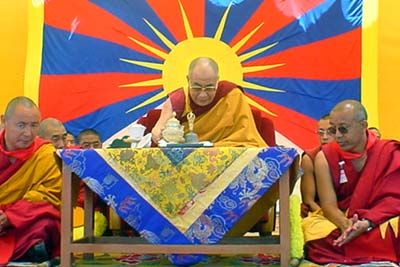
Bonding the key,
Dalai Lama says
by
Michael Scott, Vancouver Sun, September 8, 2006
Vancouver, BC (Canada) -- The Dalai Lama believes
he has the key to a happier world, and it has nothing to do with
political process or balance of power. The Buddhist spiritual
leader, who arrived in Vancouver Thursday for a three-day visit,
said the force that brings the deepest satisfaction to the world is
the tender embrace between mother and newborn child.

The Dalai Lama shares a moment with Vancouver Mayor Sam
Sullivan at city hall on Thursday.
Photograph by : Bill Keay, Vancouver Sun
"I am now 71 years old [but] I feel, still, deep in my mind, my
first experience, my mother's care. I can still feel it," the Dalai
Lama told a small audience at city hall, after a private meeting
with Mayor Sam Sullivan.
"That immediately gives me inner peace, inner calmness," he
added.
The challenge in modern society is to hang on to that deep sense of
connection later in life. "When we grow up, when our brain
develops, then our intelligence causes short-sightedness," he said.
"And I think also the influence of the environment [plays a role]:
then aggressiveness, fear, jealousy, anger, frustration -- these
things arise, and [cause our potential to] become submerged."
The Dalai Lama said his No. 1 priority is to promote this quality
of human bonding, a force he calls "human value."
"After birth, our first experience is mother's affection," he said.
"Mother's care. The child at that time, just after birth, may not
have the idea 'This is my mother.' But [will have a connection]
because of the biological system or need, feeding, relying on that
person. And on the mother's side there is also that sort of
tremendous feeling of care -- and with that milk, also comes [the
connection]. This is not due to religious faith, but because of the
biological factor. That is the basis of our life breath, how our
life started.
"So, now the time has come, I feel, that as a result of discussion
-- of exchange, different ideas, different views -- and as a result
of listening to others' problems, and noticing the global-level
problems, including terrorism, I feel, if we make more effort to
sustain our basic value, I think humanity may become more peaceful.
More compassionate. As a result, differences can be easily solved
through dialogue. Through talk. Through mutual understanding. So
that is my number-one commitment: the promotion of human
value."
The Nobel Peace Prize laureate is in Vancouver for three days of
public discussions and events around the inauguration of an
education centre being built here in his honour. During his first
stop, at city hall, he answered a wide range of questions with
humility, insight and humour.
Smiling at a mannerly scrum of reporters and photographers, the
Dalai Lama expressed his admiration for the media, and then
grinning broadly, explained how he often says that reporters should
have long noses like an elephant's, miming a long trunk-like
proboscis that gently snuffled at his interpreter's elbow. "[You
need a nose like this to] smell everywhere, he said to sustained
laughter. "I think, with respect [to Mayor Sullivan], you should
use it to smell politicians, mayors, prime ministers, religious
heads, businessmen, scientists. I think everywhere. I think we
should know the reality."
The 14th Dalai Lama was awarded honourary Canadian citizenship this
summer, a rare distinction granted only twice before -- to Nelson
Mandela and Swedish diplomat and Second World War war hero Raoul
Wallenberg.
At the time, the Chinese government made its disapproval clear,
with a sharp comment from an embassy official in Ottawa. "We said
that Dalai Lama is a separatist, so I don't think he should be
honoured with that," Chinese diplomat Zang Wei-dong said. "That
will harm the Canadian image and also harm the relationship between
China and Canada."
The Dalai Lama, who left Tibet with a 100,000 followers in 1959 to
establish a government-in-exile in India, was asked about those
comments.
He suggested that China's bark in this regard is sometimes worse
that its bite, citing a situation where Norway was criticized for
its dealings with him. "I think on one occasion . . . the Chinese
government made some serious protest. But then afterward, not much
consequence," he said.
"But, I'm very sorry. Wherever I go, it always creates some
inconvenience. I'm very sorry. But hopefully, not [by] my
mistake."
He drew more laughter when he wondered aloud what the rights and
privileges of being an honourary Canadian might include, because,
he said, smiling, he didn't want to miss out on any.
He turned serious when he said that being an honourary Canadian
made him feel as if he were being treated like a brother by
Canadians. "Actually, entire six billion human beings are brothers,
sisters. You have to share, our common world, our one world.
"I think the time has come: We must educate in that respect. These
quarrels here and there, in the name of religion, in the name of
different races, different countries, different political system,
economic system. Fighting [is] useless. Suicide."
Before China exerted its territorial claim to the ancient mountain
kingdom, the Dalai Lama was considered by his subjects to be a
god-king, the living embodiment of compassion in the world. His
struggle to preserve Tibetan culture was taken up 40 years ago by
the late George and Ingeborg Woodcock, two prominent Vancouver
intellectuals. He has made three previous visits here, in 1980,
1993 and 2004.
Since taking up exile in Dharamsala, India, in 1959, the Dalai Lama
has made education a priority, both to preserve Tibetan culture
against a dangerous and uncertain future; and as a way to reach out
to the world.
Of Tibet's current population of 300,000, about 200,000 are ethnic
Chinese, resettled there by China, since 1959. "That means we have
already become a minority," the Dalai Lama said. "As a result those
Tibetans in the towns, in their daily life, they use Chinese
language more, in shops, in restaurants, in addition to the
government official language. On every occasion they have to speak
Chinese. And then music, songs, also now more Chinese. Also, I've
heard that Tibetans are very fond of Indian popular songs. So their
way of life and also their [cuisine], eventually their mentality,
their way of thinking, these are changing.
"So usually I [say], whether intentionally or unintentionally, some
kind of cultural genocide is taking place.
With what he sees as a decline in the moral authority of organized
religion in the West and in the effectiveness of the family, the
Dalai Lama believes it is up to schools to look after the spirit of
warm-heartedness he advocates.
"In modern times, the influence of the church has a little bit
declined," he said. "And family value also [is] declining. So now
education institutions should take full responsibility, not only
for brain development but also for morals and ethics."
The challenge comes when the development of a young person's
ethical outlook becomes tied up with religious belief. "The
question [then] is what religion [to chose]," he says.
"Difficulties. And also, frankly speaking, there are quite a
substantial number of non-believers. So I think the mistake is that
those people who have not much interest in religion are also
negligent about the value of spiritual qualities such as love,
compassion, forgiveness, these things.
"So we must now find a different way, on the basis of scientific
findings and our common experiences. I think that on this basis we
can educate. [Certainly] brain development very important. [But
also] warm-heartedness, is extremely important. Otherwise [you will
find] a very educated, very brilliant person, but deep inside a
very unhappy person. And also billionaires, or leaders, big power,
big money, good education, big fame. But as an individual person,
very unhappy."
"Sufficient money, sufficient power, sufficient affairs, sufficient
friends, but still unhappy. Why? Something is wrong here."