Timeless poetry,
emotion in salute to Leonard Cohen
by
MARILYN H. KARFELD, Cleveland Jeweish News, Aug 12,
2006
Cleveland, Ohio (USA) -- The first thing that
grabs you is his gravelly voice, growling out poetic lyrics or
rumbling articulate pronouncements on life. When Leonard Cohen
emerged on the folk-pop scene nearly four decades ago, his raspy
sound became his signature as much as the elegant phrases and
soulful music he created.

Songwriter Leonard Cohen, left, and U2s Bono flank Lian
Lunson, who directs the documentary Leonard Cohen Im Your
Man.
In her enthralling documentary, Leonard Cohen Im Your Man,
opening August 11 at the Cedar Lee Theatre, Australian director
Lian Lunson lets us hear that eloquent voice.
She effectively weaves together interviews, archival footage, and
performances of Cohens best-known songs at a tribute concert in
Sydney, Australia, in January 2005. Added to the mix are Cohens
personal photos and accolades from the musical artists he
inspired.
The Montreal-born troubadours haunting ballads of love and
longing, sex and spirituality, are timeless, Lunsons film attests.
Passionately covering Cohens classics at the Sydney Opera House
are such headliners as Rufus Wainwright, Nick Cave, Bess Orton and
Martha Wainwright. Cohens songs like Suzanne, Sisters of
Mercy, and Hallelujah move us just as they spoke to earlier
generations.
Lunson cuts between interviews with Cohen, who reveals a beguiling
honesty about his life and work, and performances of each of his
songs. While the singer-songwriters musings at times can veer
toward the pretentious, he continually deflates them with his wry
humor and self-deprecating manner.
Of the ups and downs of his career, he says, Things got easier
when I no longer expected to win. You abandon your masterpiece and
sink into the real masterpiece. Then he reads his modest preface
to a Chinese translation of a volume of his poetry: Dear reader,
please forgive me if Ive wasted your time.
When he was living in Montreal, Cohen and fellow poets used to
severely critique each others work. We thought the most important
thing was good writing, he says. Poets were the unacknowledged
legislators of the world (borrowing from Shelley). We thought it
was terribly important what we were doing. Maybe it was.
He notes that his indiscreet song Chelsea Hotel No. 2, about a
sexual liaison with Janis Joplin, wouldnt have bothered the late
rock icon. My mother would have minded, he deadpans.
Although he was known as a lothario, Cohen confesses, My
reputation as a ladies man was a joke. I laughed bitterly through
the 10,000 nights I spent alone.
Among the performers who shared personal reminiscences of Cohen,
Rufus Wainwright recounts first meeting the usually sartorially
splendid songwriter. Cohen was dressed only in his underwear as he
attempted to feed regurgitated noodles to a baby bird he was
reviving.
Other artists, such as Bono and U2 bandmate the Edge, mostly just
gush over Cohen. Bono calls Cohen, who turns 72 in September, our
Shelley, our Byron. The Edge compares Cohen to Moses bringing down
the stone tablets.
While celebrating Cohens work, the film also reveals intriguing,
albeit too few, tidbits about his life. His father, who died when
he was 9, owned a clothing store. Thus began Cohens lifelong
fondness for stylish suits. He tried wearing jeans, he says, but
just wasnt comfortable in them.
Religion is a major interest in Cohens life. The first poetry that
affected him came from Bible stories and synagogue liturgy. Then he
undercuts this lofty image, noting he also found inspiration in
Marvel Comics.
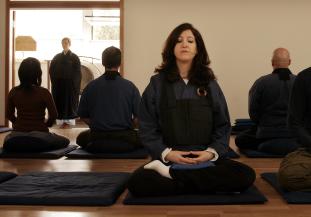
Although he was raised a Jew, Cohen sampled other religions, moving
for a few years to a Zen monastery on Mt. Baldy in California in
the 1990s. There he studied Buddhism and was ordained as a monk. He
recalls his first winter, and how Roshi, the Zen master, was
Japanese and the head monk was German.
It was the revenge of World War II, Cohen quips. An American
walking in sandals in the snow, beaten with sticks.
Serious again, Cohen notes that Roshi didnt care about his past or
who he was. So who I was began to wither. The less I felt who I
was the better I felt.
The film is produced by Lunson, Bruce Davey, and Mel Gibson, who
made headlines recently when he was stopped for drunk driving and
uttered an anti-Semitic rant to the arresting police officer. Flush
enough to bankroll film projects since the huge financial success
of his The Passion of the Christ, Gibson claims in the
documentarys production notes to have always been a major Cohen
fan.
Unfortunately, we only hear the inimitable Cohen sing once. In the
documentarys last musical number, staged for the movie at a New
York club, Bono and U2 play backup on Cohens 1988-released Tower
of Song. The dour poet-songwriter is elegantly garbed in his
trademark suit, his eyes are closed, and his chiseled features
could be immortalized on a newly minted Buffalo head nickel. As he
talks and lip-syncs his way through the lyrics, his aging voice
explores mortality and posterity with deep irony and wit.
Bono applauds the performance, and Cohen gruffly recites from one
of his poems: I had the title poet, and maybe I was one for a
while. Also the title singer was kindly accorded me, even though I
could barely carry a tune.