Law and Karma:
Dalai Lama to speak publicly for first time about the law and
social change
by John
DellaContrada, UB NewsCenter, Aug 28, 2006
BUFFALO, N.Y. (USA)-- In his very first visit to a
U.S. law school conference, His Holiness the 14th Dalai Lama will
publicly share for the first time his thoughts on how religion,
particularly Buddhism, can influence law and bring about social
change.
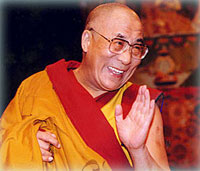
The conference, "Law, Buddhism and Social Change: A Conversation
with the Dalai Lama," will be held Sept. 20-21 at the University at
Buffalo Law School. An intimate two-hour discussion between the
Dalai Lama and legal practitioners and scholars from around the
world will open the conference at 9 a.m. on Sept. 20. For more
information, go to http://www.law.buffalo.edu/baldycenter.
"This will be one of the first times the Dalai Lama has been asked
about legal subject matter," says UB Law School Professor and
conference organizer Rebecca French, an international authority on
Tibetan law and author of "The Golden Yoke," the first book on
Buddhist legal traditions in Tibet.
"It will be fascinating to hear the Dalai Lama describe the best
way, from a Buddhist perspective, to think about punishment,
rehabilitation and retribution, and I suspect the conversation will
address how Buddhist beliefs might influence the U.S. legal
system," adds French, who notes that the Dalai Lama has
participated in a series of similar public forums on the subject of
science and the mind.
The conference is being organized by the Baldy Center for Law and
Social Policy and the UB Law School. It is being offered in
conjunction with the Dalai Lama's visit to UB, Sept. 18-20,
http://www.buffalo.edu/dalai_lama/.
French expects the conversation between the Dalai Lama and the
scholars in attendance to be quite expansive, covering issues
ranging from how constitutions provide social order, the purpose of
criminal punishment and the Karmic consequences of legal
decisions.
The Dalai Lama also may discuss his thoughts on governmental
control of personal freedoms. The Dalai Lama has spoken before on
the detrimental effects of TV on American society, and may comment
on whether the government has an obligation to restrict unhealthy
behaviors, French says.
The UB Law School is home to the Law and Buddhism Project, the
world's first and only center for the study of law and Buddhism. A
goal of the conference and of the Law and Buddhism Project,
directed by French, is to introduce Buddhist legal concepts to the
U.S. legal system, says UB Law School Dean Nils Olsen.
"It is truly a great honor that the Dalai Lama has chosen to speak
at our law school and discuss issues that go to the heart of law
and morality," says Olsen.
"U.S. law schools and universities have a long tradition of
studying legal principles found in Judaism, Christianity, Islam and
Hinduism," Olsen explains. "The serious study of Buddhist legal
traditions in the U.S. is long overdue. Buddhism, like other world
religions, can have a very positive effect on our understanding of
morality and law."
A legal anthropologist who has spent several summers studying
Tibetan law at the Dalai Lama's compound in India, French says
Buddhist concepts of Karma, human interconnectedness and
reincarnation could have a positive effect on the U.S. legal
system, and should be studied.
"Buddhists believe that you can't have closure in a case unless all
parties are in agreement with the decision, and unless the whole
network of people affected by the case is compensated. From this
process, you have a social catharsis; you have a feeling that
society has been healed.
"In the U.S. legal system, one individual gets into friction with
another individual, and from that spark of friction one person wins
and one person loses," French explains. "Very little thought is
given to interconnectedness of people and how the decision affects
all the individuals involved in the case. This process often
produces anger, social isolation and unhappiness with our legal
system.
"Ultimately, I would like to coordinate all of the Buddhist lawyers
in the U.S. and help bring people together to introduce compassion
and Buddhism to the American legal system," she adds.
French says Americans today seek a better understanding of how
religion and morality shape society's values. Faith-based political
initiatives and debates over the constitutionality of public
religious displays are examples of how American society is
attempting to reconcile morality, law and religion, she says.
Awareness and study of the religious foundations of law can provide
guidance to legal practitioners and the lay person, French
contends.
"Understanding the moral foundations of our society and our legal
system is essential for understanding who we are as a people and a
nation," she says. "Thinking through other religious legal systems
is one of the best ways to understand the moral foundations of our
own legal system, and is one of the few ways to bring in absolutely
new ideas that people can ponder."
Conference participants will include: French; Timothy Brook,
professor of history, University of British Columbia; Georges
Dreyfus, professor of religion, Williams College; Kenneth
Ehrenberg, assistant professor of philosophy, UB; David Engel, SUNY
Distinguished Professor, UB Law School; Leslie Gunawardana,
professor, University of Peradeniya, Sri Lanka; George Hezel,
professor of law, UB Law School; Andrew Huxley, senior lecturer in
law, School of Oriental and African Studies, University of London;
James Magavern, senior partner, Magavern, Magavern & Grimm;
Fernanda Pirie, research fellow, Center for Socio-Legal Studies,
University of Oxford; Frank Reynolds, professor emeritus of the
history of religions, University of Chicago; Kenneth Shockley,
assistant professor of philosophy, UB; Winnifred Fallers Sullivan,
associate professor of law, UB Law School; Vesna Wallace, associate
professor of religious studies, University of California, Santa
Barbara; and Richard Whitecross, research fellow, School of Social
and Political Studies, University of Edinburgh.
The University at Buffalo is a premier research-intensive public
university, the largest and most comprehensive campus in the State
University of New York.

