Korean Buddhism Values Education
By Kathryn Brimacombe, The Seoul Times, Oct 19, 2005
Seoul, South Korea -- Yellow leaves swirl around me in the crisp
autumn air, falling gently like soft snowflakes as the sound of
chanting draws me past windows displaying golden Buddhas in the
heart of Jongno, Seoul. I follow the rich voice as the sound grows
louder and, turning up a small incline, enter the courtyard of
Jogyesa Temple, the seat of the Jogye Order of Buddhism in South
Korea.

<< Golden Buddha at Jogyesa Temple
Having come to learn a little about Korean Buddhism, I cross the
wide courtyard to the Information Center for Foreigners, hoping
they will be able to give me some insight. The sound of the
chanting is loudest here, and I notice it is emanating from the dim
interior of a large building under construction to my right.
Covered with scaffolding and tarpaulin, it is the focus for
hundreds of worshippers who are kneeling and praying on mats
underneath an ancient tree in front of its entrance. The air is
filled with the sweet scent of incense, the joss sticks lit by
worshippers and placed in a sandy trough by a tall, seven-tiered
stone pagoda to my left, where a relic from Buddha's body is
believed to be encased.
As I walk up to the Information Center, I notice behind it is a
magnificent pavilion with beautifully painted designs of blues,
greens and reds on its supports and roof, and inside an enormous
bell, standing silent in the center. I gaze at the enchanting
architecture for several moments until a woman in her 30s, wearing
loose-fitting jeans and a pony-tail, approaches me with an easy
smile and invites me into the Information Center for Foreigners.
She introduces herself as Ms. Jeon Man Kyung, the Assistant
Director of the Information Center, and sits me down in the narrow
office with hot tea and countless brochures about the temple. Soon
after, a young woman by the name of Ms. Sujung Kim enters the
center, breathless from running, and in near-perfect English,
offers to take me on a tour of Jogyesa.

Pagoda at Jogyesa Temple >>
Jogyesa was originally built in 1910 by the revered monk, Manhae
Hanyongwun, at what is now Susong Park at the Gakhwangsa Temple. In
1938, the Daewungjeon Hall (the building that is currently being
restored) was reconstructed at the present site, and served as the
spiritual backbone for the Korean people under Japanese occupation.
After Korea's national independence in 1945, the Buddhist
Purification Movement was led by the Temple to erase the traces of
Japanese imperialism. In 1954, it was renamed Jogyesa (sa means
temple in Korean), and became the only traditional Buddhist temple
located inside the boundary of the four gates built during the
Chosun Dynasty in Seoul.
Korean Buddhism is the largest religion in the nation, as nearly
half of the country's population is Buddhist. Buddhism in Korea is
made up of 28 sects, or orders, which are joined together in the
Assembly of the Council of Buddhist Orders. Among these 28 orders,
the Jogye Order, of which Jogyesa is the head temple, is the
largest, and has been practicing its traditions for nearly 1600
years.
Buddhism first came to the Korean Peninsula from China in 372 A.D.,
and spread from the northern Kingdom of Koguryo to the southwestern
Kingdom of Paekje. Buddhism was received by the royal families of
those kingdoms, and contributed greatly to the establishment and
strengthening of royal power as the ideological foundation of the
nation. Meanwhile, in the Shilla Kingdom, Buddhism became the
religion of choice for the common people. For the next 1,000 years,
through the Unified Shilla period (668-935) and into the Goryeo
period (918-1392), Buddhism was the national religion, and Buddhist
art and culture flourished.

<< Seokguram Grotto at Bulguksa
At the beginning of the Joseon Dynasty (1392-1910), however,
Buddhism slowly declined as the new rulers adopted Confucianism.
This new interest led to the oppression and restriction of Buddhism
by some Joseon kings. Temples could not be built near towns;
instead, they had to be built in the mountains, the only place
where Buddhists were permitted to pray. Thousands of these temples,
most of the Jogye Order, still dot the mountains of Korea. In 1910,
the Joseon Dynasty came to an end with the annexation of Korea to
Japan. Although, Buddhism was greatly favored by the Japanese,
celibate sects were discouraged and monks were encouraged to take
wives, a practice that is not allowed by the Jogye Order.
The sun feebly breaks through the clouds but does little to warm
the morning air as Ms. Kim takes me around the Jogyesa complex. We
pause for several minutes at the Daewongjun Hall, also known as the
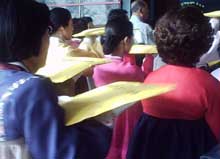
Main Buddha Hall, to observe a special ceremony. Ms. Kim explains
that the ceremony is called kasa pursa, an important occasion that
occurs only once every three years. During this special ceremony,
lay Buddhists offer robes, which they have made over the previous
two months, to the monks.