Matthew
Bortolin: Darth Vader vs. the Buddha
by Phil
Hall, www.filmthreat.com, April 15, 2005
San Francisco, USA -- When the characters of the
?Star Wars? series proclaim ?May the Force be with you!? to each
other, the Force in question is not Buddhism. In fact, Buddhism is
never mentioned anywhere in the ?Star Wars? series. Or at least not
in an overt manner!
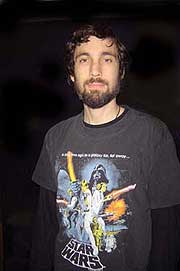
Matthew Bortolin: Buddhism teaches that the first Truth of
life is that suffering is a part of life. For me nothing makes the
fact of suffering more evident than the ?Holiday
Special?...
The link between the Buddha and Luke Skywalker and Co. has been
made by writer Matthew Bortolin. Indeed, these are twin passions:
Bortolin is an ordained member of Thich Nhat Hanh's Order of
Interbeing, and has lived in Buddhist monasteries both in the
United States and abroad. And a set of Jedi robes hangs in his
closet.
Bortolin has outlined the unlikely common ground between these two
cultural phenomena in his new book ?The Dharma of Star Wars.?
Covering the entire ?Star Wars? odyssey from the 1977 landmark
through the upcoming ?Revenge of the Sith? (albeit with one
notorious exception, which is discussed later), Bortolin traces
elements of Buddhist philosophy and theology in the epic story
lines and larger than life characters of the ?Star Wars? films.
Released by Wisdom Publications as part of the build-up to ?Revenge
of the Sith,? Bortolin?s ?The Dharma of Star Wars? brings a very
different and deeply compelling analysis of the galaxy far, far
away.
Film Threat caught up with Bortolin at his Ventura, California,
home to talk about his book and its unique considerations.
Were you initially cognizant of the parallels between ?Star
Wars? and Buddhist theology when you first saw the 1977 landmark,
or did your connections between faith and film arise over time? And
what exactly clued you to the connections?
When I saw ?Star Wars? in 1977 I didn?t
even know what Buddhism was and I probably wouldn?t have cared had
someone told me it had parallels with my favorite movie. I was
simply captivated by Luke?s quest, Obi-Wan?s wisdom, Vader?s evil
and the rest of the crew. ?Star Wars? instantly became part of me,
my thoughts, my world-view. I think of it now as my oldest friend.
?The Empire Strikes Back? made the influence of Buddhism on the
saga very apparent. Irvin Kershner (the director of The Empire
Strikes Back) said he tried to make Yoda like a Zen master and to
imbue the Dagobah scenes with a Zen feel. (By the way, ?Dagobah? is
a rewording of ?dagoba? or Buddhist shrine?just a little geeky
trivia for you). Yoda is a good jumping off point for Buddhist
themes in ?Star Wars,? but they run much deeper than what that
little Jedi Master taught Luke.
Star Wars fans have more than a little difficulty
tolerating the likes of Jar Jar Binks or the Ewoks. What role do
these less-than-loved characters serve in the Buddhist
understanding of the Star Wars series?
If nothing else they teach us that the
greatest saga of all time can be terribly flawed and still retain
its perfection. We can still enjoy the garden despite the weeds?and
we can enjoy the weeds too. Even as a kid I found the Ewoks?
victory over an entire legion of the Emperor?s best troops
implausible, but I still spent hours recreating that epic battle
with my Ewok Village playset. Yub, yub!
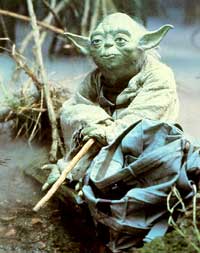
"Yoda is a good jumping off point for Buddhist
>>
themes in 'Star Wars,' but they run much deeper than what that
little Jedi Master taught Luke..."
Jar Jar?now that?s a different story. In
?The Dharma of Star Wars,? I liken Jar Jar to that fidgety,
erratic, spastic nature of our minds. He is our mind when it is
running on and on and won?t shut up no matter how many times we
yank it by the tongue and order it to quiet down! Jedi Mindfulness
and meditation help calm the Jar Jar within us (and yes, he?s there
whether we want to admit it or not).
Millions of people are obsessed with ?Star Wars.? But is there a
danger, from a Buddhist perspective, in putting too much energy and
emotion into a movie series?
Yes, there is always a danger in becoming overly obsessed with
anything. For example, I was at the midnight showing of Attack of
the Clones in LA three years ago and a fight broke out between
fanboys over some prime seats. A real fight with fisticuffs and toy
lightsabers! We can become overly attached to ideas, things and
people (like Anakin?s attachment to Padmé in ?Revenge of the Sith?)
and that attachment can lead to the dark side (again, like Anakin
in ?Sith?). At the same time, however, it is also dangerous to
overly repudiate or reject life. ?Star Wars? is fun?I say enjoy it
(sans the black eyes and swollen lips, of course).
Your book makes no mention of the notorious 1978 offering
The Star Wars Holiday Special. Can one find any Buddhist
understanding in having the likes of Art Carney or Beatrice Arthur
recklessly trespassing in the Lucas universe?
Buddhism teaches that the first Truth of
life is that suffering is a part of life. For me nothing makes the
fact of suffering more evident than the ?Holiday Special? and
especially Beatrice Arthur singing the Mos Eisley Cantina patrons
out the door. Just the memory makes my skin crawl. I have ?watched?
the ?Holiday Special? several times, but I have never made it all
the way through without firmly depressing the fast-forward button
through most of its interminable, stomach-churning scenes. In an
early draft of ?The Dharma of Star Wars? I did reference the
?Holiday Special.? I?ll repeat what I said there: If you haven?t
already seen the ?Holiday Special,? don?t!
Or for that matter, why is it that the Wookies have their
own religious holiday in ?The Star Wars Holiday Special? while the
human characters don?t seem to have any visible affiliation with a
specific religious persuasion?
By tapping into the archetypes of myth
and religion but not being passionate about any one in particular,
George Lucas dressed a highly spiritual saga in secular clothes.
There is no specific ?Star Wars? faith. ?Star Wars? is a story of
the human condition that we can all relate to in one way or
another. Buddhism, as an individual practice, a practice of
self-discovery and one that requires us to understand the truth
about reality in our own way, squares nicely with Lucas? universal
approach. Buddhism is not just for the Buddhist. It can be
practiced by anyone, anywhere, anytime.
What are your personal expectations of the upcoming
?Revenge of the Sith??
I think it?s going to be awesome! I am
confident that it will be the best of the prequel trilogy and
perhaps the entire saga (although it will be hard pressed to outdo
?The Empire Strikes Back?). Darth Vader is my favorite character
and I am excited to see the final fall of Anakin and the rise of
Vader. Anakin?s story is one many of us can relate to. It?s a story
of good intentions that go terribly awry because life is not simple
and choices between right and wrong are often blurred. There is a
saying about good intentions: ?The road to hell is paved with
them.? That is something Anakin discovers in ?Sith.? We create
hells everyday in our lives because we are also confused. Buddhist
practice helps clear the confusion so we can see life with greater
clarity and make choices that will benefit ourselves and others and
not lead us to the dark side.


