Are Buddhists
atheists?
By
Shiqin, The Buddhist Channel, June 25, 2006
Singapore -- According to online dictionary
m-w.com, an "atheist" is "one who
believes that there is no deity" and a "deity" is "the rank or
essential nature of a god/ a god or goddess/ one exalted or revered
as supremely good or powerful."
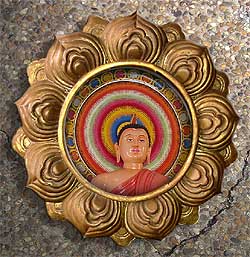
Many theists, be they monotheists (those who believe in one God)
or polytheists (those who
believe in multiple gods), see Buddhists as atheists - because
there is no god as the central refuge in its teachings.
But how true is
this?
Buddhists take refuge in the Triple
Gem (Three Jewels) - the Buddhas (there are countless Buddhas), the
Dharma (the Buddhas' teachings
that lead to enlightenment), and the Sangha (the community of Dharma
practitioners, which includes humans and gods, who have attained at
least stream-entry, which is the first spiritual fruit on the path
to enlightenment). It is important to note that the Sangha consists
of some gods (devas) too, of whom are celestial (heavenly)
Bodhisattvas such as the well
known Avalokiteshvara (Guanyin) Bodhisattva. Bodhisattvas can
manifest as some gods out of skilful means too, though Bodhisattvas
are never manifestations of ordinary gods. In this sense, Buddhists
do take refuge in some, but not all gods, as not all are of the
Sangha. However, many
gods take refuge in the Triple Gem.
Traditionally, Buddhists take refuge in all three aspects of the
Triple Gem collectively. This is true, other than the Buddha's
several first disciples, who took refuge only in the Buddha and the
Dharma he taught - in the absence of the Sangha, that was formed
shortly after - at the end of the first sermon. Yet in a way, the
Buddha himself was already the perfect
embodiment of all three aspects of the Triple Gem.
The (historical) Buddha as a
spiritual refuge is obviously not a god or a creator God
(which Buddhism does not subscribes to
- as it believes we collectively create and re-create the world
continually through karma). But one of the traditional
titles of the Buddha is "Teacher of
humans and gods". He declared himself to be wholly
spiritually purified and perfected, to be faultless, to be one who
had transcended both human and godly limitations. In the spiritual
and physical sense, every Buddha is equally supreme to each other,
and are thus "God-like" - in a very loose sense of the word.
Are Buddhas divine? According to
the same dictionary, "divine" refers to
that "of, relating to, or proceeding directly from God or a god/
being a deity/ directed to a deity/ supremely good." We need to
note that the "divine" is usually related to the godly only.
As the Buddha clearly said he is not an
incarnation of any god or any god's messenger, and that he had
transcended all gods, he is nevertheless "divine" as he is
"supremely good". The goodness of the Buddha is so supreme that it
is called "pure", which transcends both worldly and godly
goodness.
So, are Buddhist really atheists,
monotheists or polytheists? There is no clear-cut answer,
since many use these terms differently. A complete answer to the
question would resemble one of at least this length. However, Buddhism explains how theism evolved
through history, and it is from this that we can see how Buddhism
sees itself in comparison. In the ancient days of lack in
understanding of nature, when humans experienced the wrath of
nature, they instinctively assumed there to be gods of nature who
were angry at them. Thus arose belief in earth gods (who create
earthquakes), mountain gods (who create landslides), river gods
(who create floods), lightning gods (who create lightning
storms)... This is probably birth of polytheism. Some time later,
it occured to humans that these myriad gods should be under the
control of a supreme God who created and governs them, without
which there would be total chaos. This is the birth of
monotheism.
With the coming of Buddhism and its above understanding, none of
the gods or God were taken as spiritual refuges, as the Buddha's
complete awakening to the reality of life, the universe and
everything clarified the earlier (mis)understanding of the nature
of gods. But this is not to say no gods exist at all. In fact, in
Buddhist cosmology, there are 26 intricately defined heavenly
planes among its 31 planes of existence. The inhabitants of the
heavens are of course, gods. And anyone who had created sufficient
good karma can be reborn as a god, though a godly rebirth is not
Buddhism's final aim. Its final aim is to urge all to become
Buddhas - ones who have realised total freedom from the rounds of
life and death.
It is interesting to note that in the Buddhist scriptures, there is
a god described, with whom the Buddha interacted with, who had
mistaken himself to have created the universe. This god invited the
Buddha to teach after his enlightenment too. (For the sake of religious harmony, it would not be
appropriate to claim or argue if this god/God is that of any other
religion.) As described above, according to Buddhism, the
rise of a religion which is not god-centric is seen as part of the
process of the evolution of religion. The Buddha taught that, given
enough efforts of spiritual cultivation, every single being can
become spiritually evolved (be it in this life or another) to
become perfect like him in compassion and wisdom. His goal was to teach the path to "True Happiness"
for all beings, which is synonymous with the attainment of
Enlightenment, which is the realisation of the truth of all
things.
Atheism is also often lumped together with nihilism, which is in
turn related to the total lack of morals. Not that Buddhists are
"atheist" in the strictest sense of the word (as explained above),
if one examines the Buddhist code of ethics, one will discover that Buddhism has perhaps one of
the world's most comprehensive and compassionate moral system,
which even takes into consideration of plants and the smallest
sentient beings (eg. insects). Buddhism is incredibly conscious not
only about human welfare in terms of promoting anti-sexism,
anti-racism, anti-casteism, anti-speciesism, anti-dogmatism,
anti-religious intolerance... it is also mindful of ecological and
animal welfare. Thus is the first impression of the Buddha for many
that of the embodiment of all-rounded compassion and
wisdom.
