http://www.buddhistchannel.tv/index.php?id=9,2571,0,0,1,0
Dalai Lama: Tibet Wants Autonomy, Not
Independence
Time, April 15, 2006
Tibet's spiritual leader speaks
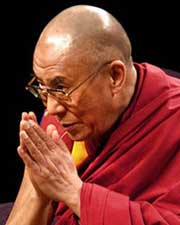
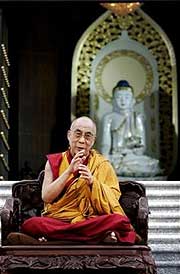
Washington, USA -- The Dalai Lama's schedule is usually set seven
years in advance, but the Tibetan spiritual leader made a rare
change to his plans in order to attend a San Francisco conference
convened by Muslim leaders to discuss religious tolerance. His
Holiness, as Tibetans call him, spoke with Time's Amanda Bower
about Islam, his hopes to return to his homeland after 47 years in
exile, and his hobby of tinkering with timepieces.
TIME: What was so important about this conference that you
changed your schedule to attend?
THE DALAI LAMA: I have two major commitments. Number one is the
promotion of human values not because of religious belief, but
because of biological reasoning. We need peace of mind. Peace of
mind is good for health, good for community, good for family, and
also for physical growth. A peaceful mind is more proper. A
disturbed mind, harmful. My number two commitment, as a believer,
is for harmony among the different religious traditions. In the
last 20, 30 years, I made these two commitments whenever I had the
opportunity. As far as the promotion of religious harmony is
concerned, I think I made some contribution, at least between the
Tibetan Buddhist community and our Christian brothers and sisters.
I think we have very good, close understanding. For example, there
are many Christian practitioners now showing their respect and
understanding about Buddhist concepts, as there is among Buddhists
now an appreciation of Christian contribution for the betterment of
the world and humanity.
Personally, from my childhood, there is a Muslim community in Lhasa
[Tibet's capital] for the last four centuries. Very peaceful. Very
gentle. No quarrels. Nowadays, in the outside world, sometimes
people get the impression Muslims are more militant. I think that
is wrong. I think these wrong impressions must be eliminated. They
are no good for the world. [Islam] is one of the important world
religious traditions that we must respect.
But everyone gathered here is a moderate. Do you think the
extremists who have been giving Islam a bad name will listen to
what you have to say?
[Laughs] I don't think they will listen. In my Buddhist community,
the radicals don't listen... But our attempt is to try to explore
the same values, send messages, and make them known to other
people. Some mischievous people always remain. Doesn't matter. It's
a mistake to generalize the behavior of a few individuals to the
whole tradition. Since 11th of September, some Muslims really carry
some violence, including terrorism. This should not be considered
representative of the whole Muslim faith. A few mischievous
individuals are everywhere, among the Hindus, among the Christians,
among the Muslims, among the Buddhists.
China's President Hu Jintao is visiting the U.S. at the
same time as you are, and you have urged your supporters here not
to demonstrate against him. Why?
Since we already have some official contact with the Chinese, we
believe it is very important to create impressions that we are very
sincere, we are fully committed.
Two weeks ago, the Chinese government said it would allow
you to visit your homeland, which you fled in 1959, if you
abandoned your pursuit of independence for Tibet. But haven't you
long said that you want autonomy, not independence, for
Tibet?
Oh yes. The world knows the Dalai Lama is not seeking independence.
The world knows. Still the Chinese do not know. [Laughs]
Do you have any heaviness of heart about giving up hope for
Tibetan independence?
No. It's not necessary. Of course the present situation, in
reality, I think that 99% of the Tibetan population is very, very
unhappy. Every year, I think more than 10,000 Tibetans come to
India. Some escape, some with permission. Every single Tibetan,
when you meet them, is crying, complaining, including some Tibetans
who have high level positions and are party members. I think many
foreigners who visit Tibet and who have some close contact with
local Tibetans also get the same impression. There are a large
number of police forces there. Why? Too much suspicion, too much
fear. If what the Chinese government claims is true, there's no
need for security like that. This is very bad, not only bad for
Tibetans, but also for the People's Republic of China as a
whole.
As far as the future is concerned, look at the European Union. In
the past centuries, those nations talked most about their
sovereignty. Now, today, the common interest is more important than
each individual nation's sovereignty. Tibet is a landlocked
country, a large area, small population, very, very backward. We
Tibetans want modernization. Therefore, in order to develop Tibet
materially as a modern nation, Tibet must remain within the
People's Republic of China. Provided Chinese give us a full
guarantee of preservation of Tibetan culture, Tibetan environment,
Tibetan spirituality, then it is of mutual benefit. [Besides]
foreign affairs [and] defense [are] all the things which Tibetans
can manage by themselves. Tibetans should have the full
autonomy.
As a hobby, you like to collect and repair watches. It
seems an unusual thing for a Tibetan monk to do.
Many Tibetans, including many monks, like wristwatches. I think
monks are more fond of watches than lay people. Lay people have a
lot of other things. [Laughs] I don't buy them for myself, they are
all presented by other people.