http://www.theepochtimes.com/news/5-8-7/31030.html
http://epochtimes.com/gb/5/8/5/n1008756.htm - see
enlarged photo of naga
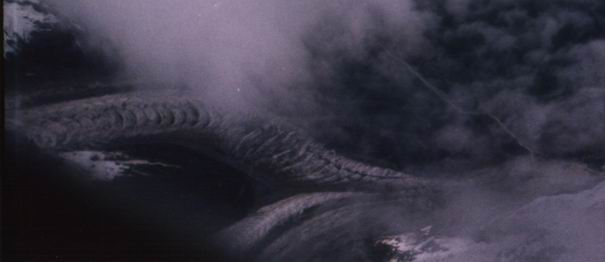
Above the Himalayas. (www.dajiyuan.com)
A photo of two peculiar dragon-shaped objects taken from a plane
flying over Tibets Himalayas piqued many users interest when
displayed on a Chinese website. The photographer is an
amateur.
On June 22, 2004, the photographer went to Tibets Amdo region to
attend the Qinghai-to-Xizang Railroad laying ceremony, and then
took a plane from Lhasa to fly back inland. When flying over the
Himalayas, he accidentally caught these two "dragons" in a picture
that he took. He called these two objects "the Tibet
dragons."
Looking at the photo, these two objects appear to have the
characteristics of crawling creatures: The bodies seem to be
covered by scales, the backs have spine-like protuberances, and
also they have gradually thinning rear ends. Although the photo
caught only a portion of the entire scene, it was sufficient to
create the appearance of two gigantic dragons flying in the
clouds.
This photo, shown on some websites such as post.baidu.com and other
forums, aroused the website visitors curiosity. One person
commented, No wonder that China is the homeland of the dragon!
Nature is truly mysterious and powerful, it can always produce
spectacular sights beyond people's expectations.
Is it really true? Is it possible there is an ancient civilization
that we dont know about preserved in places that are sparsely
populated?
It really looks like the dragons in fables, and I really hope it
is.
Certainly, most website visitors hoped that someone could confirm
the authenticity of the dragons in the photo.
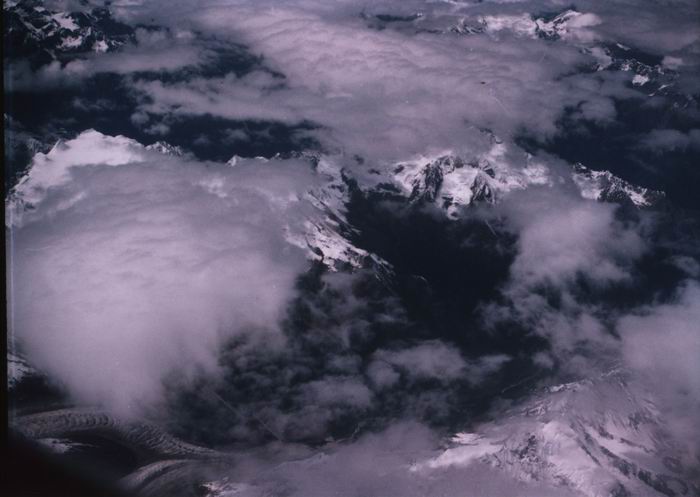
Photo of dragons taken from an airplane above the Himalayas.
(www.dajiyuan.com)
In Chinese fairy tales, the dragon is a kind of rare heavenly
creature. Fables say that it can conceal or reveal itself. It
ascends to heaven in the spring breeze and dives and hides in deep
water in the autumn wind. It can promote clouds and bring about
rain. It also became the symbol of imperial authority later on; all
emperors of previous dynasties self-designated as dragons, utensils
were also decorated with dragons.
Culturally, the dragon is the Chinese ancestors' totem. Nearly all
races in China had fables and stories with dragons as the main
subject, such as dragon boat races, the dragon lantern dance to
celebrate holidays, sacrificial offerings to the dragons to implore
timely wind and rain for good crops.
Whether this kind of creature really exists is still an unsolved
riddle. In the previous dynasties in China, there had been many
documents recording eyewitness accounts of magical dragons. The
most amazing events are the various "falling dragons," dragons that
suddenly fell to the ground under peculiar circumstances, and were
witnessed by many. A relatively recent tale occurred in the puppet
Manchuria regime in August, 1944. A black dragon fell to the ground
at the Chen Familys Weizi Village, about 9.4 miles northwest of
Zhaoyuan County, on the south shore of the Mudan River (the old
name of a section of Songhua River) in Heilongjiang province. The
black dragon was on the verge of death. The eyewitness said that
this creature had a horn on its head, scales covering its body, and
had a strong fishy smell that attracted numerous flies.
The records from previous dynasties also mentioned the connection
between the emergence of these kinds of mysterious creatures,
dragons, and the transition of dynasties on earth. The appearance
of Tibets magical dragon invites our curiosity and
imagination.


