Recap for those who wants to see part 2:
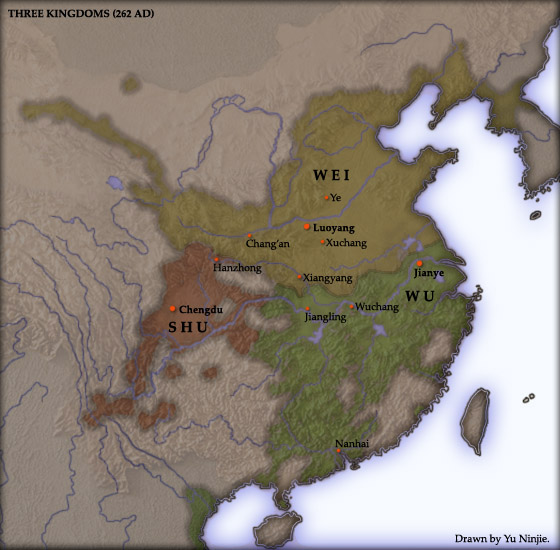
The story of RED CLIFF takes place in 208 AD in China during the
Han Dynasty. Despite the presence of an emperor, Han Xiandi, China
was then divided into many warring states.
The ambitious Prime Minister Cao Cao, by using the Emperor as his
puppet, waged war on a kingdom in the west, Xu, ruled by the
emperor’s uncle, Liu Bei. Cao Cao’s ultimate goal was to wipe out
all the kingdoms and install himself as Emperor to a unified China.
Liu Bei sent his military advisor Zhuge Liang as an envoy to the Wu
Kingdom in the south, trying to persuade its ruler Sun Quan into
joining forces. There he met Wu’s Viceroy Zhou Yu, and the two
became friends amidst this uneasy alliance.
Enraged to learn that the two kingdoms have become allies, Cao Cao
sent an army of eight hundred thousand soldiers and two thousand
ships down south, hoping to kill two birds with one stone. Cao
Cao’s army set up camp at Crow Forest, across the Yangtze River
from Red Cliff, where the allies were stationed.
With the food supply running short, and the army vastly outnumbered
by Cao Cao’s, the allies seemed doomed. Zhou Yu and Zhuge Liang had
to rely on their combined wisdom to turn the tide of battle.
Numerous battles of wits and forces, on land and on water,
eventually culminated into the most famous battle in Chinese
history, where two thousand ships were burned, and the course of
China’s history was changed forever. That was the Battle of Red
Cliff.
Movie Review:
Red Cliff, the highly anticipated epic period flick marks the
return of "bullets and guns" maestro John Woo back to making movies
in the Asia region. Taking on a section of the well-loved novel,
Romance of the Three Kingdom, this grand tale is being told in not
one but two movies.
The decision to split this epic tale is an
understandable one (although I hope it’s not a monetary reason)
Against the criticism that Andy Lau’s recent version of The Three
Kingdom had over done with the fast forwarding sequences of events
that rushes to the eventual finale, Red Cliff took the other route
and took it’s time in laying out the story.
On one hand, it allowed more build up in various
characters and agenda while the rivaling sides prepare for the
battle at Red Cliff. Taking it’s time to slow-boil the various
elements such as the different reasons for battle, the reluctance
to fight and the eventual change of mind.
However taking the time and effort doesn’t mean it
will be compelling or engaging as Red Cliff succeeded in some parts
and falter in others.
One of the distractions from enjoying this movie
would be the casting choice and (largely to personal preference)
some actors felt that they had been miscast, especially for the
role of Cao Cao and Zhuge Liang. Although the respectable Zhang
Fengyi was great in Farewell to my Concubine, it felt that he lacks
the scheming and cunningness to pull off this role. The same with
Takeshi Kaneshiro’s portrayal of Zhuge Liang which often invite
stray thoughts of "What if Chow Yun Fatt had played this role or
what if Tony Leung had not took over Zhou Yu’s role
instead"
Beside the miscast, it felt that various characters
had been mishandled. It’s obvious that Zhou Yu is the central
character in Red Cliff and Zhang Fei, Guan Yu, Zhang Fei and Zhao
Zilong are just supporting characters but this film made it felt
that it was relegating these iconic characters to nothing more than
mere capable fighters at Zhou Yu and Zhuge Liang’s disposal. In a
way, it felt that it took away some of the majestic aura that these
few characters had long established in our mind.
Several situations that compel the various
characters to act also didn’t felt that compelling at all. Such as
Sun Quan (Chang Cheng)’s reluctant and dilemma in going to war with
Cao Cao felt very naively handled. Especially in a scene when Sun
Quan had to face his fears in the form of a tiger and the
filmmakers chose to impose Cao Cao’s face over the beast to force
the point down the audience throat. The fight with the tiger was
also unimpressive in the age of spectacular special effects and the
lack of scenes between the actor and the tiger in the same shot
stood out as a sore thumb.
What Red Cliff succeeded was breathing new life to
Zhou Yu’s character who is known to be a petty General who was
jealous of Zhuge Liang’s capabilities. Tony Leung and Director John
Woo had came together to paint a more endearing aspect for Zhou Yu.
From his appreciation of music to how he leaded the first major
battle in this epic was rather intriguing and impressive to someone
who is unaware of his role in The Three Kingdom.
Fans of John Woo will be also be please to find that
the director’s trademark “Slow Mo” action sequences and ballistic
ballet with bullets had been proficiently replaced with horse
ridding sequences and weapons such as spears and swords. Even the
ever present white doves serve a more useful function besides its
usual running away from gunfights in director John Woo’s
movies.
It’s not technically possible in giving a fair
assessment to Red Cliff with just the first part. The problem with
movies that are told in two parts would be that it’s hard to judge
what would be the fruition of events and characters. Witnessing the
set up of events and characters could be tedious and unrewarding.
However for the first part, it doesn’t really strike a strong chord
with what it was trying to do (such as brotherhood and strategies)
basically it gives a very weak start for the epic.