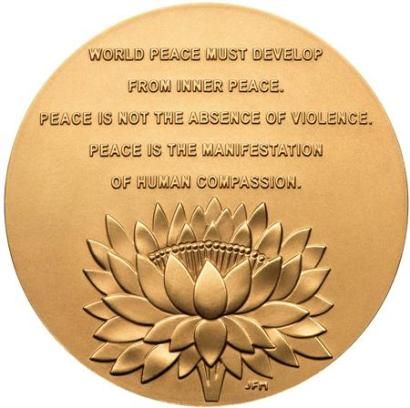
Awarding the Nobel Peace Prize to the foremost organiser for human
rights and democracy in China would reaffirm the values held most
dearly by mankind, writes Xu Youyu, philosopher, professor at the
Chinese Academy of Social Sciences and holder of the Olof Palme
Chair, Sweden for 2001-2002.
The following
op-ed is authored by Xu Youyu, philosopher, professor at the
Chinese Academy of Social Sciences and holder of the Olof Palme
Chair, Sweden for 2001-2002.
"A Letter to the European People:
I am here to urge your support of this year's Nobel
Peace Prize being bestowed upon the founder of China's Charter 08,
Liu Xiaobo.
In spite of Liu Xiaobo's many friends and supporters, I
came to know him quite late, and we first met personally only a few
years ago. In the mid-1980s, when Liu Xiaobo rose to prominence
within the literary world, I was a visiting research fellow at
Oxford, and became familiar with his ideas through Chinese
periodicals published overseas.
Contrary to the view held by many, what brought Liu
such attention at the time wasn't merely the sharpness of his
writing or his pointed critiques, but also how thorough he was in
his thinking and how much more influential his criticisms were of
mainstream ideology and dogma in China than those of other
intellectuals.
Throughout the student-led democracy movement of 1989,
I had the opportunity to observe Liu Xiaobo. He had been lecturing
abroad for quite some time, but when signs of suppression began to
appear and others began making arrangements to flee overseas, Liu
Xiaobo instead chose to discontinue his academic pursuits and
return to Beijing to immerse himself in the struggle for
democracy.
On the nights of June 3rd and 4th, I was in Tiananmen
Square, not far from the Monument to the People's Heroes. Liu
Xiaobo, along with three other intellectuals, was taking part in
the student hunger strike; it was they, who, on the early morning
of the 4th, convinced the students to peacefully evacuate the
Square and begin discussion with the soldiers suppressing them,
negotiating a smooth withdrawal.
I remember clearly the difficulty and pain Liu Xiaobo
and his comrades-in-arms— raised as they had been with the most
radical type of an education — experienced in reaching this
decision, one which only later was understood to have saved the
lives of several hundred students.
Liu Xiaobo's involvement in the 1989 democracy movement
illustrates his transformation from an eminent cultural critic to
public intellectual concerned with social and political problems
and human rights activist.
His activities in 1989 can be seen as formative in the
entirety of his following writings and other works, characterised
by an unwavering bravery and refusal to back down in the face of
danger and suppression, by the pursuit and defence of human rights,
humanism, peace and other universal values and, finally, adherence
to the practice of rational dialogue, compromise and
non-violence.
For many years, Liu Xiaobo has been the most
representative figure and foremost organiser in mainland China's
struggle for human rights and democracy. He has been at the
forefront of protests made in support of writers and intellectuals
imprisoned for their work, in appeals made for farmers and urban
residents deprived of land and home, in advocating for protection
of the religious and cultural rights of ethnic minorities in Tibet
and Xinjiang, and in fostering constructive dialogue toward seeing
peaceful co-existence between Han and all ethnic minorities.
In a series of protests aimed at upholding the
fundamental rights of all Chinese citizens, Liu Xiaobo placed
consistent emphasis on the fact that the rights and freedoms of all
Chinese citizens are protected both by the Chinese constitution and
in law, as well as a series of United Nations and international
declarations and covenants signed by the Chinese government which
safeguard human and civil rights.
Liu placed particular emphasis on seeing the Chinese
government's obligation and responsibility to abide by its own
constitution and laws as well as international covenants as
commitments to both the Chinese people and the international
community.
In launching and signing Charter 08 in 2008, Liu
Xiaobo's intent was to reaffirm, with the Chinese government
already recognising the Universal Declaration of Human Rights and
having signed the International Covenant on Civil and Political
Rights, that these are the norms with regard to interaction between
the Chinese people and the Chinese government: to be a qualified
and responsible member of the international community would require
China to adopt the universal values embodied within these two
documents.
For this, Liu Xiaobo was imprisoned, his third arrest
as a result of striving for freedom and democracy in China. On
Christmas Day, 2009, Liu Xiaobo was sentenced to 11 years in
prison. In his final statement to the court, Liu Xiaobo said that
he had neither enemies nor hate; to those who kept him under
surveillance and arrested him, to the police who interrogated him
and to the public attorneys who prosecuted and judge who sentenced
him, the message Liu Xiaobo felt it most important to convey was
that despite their various roles leading to his imprisonment, he
considered none of them his enemy.
As a political theorist and public intellectual also
concerned with social and political problems and the defence of
human rights, as well as a signatory to Charter 08, I strongly feel
the need to point out that in the judgement read by the court which
sentenced Liu Xiaobo, evidence cited to prove Liu's guilt included
his participation in Charter 08, that he collected signatures for
it, and even the content of the Charter itself - naked provocation
of the universal values held by humankind, common norms held by the
international community, and especially of the Chinese people
themselves.
As I see it, the Nobel Peace Prize both embodies and
represents the core values of civilised society: respect for life
and faith, the sanctity of the individual and the right to express
one's self. Given that Liu Xiaobo and many others signatories of
Charter 08 have faced persecution and oppression merely for
reaffirming these values, the blatant challenge they face behooves
a response from the civilised world.
To bestow the Nobel Peace Prize upon Liu Xiaobo is one
of the strongest responses which could be sent.
This would, clearly and unambiguously, reaffirm the
values held most dearly by humankind, serve as monumental support
for the struggle for the freedom and democracy which China's 1.3
billion people lack, and would mark a major step in defence of
world peace.
The Chinese authorities are able to destroy this
country's constitution and trample upon its laws wantonly, which is
why external voices, voices from the international community, are
needed to make Chinese authorities pay heed.
Bestowing the Nobel Peace Prize upon Liu Xiaobo would
serve as indirect opposition to the current state of affairs, as
well as a both authoritative and effective signal.
Liu Xiaobo's ideas and actions, in my view, are
entirely congruous to the actions and ideas held by His Holiness
the Dalai Lama, Archbishop Emeritus Desmond Tutu and Aung San Suu
Kyi; all have endeavoured to use tactics of non-violence in
effecting gradual change, of persuasion and compromise in upholding
human rights and in making the transition toward a peaceful
society.
With protest movements now taking place all across
China within every community and at every level, it is imperative
we remain vigilant in preventing violent trends from taking hold.
Awarding Liu Xiaobo the Nobel Peace Prize would have just such an
effect: people struggling for human rights in China and around the
world would find hope and strength in rational, non-violent
resistance, and see anew the possibility of putting violence and
authoritarian rule where they both belong - in the past and behind
us all.
Cordially yours,
Xu Youyu."
http://www.euractiv.com/en/pa/why-nobel-peace-prize-should-go-liu-xiaobo-analysis-498270