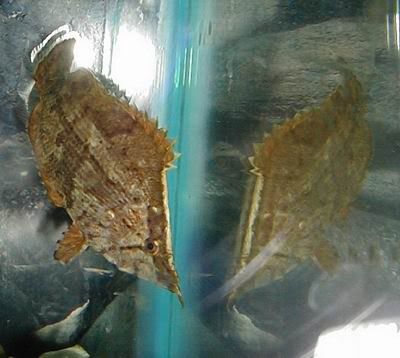

Common Name: Amazon Leaf Fish
Scientific Name: Monocirrhus polyacanthus
Family: Nandidae (Leaffishes)
Subfamily: Nandinae
Order: Perciformes
Class: Actinopterygii (ray-finned fishes)
Max. size: 10.0 cm
Environment: benthopelagic; freshwater; pH range:
5.0 - 6.0; dH range: 5.0 - 8.0
Climate: tropical; 22 - 25°C
Distribution:South America: Guyana to Brazil.
Found in the Peruvian Amazon (Ref. 6329).
Care: Very difficult fish to keep, definitely not
for beginners! Monocirrhus polyacanthus are true predators. They
are best not accompanied by other fish, although they can be
accompanied by diskusfish, angels, and larger Corydoras species.
Leaf fish can only be fed live food, juveniles will accept small
live food like bloodworms. Older specimens are more picky, and
require live fish. They eat approximately their own weight per day,
so to keep them properly, you'll need a few tanks in which feeder
fish can be bred, or have lot's of money to spend.
A pair can be kept in an 80 cm aquarium, although the larger the
better. The tank should be well planted, especially with plants
that have large leaves, like Echinodorus species, in between which
the leaf fish loves to hide. They are extremely good at hiding, and
it will always take some time before you spot them in the aquarium.
A dark soil and some floating plants will be appreciated by the
fish, but are no necessity. Some driftwood is definitely
recommended!
Breeding: At a lower pH(below 6) the fish will
spawn in a setup as described in the care section, and if fed well.
Up to 300 eggs, which hang by a thread on a leaf, are deposited by
the female, and guarded by the male.
At 25 degrees, the eggs will hatch in 4 days, and the fry are
around 5 mm. If fed well, they can reach 3 cm in 3 months.
Sexual dimorphism: Recognisable at 4 cm, females
display a ovipositor.
Additional Information: Do not use guppies as
feeder fish! Many guppies are infected with fishtuberculosis, and
leaffish are highly susceptible to TBC, and may contract it through
the feeder fish.
Life expectancy: 8-9 years.
References:
http://www.nscontact.com/catalogue/-nsc-en_60_51_01_390_1_Monocirrhus_polyacanthus_Amazon.aspx
http://aquaworld.netfirms.com/Other/Monocirrhus_polyacanthus.htm
http://www.geocities.com/willowdaleaquariumsociety/library/leaf.html


