so blur lah..cant read a sentense..
IT'S a parent's nightmare: shelling out big money
for college, then seeing the graduate unable to land a job that
requires high-level skills. This situation may be growing more
common, unfortunately, because the demand for cognitive skills
associated with higher education, after rising sharply until 2000,
has since been in decline. So concludes new research by economists
Paul Beaudry and David Green of the University of British Columbia
and Benjamin Sand of York University in Toronto.
This reversal in demand has caused
high-skilled workers to accept lower-level jobs, pushing
lower-skilled people even further down the occupational ladder or
out of work altogether. If the researchers are right (which is not
yet clear), the consequences are huge and troubling - and not just
for college grads and their parents.
Let's start with some basic facts.
There have always been some graduates who wind up in jobs that
don't require a college degree. But the share seems to be
growing.
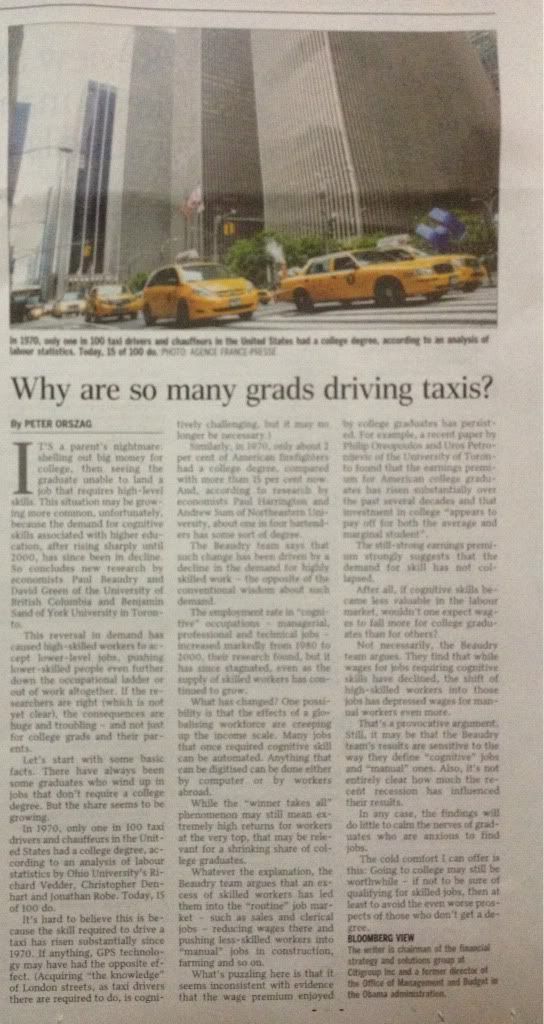
In 1970, only one in 100 taxi drivers
and chauffeurs in the United States had a college degree, according
to an analysis of labour statistics by Ohio University's Richard
Vedder, Christopher Denhart and Jonathan Robe. Today, 15 of 100
do.
It's hard to believe this is because
the skill required to drive a taxi has risen substantially since
1970. If anything, GPS technology may have had the opposite effect.
(Acquiring "the knowledge" of London streets, as taxi drivers there
are required to do, is cognitively challenging, but it may no
longer be necessary.)
Similarly, in 1970, only about 2 per
cent of American firefighters had a college degree, compared with
more than 15 per cent now. And, according to research by economists
Paul Harrington and Andrew Sum of Northeastern University, about
one in four bartenders has some sort of degree.
The Beaudry team says that such change
has been driven by a decline in the demand for highly skilled work
- the opposite of the conventional wisdom about such demand.
The employment rate in "cognitive"
occupations - managerial, professional and technical jobs -
increased markedly from 1980 to 2000, their research found, but it
has since stagnated, even as the supply of skilled workers has
continued to grow.
What has changed? One possibility is
that the effects of a globalising workforce are creeping up the
income scale. Many jobs that once required cognitive skill can be
automated. Anything that can be digitised can be done either by
computer or by workers abroad.
While the "winner takes all"
phenomenon may still mean extremely high returns for workers at the
very top, that may be relevant for a shrinking share of college
graduates.
Whatever the explanation, the Beaudry
team argues that an excess of skilled workers has led them into the
"routine" job market - such as sales and clerical jobs - reducing
wages there and pushing less-skilled workers into "manual" jobs in
construction, farming and so on.
What's puzzling here is that it seems
inconsistent with evidence that the wage premium enjoyed by college
graduates has persisted. For example, a recent paper by Philip
Oreopoulos and Uros Petronijevic of the University of Toronto found
that the earnings premium for American college graduates has risen
substantially over the past several decades and that investment in
college "appears to pay off for both the average and marginal
student".
The still-strong earnings premium
strongly suggests that the demand for skill has not collapsed.
After all, if cognitive skills became
less valuable in the labour market, wouldn't one expect wages to
fall more for college graduates than for others?
Not necessarily, the Beaudry team
argues. They find that while wages for jobs requiring cognitive
skills have declined, the shift of high-skilled workers into those
jobs has depressed wages for manual workers even more.
That's a provocative argument. Still,
it may be that the Beaudry team's results are sensitive to the way
they define "cognitive" jobs and "manual" ones. Also, it's not
entirely clear how much the recent recession has influenced their
results.
In any case, the findings will do
little to calm the nerves of graduates who are anxious to find
jobs.
The cold comfort I can offer is this:
Going to college may still be worthwhile - if not to be sure of
qualifying for skilled jobs, then at least to avoid the even worse
prospects of those who don't get a degree.
The writer is chairman of the
financial strategy and solutions group at Citigroup Inc and a
former director of the Office of Management and Budget in the Obama
administration.