[omy] Satellite ERP may mean end of gantries
The ubiquitous Electronic Road Pricing (ERP) gantry may become a
thing of the past several years down the road.
The Government is looking to
develop a next-generation ERP system, based on satellite
technology, which will not need the large gantries that require
space and time to set up.
But some motorists were
concerned that, without the gantries, they might unwittingly enter
a chargeable zone.
Transport Minister Lui Tuck
Yew said yesterday that the new system, tentatively called ERP2,
will allow the Land Transport Authority to tackle congestion more
effectively and quickly.
The current in-vehicle unit
(IU) for ERP gantries will have to be replaced for ERP2.
Undergraduate Beatrice Chua,
21, who drives, was worried that, if the ERP gantries are removed,
it might be hard to tell where the priced roads are, even if signs
are put up.
Motorcyclist Pang Chew Ting,
24, said alerting people beforehand via the new IU that they are
about to reach a chargeable road "would be good".
National University of
Singapore transport researcher Lee Der Horng said the new IU could
be similar to vehicle-navigation systems available on the market
now, and deliver value-added services.
Mr Lui - who was speaking
during a site visit to the Marina Coastal Expressway, slated to
open by year's end - said other possible uses of ERP2 include
finding stolen cars, and doing away with parking coupons by using
the new IU for charges.
He added that data collected
through ERP2 would be rendered anonymous, with the Government
working through privacy policies and safeguards.
When ERP2 is rolled out, "we
will start it off only on roads that are already priced under
today's ERP system", Mr Lui said, adding that the Government did
not intend to charge motorists the minute they left home or started
their engines.
"(A motorist) will generally
have the same paying experience," he said of ERP2, which will be
introduced only where there is congestion.
With ERP2, motorists could
also be charged based on the distance travelled, rather than at
discrete points only, as is the case with ERP gantries.
Distance-based charging will
also be "fairer and more equitable", as motorists will be charged
proportionally to how much they contribute to congestion, he
noted.
Mr Lui also said the
Government is looking to tweak the certificate of entitlement (COE)
system.
The conditions determining
which vehicles qualify for Category A COEs could be changed, such
as by introducing new criteria like engine power. This will address
concerns of how Cat A COEs - for cars up to 1,600cc, which are
typically smaller, budget models - are being used to buy higher-end
cars.
The Government is also
considering a surcharge on the second car and above owned by the
same person.
With distance-based charging,
COE prices could be brought down by the authorities as "owning a
car doesn't do any harm in terms of congestion", said transport
expert Alexander Erath.
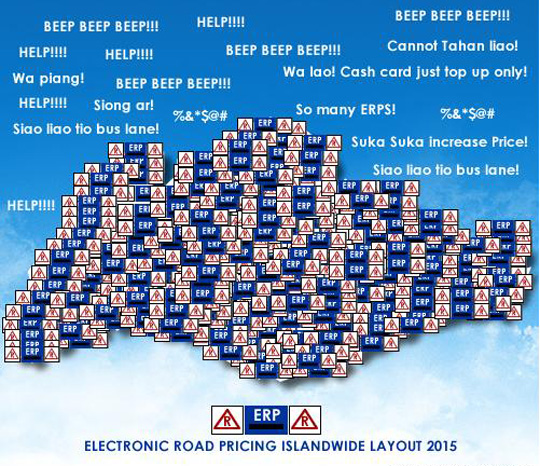
ERP = Every
Road Pay, soon to be EveRywhere Pay