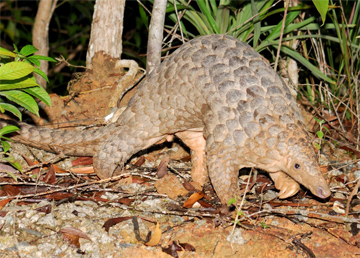
A Malayan pangolin (Manis javanica) in Kuala
Lumpur
8 hours ago
SINGAPORE (AFP) — China's insatiable demand for pangolins is
threatening the survival of the vital pest eaters in Southeast Asia
and governments must do more to protect them, experts and activists
have warned.
"Due to continual demand and the decreasing Chinese wild
population, in the past few years pangolin smuggling from Southeast
Asia has resulted in great declines in these producing countries'
wild populations," wildlife trade monitoring group TRAFFIC said in
a report.
"China has a long history of consuming pangolin as meat and in
traditional medicine," it said. The animals are toothless, scaly
mammals that provide natural pest control in the wild by eating
ants and termites.
"Pangolin populations clearly cannot stand the incessant
poaching pressure, which can only be stopped by decisive
government-backed enforcement action in the region," said Chris
Shepherd, Acting Director for TRAFFIC Southeast Asia.
The solution is better enforcement of national and international
laws designed to protect the animals, improved monitoring of the
illegal trade and more research on existing pangolin populations,
TRAFFIC said.
A spokeswoman for TRAFFIC told AFP that no estimates of the
remaining pangolin populations were available, but the report noted
that they are the most frequently encountered mammals seized from
illegal traders in Asia.
TRAFFIC quoted hunters and traders as saying there are so few
pangolins left in forests in Cambodia, Vietnam and Laos that they
are now sourcing the animals from their last remaining strongholds
in Southeast Asia and beyond.
Authorities seized 24 tonnes of frozen pangolins from Sumatra,
Indonesia, in Vietnam in March 2008 and 14 tonnes of frozen animals
in Sumatra four months later. African pangolins have also been
seized in Asia, TRAFFIC said.
"Pangolins save us millions of dollars a year in pest
destruction," said Simon Stuart, who chairs the Species Survival
Commission of the International Union for Conservation of
Nature.
"These shy creatures provide a vital service and we cannot
afford to overlook their ecological role as natural controllers of
termites and ants."