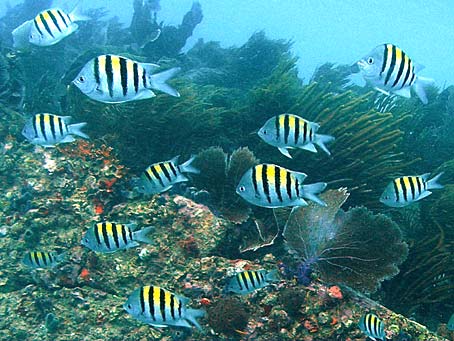
MANADO, Indonesia (AFP) – Climate
change could wipe out the world's richest ocean wilderness
by the end of the century without drastic cuts in greenhouse
gas emissions, environmental group WWF said Wednesday.
Rising water temperatures, sea levels and acidity are
threatening to destroy the vast region of Southeast
Asia known as the Coral Triangle, labelled the ocean's
answer to the Amazon rainforest, the WWF said in a new report.
Collapse of the reefs would send food production in the region
plummeting by 80 percent and imperil the livelihoods of over 100
million people.
With too little action on climate change, "you get a world in
which you have perhaps tens of millions of people homeless by the
inundation of coastlines through rapid sea level rises," report
lead author Ove Hoegh-Guldberg said.
"You see the erosion of food security and you see a world by the
end of this century which is, I think, pretty much a
nightmare."
WWF Coral Triangle Initiative Network head Lida Pet Soede said
the seas in the triangle -- bordered by East
Timor, Indonesia, Malaysia, Papua New
Guinea, the Philippines and the Solomon
Islands -- were vital sources of biodiversity.
"Some of the locations in the Coral Triangle are really
important areas for all sorts of fish. The migration of tuna and
turtles that spawn in the Coral Triangle are not going to have a
next generation," she told AFP.
Saving the Coral Triangle will require countries to commit to
deep cuts in greenhouse gas emissions.
Heat-trapping carbon gases -- notably from burning fossil fuels like coal, oil and gas -- are blamed
for warming Earth's atmosphere and driving
changes to weather patterns, as well as creating acidic seas
hostile to much marine life.
The warnings come ahead of tough negotiations over a successor
agreement to the Kyoto Protocol in the Danish
capital Copenhagen in December.
Emissions cuts of 80 percent below 1990 levels by 2050 will be
needed to avert the worst effects on the region, home to more than
half the world's coral
reefs and a linchpin for ocean life, the WWF said.
Local communities and governments will also have to curb
over-fishing and pollution, the report said.
"If you continue down the path of the over-exploitation of
resources, even if you get an incredible reduction in emissions,
there will still be a threat," WWF climate campaigner Richard Leck
said.
The report was released as ministers and officials from over 70
countries meet in the Indonesian city of Manado for the World Ocean
Conference, the first global meeting on the relationship
between oceans and climate change.
Delegates say delays over past years in dealing with climate
change mean the Earth could face a series of "tipping points" that
could trigger irreversible melting of sea ice and cripple the
ocean's ability to absorb carbon from the atmosphere.
"It is clear that the oceans perform a very important climatic
regulation function and if that is ... disturbed further then all
of humanity is likely to be affected by that," United Nations Environment Programme deputy head
Angela Cropper said.
"Time is not a luxury many of the world's islands and coastal
communities have. At stake are millions of island and coastal
peoples from the Arctic to the tropics," US-based University of
Delaware marine scientist Biliana Cicin-Sain said.
"The current global economic crisis should
not take attention away from dealing with climate change and from
maintaining the unique role of the oceans in sustaining life on
Earth."
Nations at the conference hope to pass a joint declaration aimed
at influencing the direction of the Copenhagen talks.
A meeting Friday will also see leaders from the six Coral
Triangle nations pass a joint plan on conserving the region.