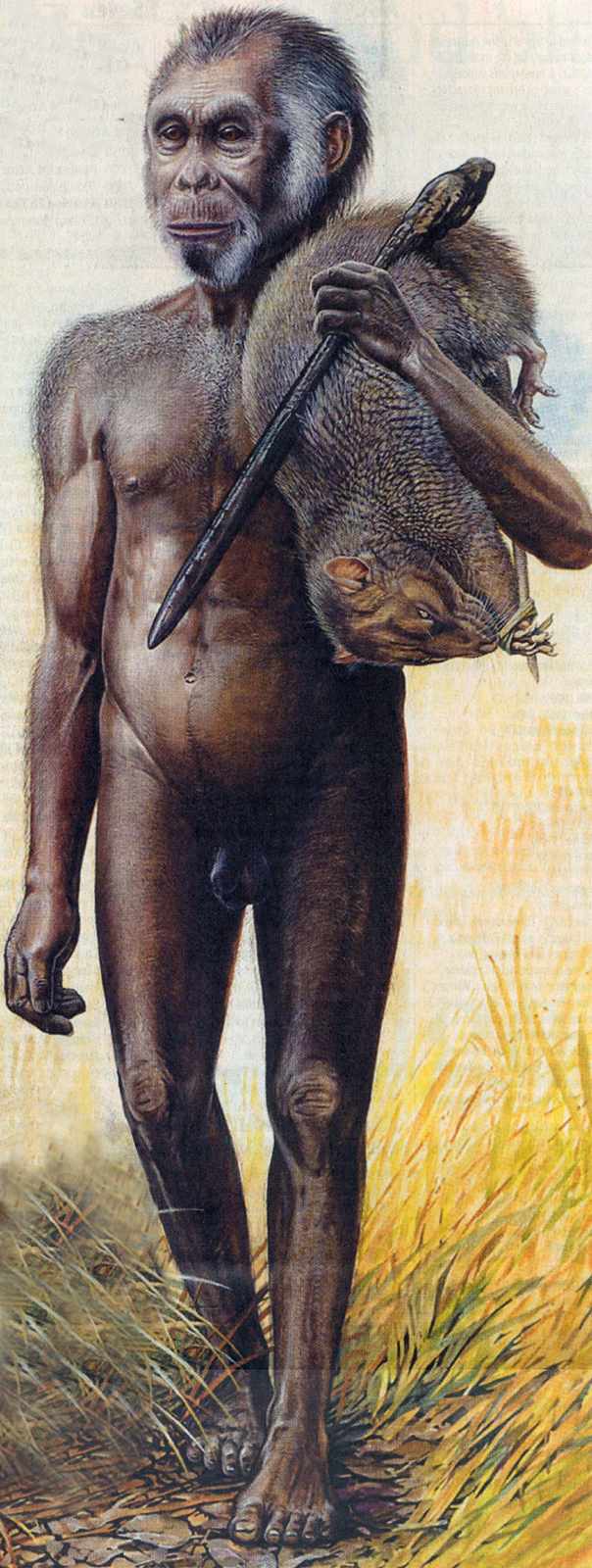
PARIS (AFP) – The tiny ancient humans dubbed hobbits, whose
remains were discovered on an Indonesian island in 2003, were a
previously unknown species altogether, according to two new
studies.
Debate has raged in the scientific community since the fossils
were found on the island of Flores, with some experts insisting
they were descended from Homo
erectus and others saying evolution could not account for
their small brains.
About a metre (three feet) tall and weighing 30 kilos (65
pounds), the tiny, tool-making hunters may have roamed the remote
island as recently as 8,000 years ago. Their fossils are about
18,000 years old.
Many scientists have said Homo
floresiensis, as the creature is now formally known, was a
prehistoric human stunted by natural
selection over millennia through a process called insular
dwarfing.
Others countered that even this evolutionary shrinking, well
documented in island-bound animals, could not account for the
chimpanzee-sized brain -- just a third the size of that in a modern
human being.
The only plausible explanation, they insisted, was that the
handful of specimens found had a genetic disorder resulting in an
abnormally small skull or that they suffered from "dwarf cretinism"
caused by deficient thyroids.
Two new studies in the British journal Nature go a long way
toward settling the debate.
A team led by William Jungers of Stony Brook University in New
York tackled the problem by analysing the hobbit's foot.
In some ways it is very human. The big toe is aligned with the
others and the joints make it possible to extend the toes as the
body's full weight falls on the foot -- attributes not found in
great apes.
But in other respects it is startlingly primitive: far longer
than its modern human equivalent and equipped with a very small big
toe, long and curved lateral toes, and a weight-bearing structure
closer to a chimpanzee's.
Recent archaeological evidence from Kenya shows that the modern
foot evolved more than 1.5 million years ago, most likely in
Homo erectus.
So unless the Flores hobbits became more primitive over time --
considered extremely unlikely -- they must have branched off the
human line at an even earlier date.
For Jungers and colleagues, this suggests their ancestor was not
Homo erectus "but instead some other more primitive hominin whose
dispersal into southeast Asia is still undocumented."
Companion studies published by the Journal of Human Evolution
bolster this theory and conjecture that these more ancient
forebears may be the still poorly understood Homo
habilis.
In any case, Homo floresiensis would be
confirmed as a separate species.
But what still has not been explained the hobbit's inordinately
small brain.
That's where hippos come into the picture.
Eleanor Weston and Adrian Lister of the Natural
History Museum in London compared fossils of several species
of ancient hippos found on the island of Madagascar with the
mainland ancestors from which they had evolved.
They were surprised to find that insular dwarfing -- driven by
the need to adapt to an island environment -- shrank their brains
far more than had previously been thought possible.
"Whatever the explanation for the tiny brain of H. floresiensis
relative to its body size, our evidence suggests that insular
dwarfing could have played a role in its evolution," they
conclude.
While the new studies answer some questions, they also raise new
ones sure to spark fresh debate, Harvard professor Daniel Lieberman
said in Nature.
Only more fossil evidence will indicate whether the hobbits of
Flores evolved from Homo erectus, whose traces have been found
throughout Eurasia, or from an even more ancient lineage not yet
found outside Africa, he said.