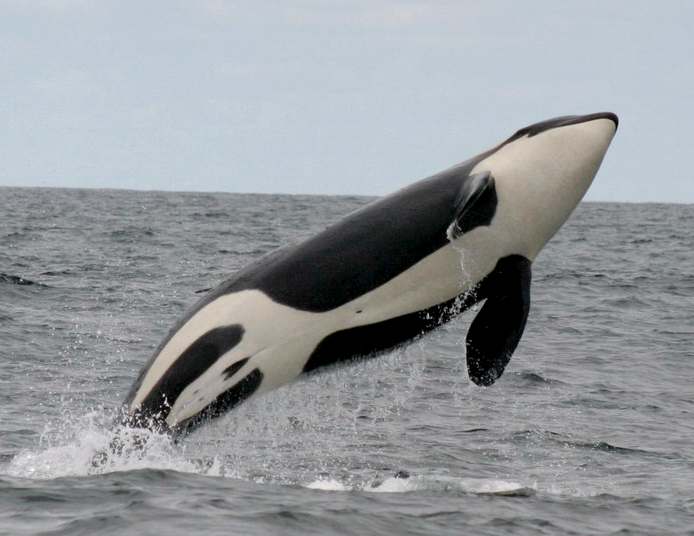
Humpback whales watching.
AFP - Wednesday, June 24
FUNCHAL, Portugal (AFP) - - Whales are worth more alive
than dead, an Australian minister said Tuesday, as campaigners
publicised the billion-dollar whale-watching industry on the
sidelines of the IWC conference.
Environment Minister Peter Garrett welcomed a report by the
International Fund for Animal Welfare (IFAW), which said that in
2008 whale-watching generated 2.1 billion dollars (1.5 billion
euros) of tourism revenue worldwide.
Garrett was speaking on the second day of the International
Whaling Commission (IWC), where pro- and anti-whaling countries are
thrashing out the issue of whether to permit increased hunting of
the marine mammals.
"The bottom line is clear," said Garrett, who before his
political career was a rock musician with Midnight Oil. "Whales are
worth much more alive than dead.
"Responsible whale-watching is the most sustainable,
environmentally-friendly and economically beneficial use of whales
in the 21st century," he told reporters at Funchal, on the
Portuguese island of Madeira.
IFAW's whale programme director Patrick Ramage told reporters:
"While governments debate what to do about whales, their citizens
are pointing the way."
In 2008, more than 13 million people had taken whale-watching
tours in 119 countries, he added.
"More than 3,000 whale-watching operations around the world now
employ an estimated 13,200 people," said Ramage.
The 2.1 billion dollars produced in 2008 was more than double
the estimated one billion dollars generated by the industry in
1998, said an executive summary of the report.
The IWAF report defined whale-watching as covering all cetaceans
-- whales, dolphins and porpoises.
Garrett attended the launch of the launch to show his
support.
Australia is one of the IWC member nations fiercely opposed to
the hunting of whales.
They, like other anti-hunting nations, argue that hunting whales
is not profitable, to the point that some whaling countries have to
subsidise the industry.
Anti-whaling nations are fighting to preserve the 1986
moratorium on whale-hunting, although Norway and Iceland are
already defying it.
Japan, which says whaling is part of its culture, kills more
than 1,000 whales a year through a loophole in the 1986 treaty that
allows their killing for scientific research.