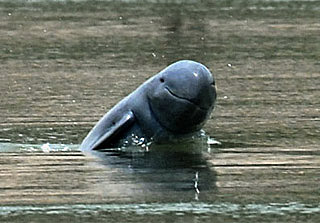
Mekong Dolphin Orcaella brevirostris
AFP
<!-- end .byline -->
PHNOM PENH (AFP) – Pollution in southeast Asia's Mekong River has pushed freshwater dolphins in
Cambodia and Laos to the brink of extinction,
a conservation report said Thursday, sparking a furious government
denial.
The WWF said only 64 to 76 Irrawaddy
dolphins remain in the Mekong after toxic levels of
pesticides, mercury and other pollutants were found in more than 50
calves who have died since 2003.
"These pollutants are widely distributed in the environment and
so the source of this pollution may involve several countries
through which the Mekong River flows," said WWF veterinary surgeon
Verne Dove in a press statement.
The organisation said it was investigating how environmental
contaminants got into the Mekong, which flows through Cambodia,
Laos, Myanmar, Thailand, Vietnam and the southern Chinese province
of Yunnan.
However, the Cambodian government official tasked with caring
for the country's Irrawaddy dolphins said there remained "about 150
to 160" of them in the Mekong, and alleged the WWF's report used
flawed research methodology.
"It's big trouble -- they (the WWF) should resign. They should
leave Cambodia," Touch Seang Tana, chairman of Cambodia's
Commission to Conserve Mekong River Dolphins and Develop
Eco-tourism, told AFP.
"They published this without consulting me, and I'm the
authority here," he said, adding he did not believe the river
contained the pollutants listed in the WWF's report.
The WWF said it suspected that high levels of mercury found in
some dead dolphins came from gold mining activities.
It added that Irrawaddy dolphins in Cambodia and Laos urgently
needed a health programme to counter the effects of
pollution on their immune systems.
Inbreeding among the small population could have also
contributed to weakened immune systems in the dead young dolphins,
all of whom were under two weeks old.
"The Mekong River dolphins are isolated from other members of
their species and they need our help," said WWF Cambodia country
director Seng Teak, adding the mammals "can show remarkable
resilience" if their habitat is protected.
The Mekong River Irrawaddy dolphin, which inhabits a
190-kilometre (118-mile) stretch in Cambodia and Laos, has been
listed as critically endangered since 2004, the WWF said.
Thousands of Irrawaddy dolphins once swam in the Mekong.
Although regarded as sacred in Cambodia and Laos, their numbers
were cut by the use of illegal fishing nets and Cambodia's
drawn-out civil conflict, in which dolphin blubber was used to
lubricate machine parts and fuel lamps.
The Cambodian government, however, has been promoting
dolphin-watching to attract eco-tourism and cracked down on the use
of illegal nets which entangled them.
It hopes such measures and establishing protected areas will
raise their numbers over the next few years.
The Mekong is one of only five freshwater habitats in the world
for the Irrawaddy dolphin, and Cambodia is
thought to support its largest remaining population.
With their pale grey skin and blunt beaks, Irrawaddy dolphins
resemble porpoises more than their sea-going cousins, and
congregate in a handful of the Mekong's natural deep-water
pools.
The river is the world's largest inland fishery, producing some
2.5 million tonnes of fish per year valued at more than 2 billion
dollars.
The Mekong also provides 80 percent of the animal protein for 60
million people who live along its lower basin.

