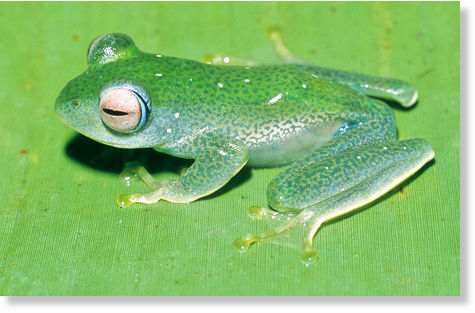
Boophis madagascariensis
PORT LOUIS (Reuters) – Scientists have found more than 200
new species of frogs in Madagascar but a political crisis is hurting conservation
of the Indian Ocean island's unique wildlife,
a study shows.
The discovery, which almost doubles the number of known
amphibians in Madagascar, illustrates an underestimation of the
natural riches that have helped spawn a $390-million-a-year tourism
industry.
However, months of instability culminating in a change of
government after street protests, have compromised gains in
conservation.
"The political instability is allowing the
cutting of the forest within national parks, generating a lot of
uncertainty about the future of the planned network of protected
areas," David Vieites, researcher at the Spanish National Natural Sciences Museum, said in a
statement.
The world's fourth-largest island, known for exotic creatures
such as the ring-tailed lemur and
poisonous frogs, is a biodiversity hotspot.
More than 80 percent of the mammals in Madagascar are found
nowhere else, while all but one of the 217 previously known species
of amphibian are believed by scientists to be native.
"People think that we know which plant and animal species live
on this planet," team member Miguel Vences, professor at the
Technical University of Braunschweig, said in the statement.
"But the centuries of discoveries has only just begun -- the
majority of life forms on Earth is still awaiting scientific
recognition."
Human demands on the land and decades of rampant logging have
destroyed 80 percent of Madagascar's rain forest, threatening
hundreds of species, he said.
The study, carried out by the Spanish Scientific
Research Council (CSIC), and published in the May issue of
the journal Proceedings of the National Academy of
Sciences, suggests the find of between 129 and 221
new species of frogs could double the number
of amphibians globally if the results are extrapolated
worldwide.
Almost a quarter of the new species discovered have not yet been
found in unprotected areas, the study stated.
Madagascar broke away from Africa almost 160 million years ago,
leaving its flora and fauna to
develop in isolation.