5. Millipede

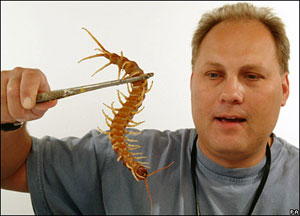
Closely related the centipede, some millipedes emit poisonous
liquid secretions or hydrogen cyanide gas through microscopic pores
on their body. Some of these substances are caustic and can burn
the exoskeleton of ants and other insect predators, and the skin
and eyes of larger predators.
4. Cone Snail

The cone snail has a proboscis which is used for feeding as well as
the launching of its harpoon. The harpoon is a hollow, barbed
organ that acts as the tongue. When ready, the snail will extend
the proboscis towards its prey and with a muscular contraction
will fire the harpoon filled with venom. The cone snails bite is
similar to a bee sting, but the larger species are responsible for
30 known cases of human death.
3. Slow Loris

The Slow Loris is one of the few mammals which is venomous. In
addition, it is the only mammal which is both venomous and
poisonous at the same time. Slow lorises produce a toxin on the
inside of its elbows which it smears on its young to prevent them
from being eaten. In addition it will lick these patches to put the
poison in its mouth, giving it a venomous bite used for self
defense.
2. Komodo Dragon

While they do not technically produce venom, their diet consists of
pretty much anything dead and that creates a special mixture of
deadly bacteria build up in their mouths. Their saliva contains
more than 50 types of bacteria and 7 are highly septic and 4 have
no known specific antidote. However, if treated with powerful
antibiotics, it proves non-fatal to humans.
1. Coral

There are many types of coral and a few of these have toxic
chemicals that are not fully researched yet. The most deadly coral
is the Palythoa. It can kill a rabbit with only a 25 nanogram
injection. To kill a human would only take 4 micrograms. Palytoxin
is considered one of the most toxic organic poisons. Symptoms of
palythoa poisoning include chest-pains, difficulty breathing,
racing pulse and low-blood pressure. Death occurs within minutes,
and there is no treatment.
(source:
The List Universe)