Thyme
Thyme is an invaluable element in the kitchen: it blends with and
enhances many other herbs without overpowering them. Thyme is best
known as one of the primary components in a classic bouquet garni.
When combined with fresh sprigs of parsley and leaves of bay, it
will enliven and give depth to the flavor of soups, stews and
sauces. A native of the sunny Mediterranean hillsides, thyme is
also a key element in the traditional, dried, aromatic blend Herbes
de Provence.

Common types of thyme
While there are over 100 varieties of thyme, all of which are
fragrant to some extent, there are three that have a special place
in the kitchen: lemon thyme (Thymus citriodorus), caraway thyme
(Thymus herba-barona), and common thyme (Thymus vulgaris).
Lemon thyme is a
compact, upright shrub that grows to a height of 12 inches. The
leaves are tiny and heart shaped, ringed with a splash of yellow.
As the name implies, lemon thyme has a bit of a citrus tang, but is
milder than most other thyme. This makes it a natural choice for
seasoning seafood dishes and even sweets. The citrus flavor also
helps to lighten fatty dishes. The natural, volatile oils also work
as a digestive aid. These same pungent oils make lemon thyme a
favorite in aroma therapy for the treatment of asthma.

Caraway thyme,
although difficult to find, makes an intriguing addition to meat
dishes and is especially tasty in combination with garlic and wine.
It is a low-growing variety that forms a dense, dark green mat. It
spreads quickly, making it a good ground cover, especially with its
soft, pink blossoms. Creeping thyme (Thymus
drucei) also called "mother of thyme" or "wild thyme," is another
low-growing variety, more often used for gardening than for
cooking. It is ideal for filling in garden pathways and between
stepping stones in areas of light foot traffic, producing a soft,
fragrant carpet under foot.
Common or garden
thyme (Thymus vulgaris) is the variety with which people are
most familiar. A shrubby perennial that grows six to twelve inches,
its narrow, pale grey, green leaves have a pungent, woody aroma. A
native of the Mediterranean, it grows in areas where there is
plenty of sun and good drainage. Drought conditions tends to
concentrate the oils, producing a more potent herb. When cooking
with thyme be sure to add it early in the process so the oils, and
thus the flavor, has time to be released.
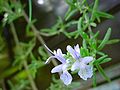
 Flowering garden thyme
History & Uses
The use of thyme has been recorded as far back as 3000 BC when it
was used as an antiseptic by the Sumerians. The early Egyptians
also used thyme as one of the ingredients in their mummification
process.
The hills of Greece are covered with wild thyme, and thyme honey
from the tiny pink and lavender blossoms is plentiful. To the
ancient Greeks, thyme came to denote elegance, and the phrase "to
smell of thyme" became an expression of stylish praise. Thyme was
widely used: medically, in massage and bath oils, as incense in the
temples and as an aphrodisiac. Even the origins of the word thyme
are Greek: from the word thymon meaning "courage."
The Romans also associated thyme with courage and vigor, bathing in
waters scented with thyme to prepare themselves for battle. The
Scottish highlanders of old would prepare a tea of wild thyme for
the same purpose, as well as for warding off nightmares. During the
Middle Ages, European ladies embroidered a sprig of thyme on tunics
for their knights, again as a token of courage.
More recently, noted herbalist Culpeper recommended an infusion of
thyme to relieve "the headaches occasioned by inebriation."
In literature, thyme is often associated with the activities of
fairies. Shakespeare's Oberon, king of the fairies, speaks of
knowing "...where the wild thyme grows." The English variety of
wild thyme referred to has the highest concentration of volatile
oils. Perhaps this accounts for its use as one of the main
ingredients in a 17th century recipe which "enables one to see the
Faeries."
With its elfin leaves, delicate blossoms and subtle, woodsy flavor,
it is easy to see why thyme might be associated with things elusive
and magical, even in the kitchen.