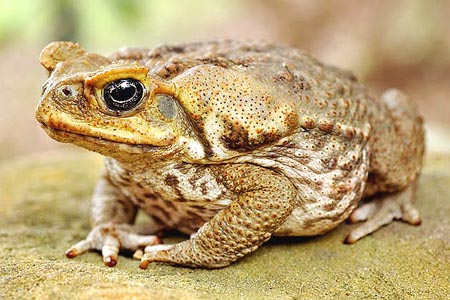
Admire this specimen of calmness and good peripheral awareness,
not to mention a good indicator of environmental change..Learn from
the toad.He teaches many things.. 
This article is an excerpt from Penn State University's Earth:Our
Role research paper.The author,Joseph Kiesecker, Ph.D., is
assistant professor of biology in the Eberly College of
Science
"Amphibians may be indicator species," said Kiesecker, a natural
form of the "canary in the coal mine" warning of environmental
stress. Because of their metamorphic life cycles often, egg to
tadpole (or other water-living larva) to land-based adult
amphibians need both aquatic and terrestrial habitats. Unlike birds
or snakes, they lay eggs without shells. "The only thing protecting
their eggs from the environment is a very thin and permeable
gelatinous matrix." Even as adults, their moist skin, unprotected
by scales or feathers or hair, is very sensitive to its
surroundings.
Amphibians are also key elements in the food chain. Both predator
and prey, they consume great quantities of insects, while
themselves providing the exclusive food of many mammals, birds, and
snakes. In fact, in some places they form the largest component of
vertebrate biomass; that is, taken en masse, more live weight per
acre is due to frogs, toads, salamanders, newts, and caecilians
than to mammals, birds, or reptiles. "Their loss would have an
effect," Kiesecker said.
So when reports of the decline of frogs and toads in relatively
pristine environments such as nature reserves and parks began
accumulating in the late 1980s, ecologists around the world became
concerned. "We know that populations fluctuate naturally,"
Kiesecker said. "But here we were seeing mass mortality losses of
certain species across a wide geographical area." Habitat loss or
the direct effects of pollution could not be the only answer in
such wilderness sites. "The places in the West that have seen
amphibian declines are not places that have overt signs of human
effects. The changes arent obvious, theyre not things we can put
our fingers on. Certain geographical areas seemed to be affected
more than others, and even within those hot spots the declines
didnt appear to be random."
Several of the species lost were new and fascinating to
science. The strikingly colored Golden Toad, for example, was
discovered in the Monteverdean Cloud Forest in Costa Rica in the
mid-1970s. "By the mid-1980s, it was no longer found." A frog
discovered near Queensland, Australia, in 1970 "had an amazing
lifestyle," Kiesecker said. "When Mike Tyler, who discovered it,
described the species, no one would believe him." The female
swallows her eggs and broods them in her stomach until they hatch
and the young emerge from her mouth. "The young release a chemical,
a prostaglandin, that shuts off the mothers digestion," Kiesecker
said. "This frog could have taught us a lot about digestive
disorders, but its no longer found." Since 1970, it has gone
extinct.
"Theres little consensus on the causes of these declines, but
because they are on a global scale, weve started looking at global
causes," Kiesecker said. In addition to habitat loss, suspects
include an increase in ultraviolet radiation due to damage to the
ozone layer by chlorofluorocarbons, changes in patterns of
temperature and moisture, and outbreaks of disease.
"In the few places that have been examined in detail, we see a
complicated mix of factors are responsible." Amphibians are thus a
good example of how difficult it may be to understand how global
climate change will translate into species loss in the
future.