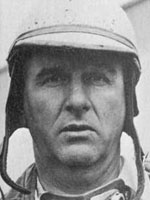
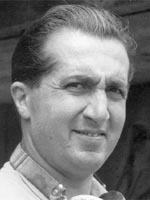
Jack Brabham (AUS) World Champion - 1959-1960, 1966
Grand Prix Starts: 125 Grand Prix
Wins: 14 Pole Positions: 13
Jack Brabham's three world championships were the product of both
his engineering expertise and driving skill. His first two titles,
in rear-engined Coopers he helped develop, confirmed the
obsolescence of front-engined Formula One cars. His third title, in
a Brabham, made him the only driver to become champion in a car of
his own make. For his lifetime achievements, which also included
nurturing the talents of other notable drivers and pioneering the
business side of the sport, he became the first Formula One driver
to receive a knighthood.
John Arthur 'Jack' Brabham, was born on April 2, 1926, in
Hurstville, an Australian town near Sydney where his father was a
greengrocer. From an early age Jack was far less interested in
fruit and vegetables than in the Brabham shop's delivery vehicles.
He learned to drive them long before he was eligible for a licence
and by his early teens he was equally adept at keeping them
roadworthy. His mechanical aptitude led him to a technical college
where he studied practical engineering. Not academically-inclined,
he left school at 15 and went to work in an engineering shop, then
a garage. At 18 he joined the Royal Australian Air Force in
Adelaide, where he wanted to learn to fly but was instead trained
to fill a wartime shortage of flight mechanics. Upon his discharge,
in 1946, an uncle in the construction business built him a workshop
in Sydney, where Jack opened his own engineering
establishment.
In 1951 he married Betty, who became the mother of their three
sons, Geoffrey, Gary and David, all of whom would race, though not
nearly as successfully as their father. Jack's introduction to
motorsport came through a friend who raced midgets on dirt track
ovals. Jack helped him build a new car and when his friend decided
to stop driving Jack took over and became a regular winner. In
self-prepared midgets he won four successive Australian
championships and was the 1953 hillclimb champion in a
British-built Cooper-Bristol. Two years later his growing ambition
to expand his motorsport horizons brought Jack to England. A
meeting with John and Charles Cooper, constructors of his
successful Australian car, led to a friendship and partnership that
would propel the tiny Cooper Car Company and 'Black Jack' Brabham
into the forefront of Formula One history.
With Brabham providing the inspiration (he helped persuade the
Coopers to take the rear-engine route into Formula One racing) and
the perspiration (he built up his first chassis in Cooper's
workshop) the tiny British cars with the engines in the back sped
to the front in an era previously dominated by big, front-engined
Italian and German roadsters. In the Brabham-led team's first full
championship season of 1958 the debut win for a Cooper came
courtesy of Stirling Moss, who drove Rob Walker's private entry to
victory in Argentina. In 1959 Moss won twice, but Brabham's
victories in Monaco and Britain together with his consistently high
placings resulted in the Australian winning a drivers title that
some thought owed more to stealth than skill, an opinion at least
partly based on Brabham's low-key presence.
Always a man of few words - his nickname 'Black Jack' referred to
both his dark hair and his propensity for maintaining a shadowy
silence - he avoided small talk and was undemonstrative in the
extreme. But behind the wheel he was anything but shy and retiring.
He put his head down and drove exceedingly forcefully,
opposite-locking his car dirt-track style, and was not averse to
deliberately showering gravel in the face of a too closely
following pursuer. His aversion for the limelight became more of a
problem in 1960, when he completely dominated the nine-race series,
winning consecutively in Holland, Belgium, France, Britain and
Portugal, en route to his second successive championship.
Following an unproductive 1961 season, when the Ferraris were all
powerful, Brabham left Cooper to form Motor Racing Developments, in
partnership with the talented Australian designer Ron Tauranac. The
MRD Brabhams were quickly successful in several categories of
racing, particularly Formula Two where for several years they
dominated, affording the opportunity for many drivers to advance
their careers. The Brabham Formula One car, which first appeared
late in 1962, became steadily more competitive as the team leader
personally perfected the chassis set-up and fine-tuned the Climax
engines. In 1964 Brabham had the satisfaction of seeing his team
mate Dan Gurney win in France and Mexico.
For 1966, when the new 3-litre formula came into effect, Brabham
persuaded an Australian company Repco (a manufacturer of automotive
components) to produce a Formula One engine from a venerable
Oldsmobile V8 design. Equally ancient was Brabham himself, or so it
seemed to the media and his much younger rivals who used to kid him
about his age. Prior to the 1966 Dutch Grand Prix, his first race
after his 40th birthday, 'Geriatric Jack' Brabham hobbled onto the
starting grid at Zandvoort, wearing a long false beard and leaning
on a cane. Sportingly, several of his laughing opponents helped him
into the cockpit of his Brabham-Repco, which happened to be on pole
position. Tossing aside his beard and cane Brabham proceeded to win
that race, a feat he also accomplished in France, in Britain and in
Germany - on the notoriously difficult and dangerous Nurburgring -
a victory he felt was the most satisfying of his career. Thus in
1966 Brabham became the first (and still only) driver, to win the
championship in a car of his own make.
Brabham also established the precedent for Formula One drivers to
become pilots of their own planes. Though such transport at the
time was exotic, Brabham's tastes remained simple. Distrustful of
foreign fare, he flew his own steaks to the races. His passengers
over the years included a succession of his Brabham team mates
Bruce McLaren, Dan Gurney, Denny Hulme, Jochen Rindt, Jacky Ickx
all of whom benefited from his tutelage and made their mark in
Formula One racing.
Jack Brabham, whose final victory came in the 1970 South African
Grand Prix when he was 44, chose that season to retire as a driver.
The Brabham team was sold to Bernie Ecclestone and Jack returned
home to Australia, where he busied himself running a farm, a car
dealership and an aviation company, and helped his sons with their
racing careers. His contribution to British motorsport was
officially recognised in 1985 and he became Sir Jack Brabham.
Text - Gerald Donaldson
Photo - © Schlegelmilch