No modifications needed, just additions.
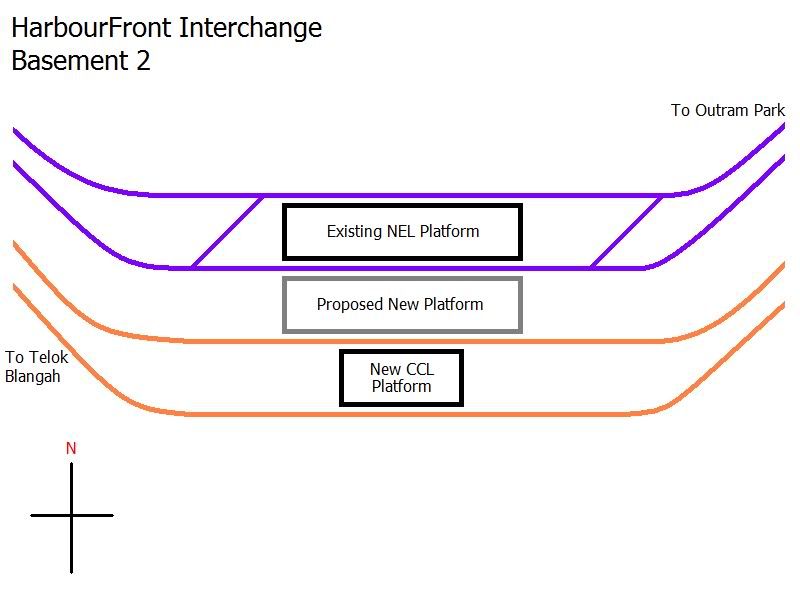
I've tried to make this look to-scale. So anyway, if NEL
continues using Platform A for boarding and alighting during off
peak, passengers will alight on the left for transfer to the CCL,
and alight on the right to exit the station. If it proceeds on to
the TBS and Platform B, allow passengers to stay on the train.
Similarly, CCL will operate the same way, by stopping at its
Platform B. Passengers will alight on the left for transfer to NEL,
and the right to VivoCity. If it proceeds on to the TBS and
Platform A, allow passengers to stay on the train. But if the
crossover before entering the station is a scissors/diamond/tandem
crossing, this method will prove difficult and it may be as dumb as
JEMP.
To add on: This method was used in Hong Kong's Nam Cheong
station to connect the Tung Chung Line with the West Rail Line,
which was built 5 years apart. Too bad LTA didn't plan for this, as
seen on the signboard posted in HarbourFront Centre.
Ok, sounds potentially a solution, but we must look at the fact
how does the track in CCL aligns, where got so swee meh? (Not sure
for me, I dont stay there)
BTW, to improve ur idea, it is unlikely that either SBST or SMRT
would ever allow passengers to stay on a TBS, which I guess that if
it is a off peak hour, then the platform A on NEL would open on
both sides, such that passengers would alight from the left to
transfer CCL, while alighting on the right would go to the Vivo.
All passengers will be allowed to be stayed on the train and no
staff will come and kick your butt out.
If, it is a peak hour, then only left doors of NEL would open,
and the staff will ask everybody to alight, and transfer to CCL /
go to Vivo on the left and for cases that are overstopped, they
have to transfer to another (probably same lah) train via concourse
(Climbing Up & down exercise via esclators / stairs / lifts
....?).
So the CCL will work the same way as well.

