"Mystery girl of
Ubin."
Tan Shzr Ee
The Straits Times, 09 March 2003
(c) 2003 Singapore Press Holdings Limited
An urn in an obscure Pulau Ubin temple, said to hold the remains of
a WWI German girl, has been attracting devotees since the
1930s
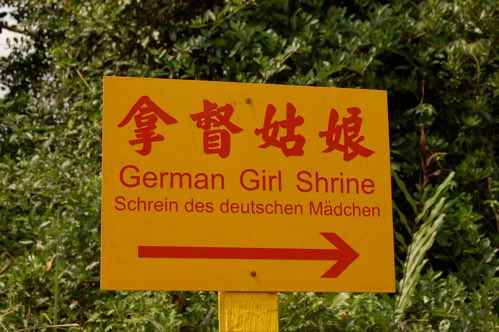
THEY call her the German Girl, or the Nadu Guniang - a
Malay-Chinese appropriation of the words 'Datuk' and 'Miss'.
She makes her home in a yellow shack by an Assam tree, among
carpets of lallang and grass.
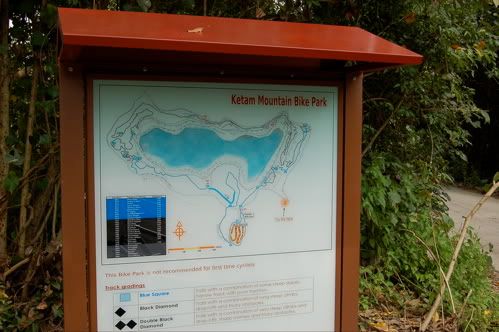
The place: Pulau Ubin's south-western plains, far away from the
cries of cyclists daytripping from the Singaporean mainland, or
other gourmets slurping down prawns by the northern island's
eateries.
All around her wooden hut, the air is dead still. But signs of
human activity show through the lick of flaming candles and smoking
joss-sticks twirling around her altar of an abode every day.
She is dead - and has been dead for more than 80 years.
A trickle of devotees on the island - and across the sea from
Singapore - still meander round to the obscure spot to pay their
respects regularly.
'I've been coming here for years,' says Madam Cheng Xuan Li, 39, a
factory worker who troops down to the site every weekend with her
family, armed with packets of Qoo Grape and floral offerings.
'An old friend told me about this temple. I have prayed for things,
and have received them. It's only right that I return the
favours.'
She is not the only visitor. Pulau Ubin resident Chye Leng Keng,
74, reveals that worshippers from as far as Thailand and Myanmar
have come to pay homage as well, over the years.
Throughout his entire life, the old man and his wife have been
living in a corrugated-iron hut, stapled together with age and
dust, only footsteps away from the temple.
He is the key witness to the strange proceedings that take place
every time devotees troop in to worship the deity.
'People come, sometimes with mediums who claim to speak German, and
they ask for all sorts of things,' he says.
'They pray for health. They ask for Toto and 4D numbers.'
But the story began even before Chye himself was born.
Local folklore goes that the girl was the daughter of a coffee
plantation manager who lived near the present temple site in the
early 20th century.
At the end of World War I, British soldiers rushed in to intern her
parents but she was said to have escaped through the back
door.
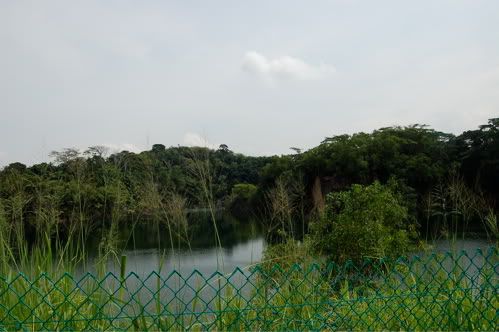
In her haste, she fell into a quarry behind the coffee complex,
stumbling to her death.
Her corpse was discovered by Boyanese plantation labourers, who
threw sand over her body and offered prayers, flowers and incense
as a gesture of goodwill each time they passed her.
Eventually, a group of Chinese workers on the island carted her
remains to the crest of the quarry's hill and gave her a proper
burial.
'How she became a temple of worship - I have no idea,' says Chye
who used to work in a shipyard and has three grown-up children
living on the mainland.
'The workers had probably been treated well by her parents, and
maybe did what they did as a gesture of thanks.'
Whatever the long-winded route the German Girl's tale took to
become reincarnated into its present-day myth, worshippers and Toto
punters have not stopped coming.
From the 1920s to the 1970s, they left a trail of bananas and soft
drinks on the burial ground for Chye to steal - as a hungry
teenager and, later, as a cheeky old man up to nosey antics.
'I'm not pantang (superstitious),' he says proudly.
'I don't believe in all this ghost talk. I've never seen one in my
70 years in this place.'
In 1974, the grave was exhumed to make way for quarry excavation
work and relocated to its present spot near Chye's hut.
He remembers playing kaypoh at the dig, sticking his head in the
crowd to see a rusty cross and a few strands of hair recovered from
the grave. These were apparently transferred to an expensive
Jiangsu urn, bought for the ritual of ash-transferring by quarry
company Aik Hwa.
Today, the supposed urn - a heavy white jar decked with tattered
scarves - sits upright on a dust-caked altar strewn with a
battleforce of eerie feminine tributes: hair brushes, nail polish,
powder, Safflower Oil, Florida Water, Hazeline Snow and the odd
tube of Revlon lipstick.
Newer displays - red packets rolled into tokens used for casting 4D
numbers - bear imprints as fresh as this year's Powerpuff Girl ang
pow logos.
A red medium's table and chair sit quietly in another corner,
adjacent to the altar.
For all the fuss over the urn, Chye swears that it is actually only
a replica of the original 1974 pot, which he believes to have been
stolen by vandals simply for its beautiful Jiangsu design.
'It doesn't look the same as the one I'd seen. But people still
worship it,' he says.
'Anyway, Singaporeans are strange. It's ironic that this German
girl - a Roman Catholic going by her crucifix - should become some
kind of Taoist deity for all these Chinese punters.'
The mystery has not only intrigued him but also caught on with two
curious filmmakers. Ho Choon Hiong, 28, and Michael Kam, 34,
stumbled across the temple while making a documentary on Pulau
Ubin's nine temples and 11 shrines in 2000.
They have done the extra legwork of tracking down the former coffee
plantation's 19th-century land deeds to a certain Daniel Brandt and
Hermann Muhlingans of Germany.
But beyond these two names, they have failed to unearth further
information on the supposed girl or her parents. Further enquiries
with the German Club and other sister organisations here have drawn
a blank.
A Sunday Life! check with the Singapore Land Authority and the
National Archives similarly revealed nothing.
Yet Ho, who has been tracking this temple (below) for two years,
does not intend to give up - not least when there is talk that it
may be torn down to make way for expansion of the Outward Bound
School nearby.
'I'm just hoping that it can be preserved or saved in some way,
even if the land were to be taken over,' he says.
'One day, I want to find out who the German girl really was and
what she looked like,' he adds.
For now, however, he is content to unravel the other mystery behind
the urn: whether it contains the ashes of anything vaguely,
formerly human, or, as Chye insists, is simply a replacement vessel
for the Jiangsu original.
Balancing on a stool and blowing dust off the stacks of offerings,
the intrepid Ho scales the altar on bended knee. He pries nervously
at the lid of the porcelain jar.
'I have a clear conscience,' he says with a grin. 'Nothing to be
afraid of.'
The big moment arrives: The lid is cranked open.
The urn contains nothing.
Nameless, faceless, speechless - and now, formless.
Why would anybody still worship an empty pot? But adamant devotee
Madam Cheng insists: 'Ah, but that's exactly why she's a deity.
She's invisible but everywhere, like Tua Pek Kong. Her power is
omnipresent.'