CONTINUED FROM 1ST POST.....
Yet to the fisherman around the coast of Newfoundland, they are
simply a threat to local fish stocks; a menace to be eradicated by
any means possible.
I wish I could say such callous indifference was surprising. But
even before I had been flown over the ice, the hypocrisy of the
Canadian government had already prepared me for what lay
ahead.
Before I was allowed to enter Canada, I had to sign a special visa
form which stated that I would not "touch or pick up" a seal,
because that would make it stressed. (I wonder what smashing its
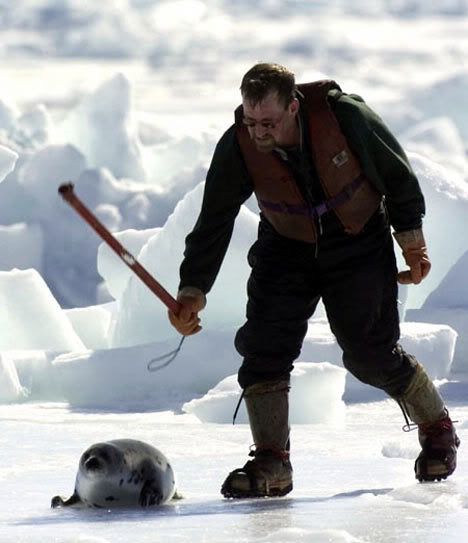
skull with a 'hakapik' - a club with a useful spike on the end -
would make it?)
I also had to agree that I would not try to rescue an injured seal.
(Last year, on a visit to Newfoundland to protest against the cull,
Sir Paul McCartney had to return home before the killing started
because he couldn't trust himself not to intervene.)
I even had to agree to keep 20 metres away from the
fishermen.
I don't know who this last edict was meant to protect - them, or
me?
Last year, an angry mob, made up mostly of the wives of the
fishermen, attacked an animal welfare vehicle monitoring the cull
and forced it off the road.
Such is local resentment towads those who publicise the slaughter
that, on leaving the helicopter, I was warned to hide my notebook
and camera in case locals got wind of the fact I was a
journalist.
It seems our pilot had been very brave to fly us out over the
ice.
Yet last week, the Canadian government was busy trying to persuade
the world that the hunt was humane and necessary and
sustainable.
An 11-strong delegation, headed by special ambassador Loyola
Sullivan, travelled to the EU to plead their case, before turning
up at Westminster to meet MPs. (Britain, unlike Italy, Belgium and
Luxembourg, has yet to impose a ban on seal products.)
Sullivan was full of platitudes, stressing the hunt was no more
cruel than an abattoir, and pointing out that very young seals can
no longer be killed.
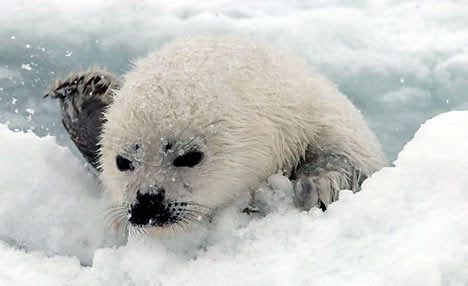
Although it is true that the killing of "white coats" - newborn
pups with thick, white fur - has been banned since 1983, a pup can
still be slaughtered when it is only 12 days old, just as it starts
to moult (these are called "ragged jackets"; or when it is a
"beater" (still under four weeks old and unable to swim
properly).
But because the hunt is so remote, it is impossible to regulate or
monitor. The atrocities that take place are almost too horrendous
to document.
Although some pups are shot, the vast majority are clubbed. This is
because clubbing is cheaper and doesn't spoil the quality of the
pelt.
Even in good condition, a pelt is worth just $US 78 (£36). Yet so
many are slaughtered that for the fishermen in Newfoundland, the
annual cull nets £13 million.
Pelts are exported to Norway, Russia, China and South Korea to be
made into fashion garments that are sold all over the world.
But because public hostility is growing towards the seal cull,
unscrupulous dealers often deliberately mislabel seal fur, claiming
it is rabbit, or even fake fur.
One thing is certain: with demand for fur of all kinds running high
on the back of its renewed popularity on the catwalk, the Canadian
fishermen can be sure of a vibrant market for this year's "harvest"
- though with pups so few in number, the competition between
fishing boats will be fierce, resulting in even more frenzied
killing.
I ask the animal welfare observers accompanying me, who have
witnessed such scenes many times before, to tell me which aspect of
the slaughter they find most distressing.
One tells me how she has witnessed pups being dragged by hooks
across the ice, and once saw a pup take 45 minutes to die after
being clubbed on the head.
"She was on the ice, just gurgling and crying, and there was
nothing we could do to intervene."
Another described how, when the hunt begins, the female seals all
try to keep an eye on their babies until fear drives them into the
water.
Once the boats have gone, they all come back onto the ice, calling
for their pups.
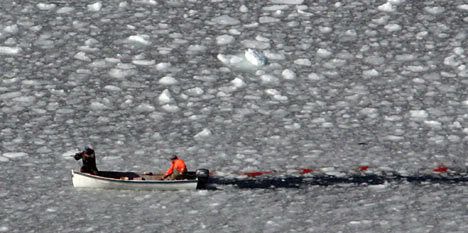
They waddle up to the huge, steaming pile of offal that is left to
rot on the ice (seal blubber is virtually worthless), and they
actually sort gently through the bodies, trying to find their
babies.
"The sound the mothers make is so terrible, so plaintive, it haunts
you for ever," she said. Perhaps the sound of the mothers wailing
should be played at the next fashion show given by the likes of
Christopher Bailey at Burberry, or Julien Macdonald, or Karl
Lagerfeld, or even our own Amanda Wakeley.
These designers will protest that they don't use seal fur - only
silver fox or mink.
That's not the point.
By using animal fur of any kind, they make this sort of brutality
acceptable and chic and normal, and lovely and desirable.
Having witnessed the seals' desperate situation first-hand, I can
vouch it is no such thing. It is utterly repellent.
For information on what you can do to stop the commercial seal
hunt, visit www.protectseals.org or www.hsus.org