source:
http://www.kungfucinema.com/reviews/revengeofthekungfumaster
.htm
Revenge of the Kung Fu Master [TV] (1994)
AKA: Kung Fu Master Hung Hei Kwun; The Kung Fu Master II
Premise: The latter two-thirds of the truncated Kung Fu Master
television series tells the story of how Han kung fu masters led by
Hung Gar founder Hung Hei-kwun (Donnie Yen) emerge from the ashes
of Southern Shaolin to fight Wu Dang master Pai Mei and the ruling
Qing empire.
Review: Revenge of the Kung Fu Master is the latter two-thirds of a
30-hour ATV television series edited down to approximately six
hours by Tai Seng and released on two separate two-disc DVD sets.
This is one of the most ambitious and popular martial arts series
ATV ever aired, second only to their follow-up, Fist of Fury.
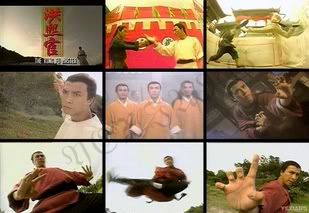
Donnie Yen (Iron Monkey, Hero) stars as the famed founder of Hung
Gar, Hung Hei-kwun and acts as action director, while filmmaker
Benny Chan (New Police Story) directs. This professional filmmaking
talent, a large amount of traditional-style kung fu action, solid
acting, and good production values for a Hong Kong TV series all
make this show well worth taking the time to see, either in this
edited and subtitled form or in the unedited and non-subtitled
version available only on VCD.
The Kung Fu Master series is the story of Hung Hei-kwun, a
legendary figure in kung fu lore who is responsible for the
founding of Hung Gar kung fu which is practiced to this day. He was
also a secular student of Shaolin and Ming patriot who joined the
failed rebellion against the ruling Qing government. Revenge of the
Kung Fu Master picks up with Hei-kwun and his friends Ko Chun-chung
(Lawrence Yan) and Chi-gun entering Shaolin Temple in hopes of
improving their kung fu and continuing their struggle against the
Qing. Here they meet the mischievous Fong Sai-yuk (Nick Cheung
Ka-fei) and Wu Wai-kin who sneaks in to steal a kung fu manual.
After leaving Shaolin, they join Wing Chun founder Yim Wing-chun
(Erica Choi) and Hei-kwun's father Ting-lam (Poon Chi-man) to
resume their fight against the Qing and their allies from Wu Dang
Mountain. Eventually, Chun-chung becomes a traitor who sides with
the Qing, Wu Dang leader Pai Mei (White Brows) emerges to challenge
both the rebels and the throne, and Shaolin Temple itself is
threatened. With the help of his father, Hei-kwun struggles to
combine his family kung fu style with his Shaolin teachings in
order to create the Hung Fist technique and challenge Pai Mei and
his traitorous friend.
This series should be of prime interest to anyone interested in
kung fu folklore. It deals entirely with real Southern Chinese folk
heroes, no doubt in circumstances exaggerated and warped by time
and countless retellings, but fascinating nevertheless. Classic
kung fu buffs will recognize the fight between Hung Hei-kwun and
Pai Mei from Shaw Brothers' Executioners from Shaolin (1976). Fong
Sai-yuk was made famous by Jet Li's portrayal in Fong Sai Yuk
(1993) and its sequel, but this popular character has been around
for years. Chang Cheh's Shaolin Temple (1976) features Sai-yuk as
played by Alexander Fu Sheng and all the rest of the heroes who
trained at the Southern Shaolin Temple before it was burned down.
Li also played Hei-kwun in Wong Jing's oddball film The New Legend
of Shaolin (1994).
As a television version of this legend, the series gets a dramatic
boost while maintaining heavy action, although Tai Seng's
compressed version omits a lot of the non-action scenes where
character development occurs. Like The Kung Fu Master, Revenge
feels a bit rushed and obviously has gaps. However, there is enough
of the core story development to follow along. The main draw is the
action, mostly choreographed by Donnie Yen. Power powder is
overused and some of the sparring is chaotic, but Donnie gets good
performances out of mostly non-martial arts stars who work
primarily on TV productions. Donnie himself is in his prime and is
in great form. As Bey Logan points out in his commentary, Donnie
does a spectacular job of representing the Hung Gar style towards
the series' end. A lot of the action mimics the style Donnie dealt
with while working with Yuen Wo-ping on Iron Monkey and it's a
testament to his skill that he is able to translate feature
film-quality action to the small screen on a budget and with less
time per action scene. Donnie also gets credit for delivering a
solid acting performance, something he rare gets a chance to do in
film. There is a powerful scene where he is forced to watch his
internally-wounded father perform a series of kung fu movements,
knowing full well that doing so will only worsen his
condition.
A treat is seeing the character of Pai Mei, who comes across as a
Wu Dang god with iron skin, unrivaled kung fu (until the Hung Gar
style appears) and a look that could freeze the hearts of his
enemies (figuratively). Lo Lieh is synonymous with the role, but
the aged TV actor who portrays Pai Mei does a magnificent job. On
the topic of Lo Lieh, this veteran actor also appears in the series
as a Qing general. It's a minor, mostly non-action role, but it's
always nice to see old screen legends of his stature at work.
As stated previously, the production values are good by ATV
standards. Yet they are still poor by movie standards. Hairnets,
hairpiece seams, and occasionally cheap-looking sets and costumes
are impossible to ignore. The burning of Shaolin is underwhelming
and the Beta camera work gives everything a slightly artificial
look. Viewers should still cut the makers a little slack. A lot of
time and effort still went into the production and its strengths
which include an engaging plot, good acting from mostly TV actors
and Donnie's choreography balance out the rough spots.
As their first attempt at editing a TV series, Tai Seng did a poor
job with Fist of Fury, but they did much better with the previous
Donnie Yen series. It's recommended that The Kung Fu Master be
watched first, followed by Revenge of the Kung Fu Master. If there
was only one kung fu TV series from Hong Kong to watch, this might
be it. -
- Mark Pollard