Welcome to the year of the tablet. Again.
Last year was supposed to be the year manufacturers would wow
consumers with offerings of all sorts of tablet computers. Steven
A. Ballmer, Microsoft's chief executive, took the stage in January
at the International Consumer Electronics Show, the industry's
premier trade show, and displayed three devices that he said would
be on sale in the months ahead. Dozens of smaller companies laid
out their own tablet plans at the show.
But few of these promises came to fruition; none of Microsoft's
tablets ever showed up in stores.
Instead, in April, Apple's iPad came out. And the year became
the Year of the iPad.
This year, manufacturers are promising it will be different,
saying that after the success of the iPad, they have learned a lot
about what consumers want in a tablet.
"We could have done this a year ago and rushed it out, but it
wouldn't have had the right features," said Phil Osako, director of
product marketing at Toshiba, which is introducing a new tablet at
this year's show, which begins Thursday in Las Vegas.
Perhaps the most important feature is the ability to watch
high-quality video, say industry analysts, pointing to market
research showing that, above all, consumers want to use tablets for
all kinds of media consumption -- watching films, looking at and
sharing photographs, playing games.
"Apple competitors' first instinct was to build a cheaper device
and put a cheaper processor in it," said Sarah Rotman Epps, an
analyst with Forrester Research, a market research firm. "The
problem with that is that it wouldn't have been as good for the
video screens."
At this year's show, Research In Motion and Hewlett-Packard are
expected to show off tablet computers, while scheduled appearances
by executives at Motorola and Microsoft are widely thought to be
coming-out parties for their company's devices.
Mr. Ballmer is to give the keynote address in Las Vegas on
Wednesday, the eve of the show; some analysts and bloggers have
described this as a do-over of last year.
And on the show floor this year, manufacturers whose primary
expertise rests in cellular phones, personal computers and even
televisions are planning to display their first forays into the
tablet market.
At the same time, industry analysts say demand for these devices
is poised to spike. More than 24 million tablet computers are
projected to be sold in the United States this year, up from 10.3
million in 2010, according to Forrester. IDC, another research
firm, expects to see 42 million tablet sales worldwide in 2011.
As of October, Apple had sold 7.46 million iPads worldwide,
according to the company's last reported figures. It had virtually
no competitors all year, until the Samsung Galaxy Tab became
available in November. Samsung says it has sold 1.5 million Galaxy
Tabs since then.
How do the competitors catch up?
Many companies are withholding the specifics of their tablets
until they are formally introduced. But those who have discussed
their plans say they will both offer specific features that the
iPad is lacking, and undercut their competitors on price.
Mr. Osako from Toshiba said Apple's experience over the last
year has helped his company by creating demand for tablets while
Toshiba fine-tuned its plans. Toshiba's tablet, which will run on
Google's Android operating system, resembles an iPad with a grippy
rubberized backing. The company has incorporated features it has
developed for its laptops, like stereo speakers and a screen that
adjusts in contrast depending on the lighting. Both of those
features will make it more comfortable for consumers to watch
video.
Mr. Osako also listed features unavailable on the iPad, like
front- and back-facing cameras, ports for H.D.M.I. hookups and SIM
cards, and the ability to run Adobe Flash.
"We really view this as the next revolution," he said.
Other companies are looking to distinguish themselves by price.
Enspert, a Korean manufacturer that is already selling tablets in
Korea, is planning to introduce an Android tablet with a seven-inch
screen for under $350 at the show, and sell it in the United States
this year. By the end of the summer, the tablet, the Identity Tab,
will also be available with a data plan through a major wireless
carrier for about $100, Bobby Cha, the company's chief marketing
officer, said in a telephone interview.
Mr. Cha said technology consumers pay a heavy premium for
familiar brand names, creating opportunity for little-known
companies with similar products.
"The market is open to everybody, so we know where everybody
stands," he said. "Apple changed the market dynamics, but we're
going to occupy a price point that is much more appealing to the
American mass-market customer."
Creating similar products for much lower prices may be difficult
because the iPad has conditioned customers to expect a device that
is both relatively light and powerful enough to display
high-quality media, said Mark Donovan, an analyst with comScore, a
market research organization. But he also said that success would
be determined largely based on the software that the devices run,
and not only on the number of features that manufacturers can pack
into the hardware.
The tablet market is shaping up to resemble the smartphone
market, in which a few companies, like Apple, Research In Motion
and Microsoft, design their own operating systems, while many
others design hardware that runs on Google's Android operating
system.
Perhaps the companies best positioned to succeed are those that
make cellphones, several analysts who follow the market said.
Handset makers already have relationships with wireless carriers,
which can hide the full price of devices by subsidizing them when
consumers also purchase data plans.
Many manufacturers are focusing solely on creating hardware that
will run on Google's Android operating system. In part, companies
were delayed last year because they were waiting for updated
versions of Android that would be designed specifically for tablet
computers. That wait seems to be over.
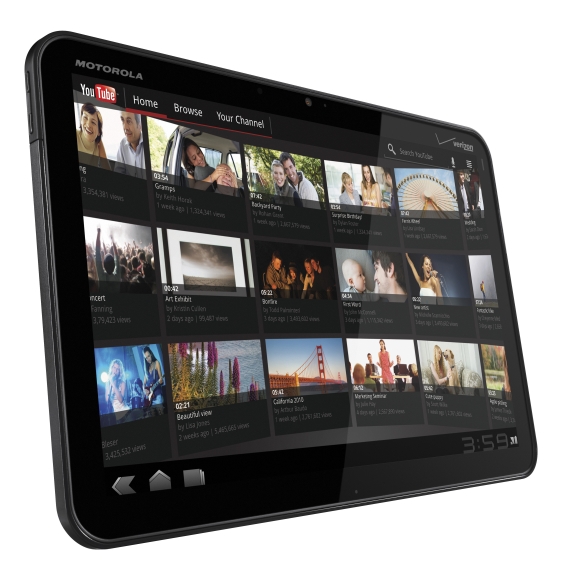
Devices can already run Android 2.3, known as Gingerbread, and
Android 3.0, known as Honeycomb, is scheduled to be available this
year. Andy Rubin, vice president for engineering at Google, showed
a prototype of a Motorola tablet running the operating system at a
conference in December.
Apple's experience with the iPad has also shown that consumers
place a high value on the number and quality of apps. And so no
matter how good tablets look in Las Vegas at the electronics show,
the competition will continue as developers begin to write apps for
the various devices.
"You can build these devices, which is great, but it's no longer
enough to say, 'O.K., you have the Internet,' " said Mr.
Donovan of comScore. "You need developers."
CEO Steve Ballmer said Microsoft needs to do better in the
market for tablet computers that Apple has found success in with
the iPad.
Microsoft is teaming up with nearly two dozen hardware makers to
release Windows-based tablet computers, Microsoft chief executive
Steve Ballmer said Monday, devices like Apple's popular iPad."This
year one of the most important things that we will do in the smart
device category is really push forward with Windows 7-based slates
and Windows 7 phones," Ballmer said.
Trefis submits: According to a New York Times report, [1]
Microsoft (MSFT) is expected to unveil tablet PCs utilizing a
customized form of its Windows 7 operating system at the 2011
Consumer Electronics Show in Las Vegas. According to the report,
the tablet devices will be built by Samsung and Dell (DELL), and
will feature Windows OS.
Is this the secret weapon in Microsoft's battle against Apple
and Google for the tablet market?
Apple will see no iPad competition from Microsoft for at least
one year, thanks to Microsoft's relia
Apple's tablet is for consumers. Microsoft should aim for
business users.
Michael Comeau submits:The Apple (AAPL) iPad is the most
important consumer-electronics device released in 2010. Overcoming
media skepticism towards its usefulness, the iPad’s brilliant
design and friendly-user experience captured the hearts of hordes
of consumers - 4.5 million a quarter, according to Bernstein
Research.
A Microsoft slate to counter Apple’s popular iPad tablet
computer will be seen by the Christmas holiday, Microsoft’s Chief
Executive Steve Ballmer said on Tuesday
Microsoft chief executive Steve Ballmer said Thursday that
developing Windows-based tablet computers and getting them to
market is "job one urgency" for the US software giant."We have got
to make things happen with Windows 7 on slates," Ballmer told
financial analysts at Microsoft headquarters in Redmond,
Washington, during a meeting that was streamed live on the Web."It
is job one urgency around here, nobody's sleeping at the switch,"
he said of developing rival devices to Apple's popular iPad.
Microsoft Chief Executive Steve Ballmer said Thursday that the
software giant is urgently working with its partners to unveil a
host of tablet computers running Windows 7, to compete with Apple's
fast-selling iPad.