Galactic collision captured in stunning
detail
When galaxies collide
By Lucy Sherriff
Tuesday 17th October 2006 13:05 GMT
Astronomers using the Hubble Space Telescope have snapped the most
detailed image ever of a pair of colliding galaxies, known as the
Antenna galaxy.
The galaxies are the nearest merging pair to Earth, and the
youngest too: the collision began about 500m years ago. As the two
galaxies smash into one another, they create ideal conditions for
new stars to be born. And new stars are forming in their
billions.
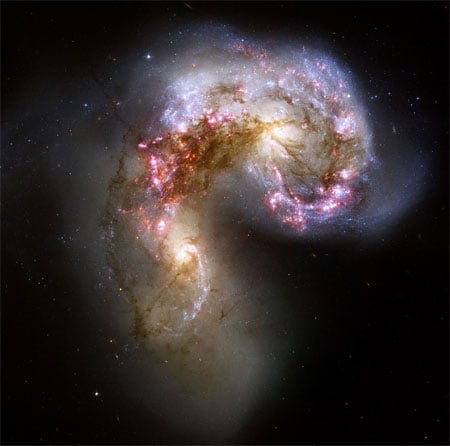
So what are you looking at in that picture? (For a larger image,
click here.)
Well, according to the NASA boffins:
"Nearly half of the faint objects in the Antennae are young
clusters containing tens of thousands of stars. The orange blobs to
the left and right of image centre are the two cores of the
original galaxies and consist mainly of old stars criss-crossed by
filaments of dark brown dust. The two galaxies are dotted with
brilliant blue star-forming regions surrounded by pink hydrogen
gas."
The new images from Hubble are helping astronomers sort out which
bright spots are what. For instance, the brightest blobs are the
biggest and most compact clusters, known as super clusters. But
some of the bright spots are also solo stars.
The majority of the super clusters will eventually disperse, adding
their residents to the general background of the galaxy. Some,
around 100 of the very biggest, will manage to stick together,
forming globular clusters, like the ones in our own Milky Way
galaxy.
Speaking of the Milky Way, it is worth noting that the astronomers
are also watching this collision to get a better idea of the fate
that awaits our own galaxy, which is likely to collide with the
(cosmically) nearish Andromeda galaxy in about six billion years
time.


