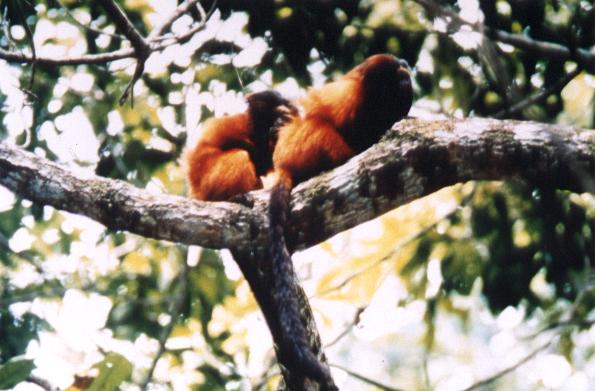
The black-faced lion tamarin has a golden body and a black face.
Its head and body length is approximately 30 cm (12" ), and it
weighs approximately 600 g (21 oz). This lion tamarin prefers
primary lowland coastal forest (restinga), where it eats fruit,
insects, nectar and plant exudates. It is arboreal and diurnal.
Black-faced lion tamarins occur in groups of 2 - 11, with an
average of 5 members per group.
The black-faced lion tamarin was first documented by Western
science in 1990 on the island of Superagui, Brazil. By 1995,
surveys revealed that it occurred on Superagui and adjacent parts
of the mainland in the states of Parana and Sao Paulo, Brazil. Its
available habitat totals approximately 17,300 hectares (68 sq mi).
The black-faced lion tamarin is threatened by the development of
tourism, the harvesting of palm hearts, and further deforestation
to provide more land for cattle ranching.
Scientific Name: Leontopithecus
caissara
Full Taxonomy:
http://animaldiversity.ummz.umich.edu/site/accounts/classification/path/Leontopithecus_caissara.html#Leontopithecus%20caissara