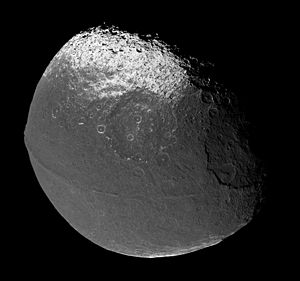
Iapetus (eye-ap'-ə-təs, IPA /aɪˈæpətəs/, Greek
Ιαπετός is the third-largest moon of Saturn,
discovered by Giovanni Domenico Cassini in 1671. Iapetus is best
known for its dramatic 'two-tone' coloration, but recent
discoveries by the Cassini mission have revealed several other
unusual physical characteristics. These mysteries are currently
under investigation by scientists and new information about Iapetus
is accumulating continuously.
Iapetus is named after the mythological Iapetus. It is also
designated Saturn VIII.
Giovanni Cassini named the four moons he discovered (Tethys, Dione,
Rhea and Iapetus) Lodicea Sidera ("the stars of Louis") to honour
king Louis XIV. However, astronomers fell into the habit of
referring to them and Titan as Saturn I through Saturn V. Once
Mimas and Enceladus were discovered, in 1789, the numbering scheme
was extended to Saturn VII.
The names of all seven satellites of Saturn then known come from
John Herschel (son of William Herschel, discoverer of Mimas and
Enceladus) in his 1847 publication Results of Astronomical
Observations made at the Cape of Good Hope ([2]), wherein he
suggested the names of the Titans, sisters and brothers of Cronos
(the Greek Saturn), be used.
The orbit of Iapetus is somewhat unusual. Although it is one of
Saturn's largest moons, it orbits much farther from Saturn than the
next closest major moon, Titan. It has also the most inclined
orbital plane of the regular satellites; only the irregular outer
satellites like Phoebe have more inclined orbits. The cause of this
is unknown.
Because of this distant, inclined orbit, Iapetus is the only large
moon from which the rings of Saturn would be clearly visible; from
the other inner moons, the rings would be edge-on and difficult to
see.
The low density of Iapetus indicates that it is primarily composed
of ice, with only a small amount of rocky materials.
Furthermore, the overall shape of Iapetus is neither spherical nor
ellipsoidunusual for a large moon; parts of its globe appear to be
squashed flat, and its unique equatorial ridge (see below) is so
high that it visibly distorts the moon's shape even when viewed
from a distance. Scientists are currently unable to describe
Iapetus's shape perfectly as the Cassini probe has not yet imaged
its entire surface. [3]
Iapetus is a heavily cratered body, and Cassini images have
revealed large impact basins in the dark region, at least three of
which are over 350 km wide. The largest has a diameter over 500 km;
its rim is extremely steep and includes a scarp over 15 km
high.
[edit]
Two-tone coloration
In the seventeenth century, Giovanni Cassini observed that he could
see Iapetus only on one side of Saturn and not on the other. He
drew the conclusion that one side of Iapetus was darker than the
other, a conclusion confirmed by images from the Voyager and
Cassini spacecraft.
The difference in colouring between the two Iapetian hemispheres is
striking. The leading hemisphere is dark (albedo .03.05) with a
slight reddish-brown coloring, while most of the trailing
hemisphere and poles is bright (albedo .5-.6, almost as bright as
Europa). The pattern of coloration is analogous to a spherical
yin-yang symbol. The dark region is named Cassini Regio, and the
bright region Roncevaux Terra.
The origin of this dark material is not currently known, though
several theories have been proposed (see below). Its thickness is
also unknown; there are no bright craters present on the dark
hemisphere, so if the dark material is thin it must either be
extremely recent, or constantly renewed, as otherwise a meteor
impact would have punched through the layer to reveal brighter
underlying material.
When NASA's Voyager 2 flew past Iapetus on August 22, 1981 at a
relatively distant 966,000 km (600,000 mi), the spacecraft's
cameras could make out few details in the area of dark material,
but revealed the bright side to be icy and heavily cratered. On
December 31, 2004, the Cassini spacecraft passed within 123,000 km
(77,000 mi) of Iapetus and photographed Cassini Regio at far a
higher resolution than Voyager was able, but the mystery
surrounding its origin has only deepened.
Cassini is scheduled for a much closer approach on September 10,
2007 1,200 km (800 mi).