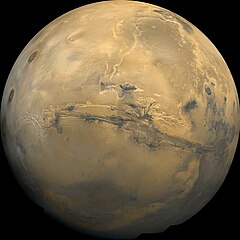
Earth passes Mars every 780 days (or two years plus seven weeks
and one day) at a distance of about 80,000,000 km. However, this
varies because the orbits are elliptical. To a naked-eye observer,
Mars usually shows a distinct yellow, orange or reddish colour, and
varies in brightness more than any other planet as seen from Earth
over the course of its orbit, due to the fact that when furthest
away from the Earth it is more than seven times as far from the
latter as when it is closest (and can be lost in the Sun's glare
for months at a time when least favourably positioned). At its most
favourable times which occur twice every 32 years, alternately at
15 and 17-year intervals, and always between late July and late
September Mars shows a wealth of surface detail to a telescope.
Especially noticeable, even at low magnification, are the polar ice
caps.
The "Ares Vallis" area as photographed by Mars Pathfinder (click
for detailed description).On August 27, 2003, at 9:51:13 UT, Mars
made its closest approach to Earth in nearly 60,000 years:
55,758,006 km (approximately 35 million miles) without Light-time
correction. This close approach came about because Mars was one day
from opposition and about three days from its perihelion, making
Mars particularly easy to see from Earth. The last time it came so
close is estimated to have been on September 12, 57,617 BC.
Detailed analysis of the solar system's gravitational landscape
forecasts an even closer approach in 2287. However, to keep this in
perspective, this record approach was only an imperceptibly tiny
fraction less than other recent close approaches that occur four
times every 284 years. For instance, the minimum distance on August
22, 1924 was 0.37284 AU, compared to 0.37271 AU on August 27, 2003,
and the minimum distance on August 24, 2208 will be 0.37278
AU.
A transit of the Earth as seen from Mars will occur on November 10,
2084. At that time the Sun, the Earth and Mars will be exactly in a
line. There are also transits of Mercury and transits of Venus, and
the moon Deimos is of sufficiently small angular diameter that its
partial "eclipses" of the Sun are best considered transits (see
Transit of Deimos from Mars).
The only occultation of Mars by Venus to be observed was that of
October 3, 1590, seen by M. Möstlin at Heidelberg
Dozens of spacecraft, including orbiters, landers, and rovers, have
been sent to Mars by the Soviet Union, the United States, Europe,
and Japan to study the planet's surface, climate, and geography.
Roughly two-thirds of all spacecraft destined for Mars have failed
in one manner or another before completing or even beginning their
missions. Part of this high failure rate can be ascribed to
technical problems, but enough have either failed or lost
communications for no apparent reason that some researchers
half-jokingly speak of an Earth-Mars "Bermuda Triangle" or of a
Great Galactic Ghoul which subsists on a diet of Mars probes, or of
a Mars Curse.
Among the most successful missions are the Mars probe program, the
Mariner and Viking programs, Mars Global Surveyor, Mars Pathfinder,
and Mars Odyssey. Global Surveyor has taken pictures of gullies and
debris flow features that suggest there may be current sources of
liquid water, similar to an aquifer, at or near the surface of the
planet. Another possible origin proposed for these gully features
is transient melting of surface water snow, frost, or ice. Mars
Odyssey determined that there are significant deposits of water ice
in the upper meter or so of Mars' regolith within 30° of the north
and south pole.
In 2003, the ESA launched the Mars Express craft consisting of the
Mars Express Orbiter and the lander Beagle 2. Attempts to contact
the Beagle 2 failed and it was declared lost in early February
2004
Also in 2003, NASA launched the twin Mars Exploration Rovers named
Spirit (MER-A) and Opportunity (MER-B). Both missions landed
successfully in January 2004 and have met or exceeded all their
targets; while a 90-day nominal mission was planned, as of December
2005, their missions have been extended twice and they continue to
return science, although some mechanical faults have occurred.
Among the most significant science return has been evidence of
liquid water some time in the past at both landing sites. In
addition, dust devils imaged from ground-level have been detected
moving across the surface of Mars by Spirit (MER-A). Dust devils
have even passed over the Rovers, cleaning the solar panels in the
process (see picture below). Dust devils were first imaged on Mars
from the surface by Mars Pathfinder.
Some evidence suggests that the planet once was significantly more
habitable than today, but the question on whether living organisms
ever actually existed there is an open one. Some researchers think
that a certain rock which is believed to have originated on Mars -
specifically, meteorite ALH84001 - does contain evidence of past
biologic activity, but no consensus about these claims has been
achieved so far and recent research indicates that the rock, since
its creation several billion years ago, has never been exposed to
temperatures for extended periods of time that would allow for
liquid water.
The Viking probes carried experiments designed to detect
microorganisms in Martian soil at their respective landing sites,
and had some positive results, later denied by many scientists,
resulting in ongoing controversy. Also, present biologic activity
is one of the explanations that have been suggested for the
presence of traces of methane within the Martian atmosphere, but
other explanations not involving life are generally considered more
likely.
If colonization is going to happen, Mars seems a likely choice due
to its rather hospitable conditions (compared with other planets,
it is most like Earth).