Earth, also known as Terra, and Tellus mostly in the 19th
century, is the third-closest planet to the Sun. It is the largest
of the solar system's terrestrial planets, and the only planetary
body that modern science confirms as harboring life. Scientific
evidence indicates that the planet formed around 4.57 billion
(4.57×10⁹) years ago, and shortly thereafter (4.533 billion years
ago) acquired its single natural satellite, the Moon.
The Earth consists of several atmospheric, hydrologic, and mainly
geologic layers. Its components are the atmosphere, the
hydrosphere, the crust, the mantle, and its core. The biosphere is
a tiny layer in this composition and is usually not considered part
of the physical layers of the Earth.
The geologic component layers of the Earth are located at the
following depths below surface:
0 to 60 km - Lithosphere (locally varies between 5 and 200
km)
0 to 35 km - Crust (locally varies between 5 and 70 km)
35 to 60 km - Uppermost part of mantle
35 to 2890 km - Mantle
100 to 700 km - Asthenosphere
2890 to 5100 km - Outer Core
5100 to 6378 km - Inner Core
It takes the Earth 23 hours, 56 minutes and 4.091 seconds (1
sidereal day) to rotate around the axis connecting the north pole
and the south pole. From Earth the main apparent motion of
celestial bodies in the sky (except meteors which are within the
atmosphere and low-orbiting satellites) is the movement to the west
at a rate of 15 °/h = 15'/min, i.e., a Sun or Moon diameter every
two minutes.
Earth orbits the Sun every 365.2564 mean solar days (1 sidereal
year). From Earth, this gives an apparent movement of the Sun with
respect to the stars at a rate of ca. 1 °/day, i.e., a Sun or Moon
diameter every 12 hours eastward.
The orbital speed of the Earth averages about 30 km/s (108,000
km/h), which is enough to cover one Earth diameter (~12,700 km) in
7 minutes, and one distance to the Moon (384,000 km) in 4
hours.
Earth has one natural satellite, the Moon, which orbits around
Earth every 27 1/3 days. From Earth this gives an apparent movement
of the Moon with respect to the Sun and the stars at a rate of
roughly 12 °/day, i.e., a Moon diameter every hour eastward.
Viewed from Earth's north pole, the motion of Earth, its moon and
their axial rotations are all counterclockwise.
The orbital and axial planes are not precisely aligned: Earth's
axis is tilted some 23.5 degrees against the Earth-Sun plane (which
causes the seasons); and the Earth-Moon plane is tilted about 5
degrees against the Earth-Sun plane (otherwise there would be an
eclipse every month).
The Hill sphere (sphere of influence) of the Earth is about 1.5 Gm
(930 thousand miles) in radius, within which one natural satellite
(the Moon) comfortably orbits.
In an inertial reference frame, the Earth's axis undergoes a slow
precessional motion with a period of some 25,800 years, as well as
a nutation with a main period of 18.6 years. These motions are
caused by the differential attraction of Sun and Moon on the
equatorial bulge due to the Earth's oblateness. In a reference
frame attached to the solid body of the Earth, its rotation is also
slightly irregular due to polar motion. The polar motion is
quasi-periodic, containing an annual component and a component with
a 14-month period called the Chandler wobble. Also, the rotational
velocity varies, a phenomenon known as length of day
variation.
In modern times, Earth's perihelion is always about January 3, and
aphelion is about July 4. For other eras, see precession and
Milankovitch cycles.
The Earth is sometimes referred to as the Third Planet from the Sun
because, of the nine planets of our solar system, Earth is the
third closest planet to the sun.
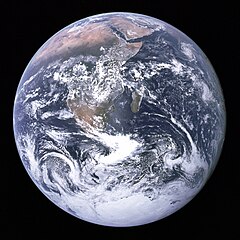
Lets cherish this blue marble ...


