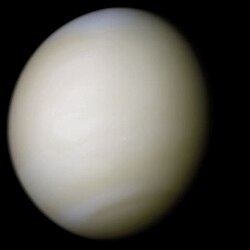
Venus, the second planet from the Sun, is named after the Roman
goddess Venus. A terrestrial planet, it is sometimes called Earth's
"sister planet", as the two are very similar in size and bulk
composition. Although all planets' orbits are elliptical, Venus's
orbit is the closest to circular, with an eccentricity of less than
1%. As Venus is closer to the Sun than the Earth, it always appears
in roughly the same direction from Earth as the Sun (the greatest
elongation is 47.8°), so on Earth it can usually only be seen a few
hours before sunrise or a few hours after sunset. However, when at
its brightest, Venus may be seen during the daytime, making it one
of only two heavenly bodies that can be seen both day and night
(the other being the Moon). It is sometimes referred to as the
"Morning Star" or the "Evening Star", and when it is visible in
dark skies it is by far the brightest star-like object in the
sky.
The cycle between one maximum elongation and the next lasts 584
days. After these 584 days Venus is visible in a position 72
degrees away from the previous one. Since 5 * 584 = 2920, which is
equivalent to 8 * 365 Venus returns to the same point in the sky
every 8 years (minus two leap days). This was known as the Sothis
cycle in ancient Egypt, and was familiar to the Maya as well.
Another association is with the Moon, because 2920 days equal
almost exactly 99 lunations (29.5 * 99 = 2920.5).
Venus has a very slow retrograde rotation, meaning that, unlike
with most planets, the direction of rotation on its axis is the
opposite of its orbital revolution around the Sun. The very slow
rotation means that the distinction between its Sidereal day
(rotation relative to the stars) and Solar day (relative to the
Sun) is very significant.
The pentagram has long been associated with the planet Venus and
the worship of the goddess Venus, or her equivalent. It is most
likely to have originated from the observations of prehistoric
astronomers. When viewed from Earth, the successive conjunctions of
Venus plot the points of a pentagram around the Sun every eight
years, returning to its starting point after a forty year
cycle.
Venus was known to ancient Babylonians around 1600 BC, and to the
Mayan civilization (the Mayans developed a religious calendar based
on Venus's motion) and must have been known long before in
prehistoric times, given that it is the third brightest object in
the sky after the Sun and Moon. The Maasai people in Africa named
the planet Kileken, and have a myth about it called "The Orphan
Boy." The Morning Star was called the Bearer of Light ("phôsphoros"
or "eôsphoros" in Greek and "Lucifer" in Latin, a term later used
of the fallen angel cast out of heaven, see Isaiah 14:12). To the
Jews it was known as Noga ("shining") and it was used in rabbinic
literature as a symbol of beauty and purity
Venus has an atmosphere consisting mainly of carbon dioxide and a
small amount of nitrogen, with a pressure at the surface about 90
times that of Earth (a pressure equivalent to a depth of 1
kilometer under Earth's oceans); its atmosphere is also roughly 90
times more massive than ours. This enormously CO2-rich atmosphere
results in a strong greenhouse effect that raises the surface
temperature more than 400 °C (750 °F) above what it would be
otherwise, causing temperatures at the surface to reach extremes as
great as 500 °C (930 °F) in low elevation regions near the planet's
equator. This makes Venus's surface hotter than Mercury's, even
though Venus is nearly twice as distant from the Sun and only
receives 25% of the solar irradiance (2613.9 W/m² in the upper
atmosphere, and just 1071.1 W/m² at the surface). Owing to the
thermal inertia and convection of its dense atmosphere, the
temperature does not vary significantly between the night and day
sides of Venus despite its extremely slow rotation of less than one
rotation per Venusian year, meaning that, at the equator, Venus'
surface rotates at a mere 6.5 km/h (4 mph). Upper atmosphere winds
circling the planet approximately every 4 days help distribute the
heat to other areas on the surface.
The solar irradiance is so much lower at the surface of Venus
because the planet's thick cloud cover reflects the majority of the
sunlight back into space. This prevents most of the sunlight from
ever heating the surface. Venus's bolometric albedo is
approximately 60%, and its visual light albedo is even greater.
Thus, despite being closer to the Sun than Earth, the surface of
Venus is not as well heated and even less well lit by the Sun. In
the absence of any greenhouse effect, the temperature at the
surface of Venus would be quite similar to Earth. A common
conceptual misunderstanding regarding Venus is the mistaken belief
that its thick cloud cover traps heat, as the opposite is actually
true. The cloud cover keeps the planet much cooler than it would be
otherwise. The immense quantity of CO2 in the atmosphere is what
traps the heat by the greenhouse mechanism.
There are strong 300 km/h (200 mph) winds at the cloud tops, but
winds at the surface are very slow, no more than a few miles per
hour. However, owing to the high density of the atmosphere at
Venus's surface, even such slow winds exert a significant amount of
force against obstructions. The clouds are mainly composed of
sulfur dioxide and sulfuric acid droplets and cover the planet
completely, obscuring any surface details from the human eye. The
temperature at the tops of these clouds is approximately −45 °C
(−50 °F). The mean surface temperature of Venus, as given by NASA,
is 464 °C (864 °F). The minimal value of the temperature, listed in
the table, refers to cloud tops the surface temperature is never
below 400 °C (750 °F). (This makes the surface temperature hot
enough to melt lead.)
The atmosphere also contains hydrogen sulfide (H2S) and carbonyl
sulfide (SCO). Hydrogen sulfide reacts with sulfur dioxide, which
implies that some process must be creating these components. It is
unclear how the carbonyl sulfide could be formed--it is often a
sign of biological activity. Some have suggested that microbes
exist in the clouds (which also contain droplets of water), and
produce these components from water, carbon monoxide and sulfur
dioxide.