Q1
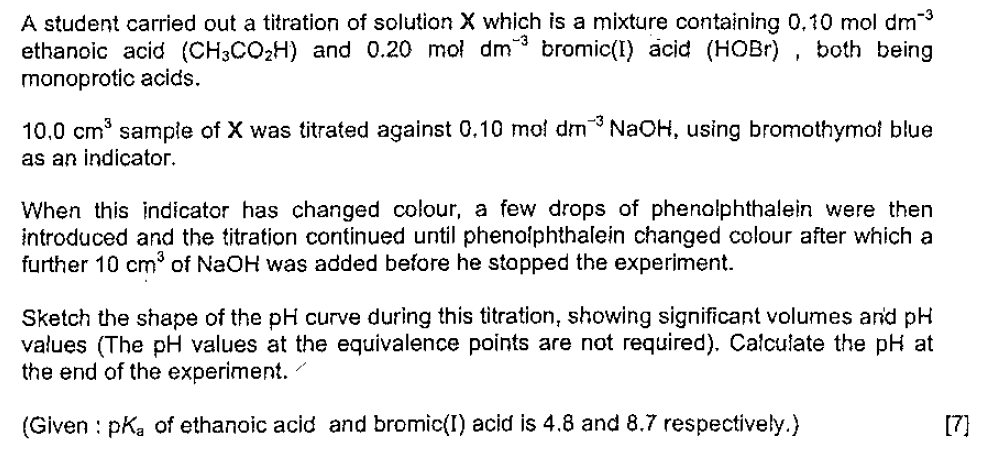
As a follow up to the previous question, the question was correct
as I omitted the (I) in the bromic (I) acid.
The answer indicates the precise volumes of sodium hydroxide
required for during the 2 equivalence points as 10cm³ and 30cm³.
However, wouldn’t that mean we have to assume that the mixture
contains an equal volume of ethanoic acid and bromic (I) acid? Is
this a reasonable assumption to make in light of the information
provided?
Q2
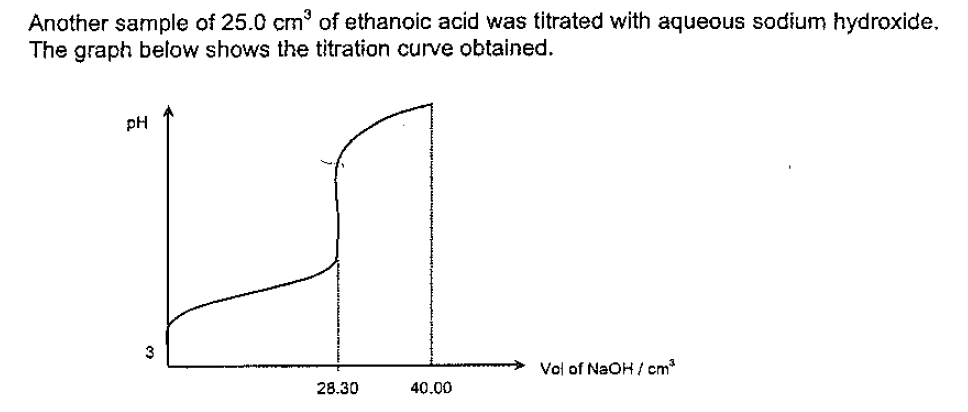

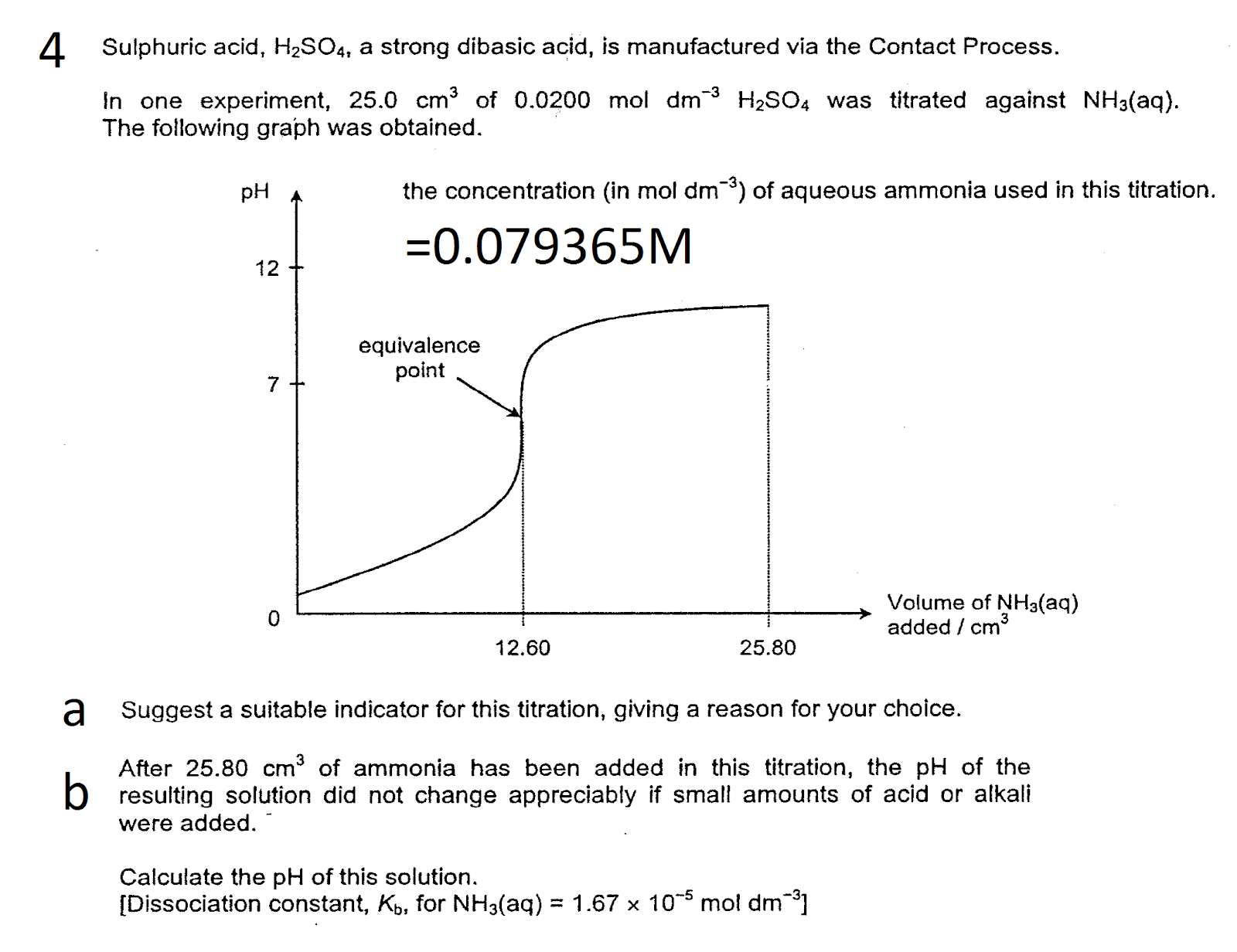
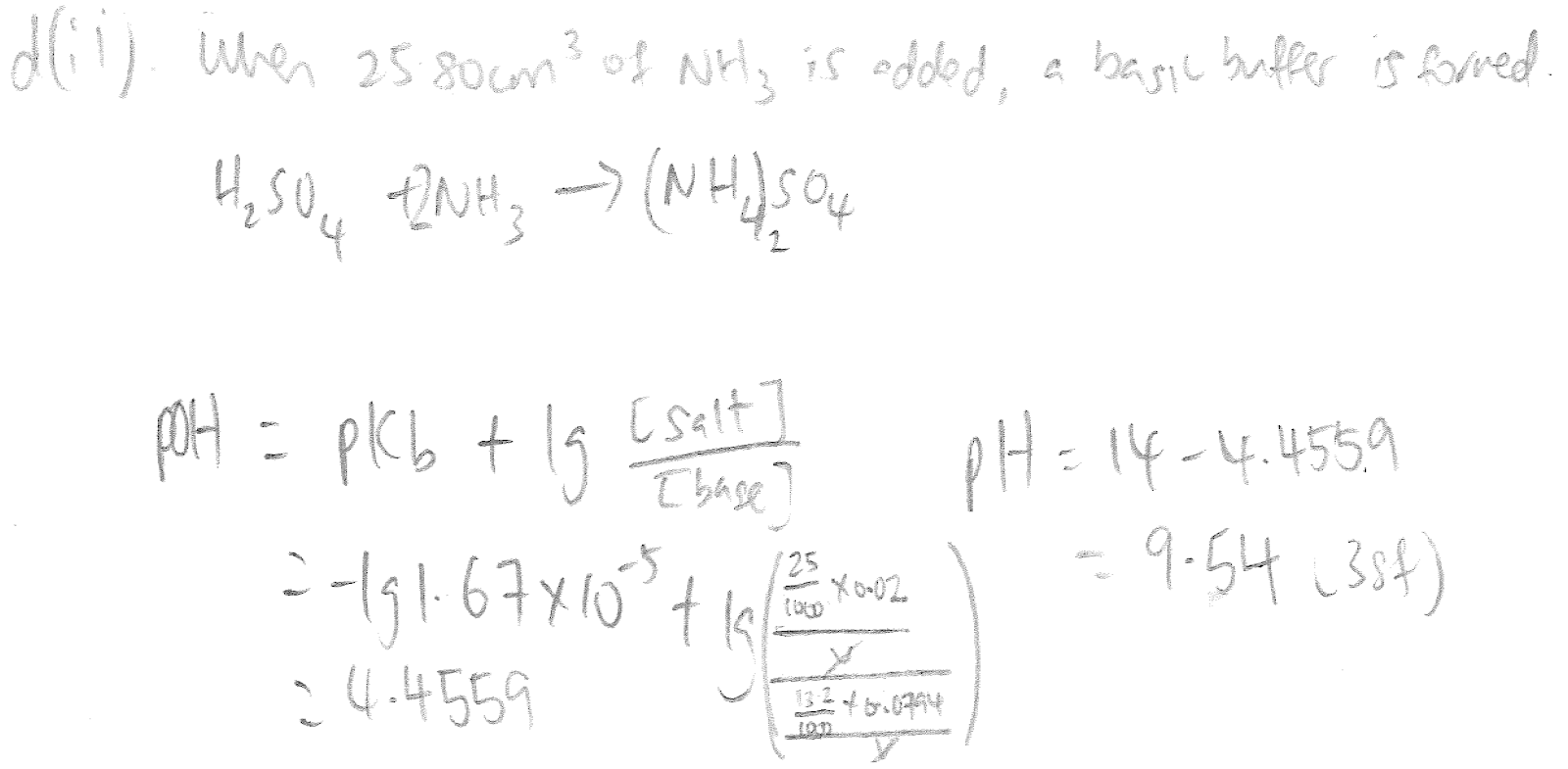
For part (ii) my pH at equivalence point is 8.61 but the answer
suggests 8.58. Did I overlook something? As for (iii), I am only
able to get a pH of 11.946 (5sf).
I carried out my calculations using the exact values from the
calculator. Alternatively, I would write 5sf for my intermediate
workings and round it up to 3sf for the final answer. Both of them
do not yield a pH of 12.0. If my calculations are correct, should I
reduce the number of significant figures just to “confirm” the
value of 12.0?
Q3
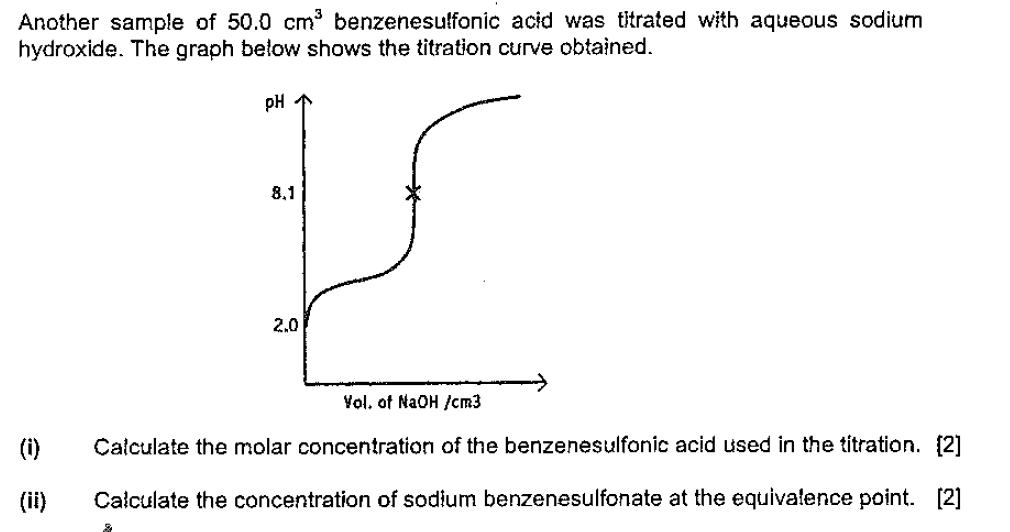
(Ka of acid = 5.9x10^-4M)
I reckon this is a blind spot on my part, but using the formula Ka
≈ [H+]²/[acid] yields an answer of 0.169M instead of 0.179M as
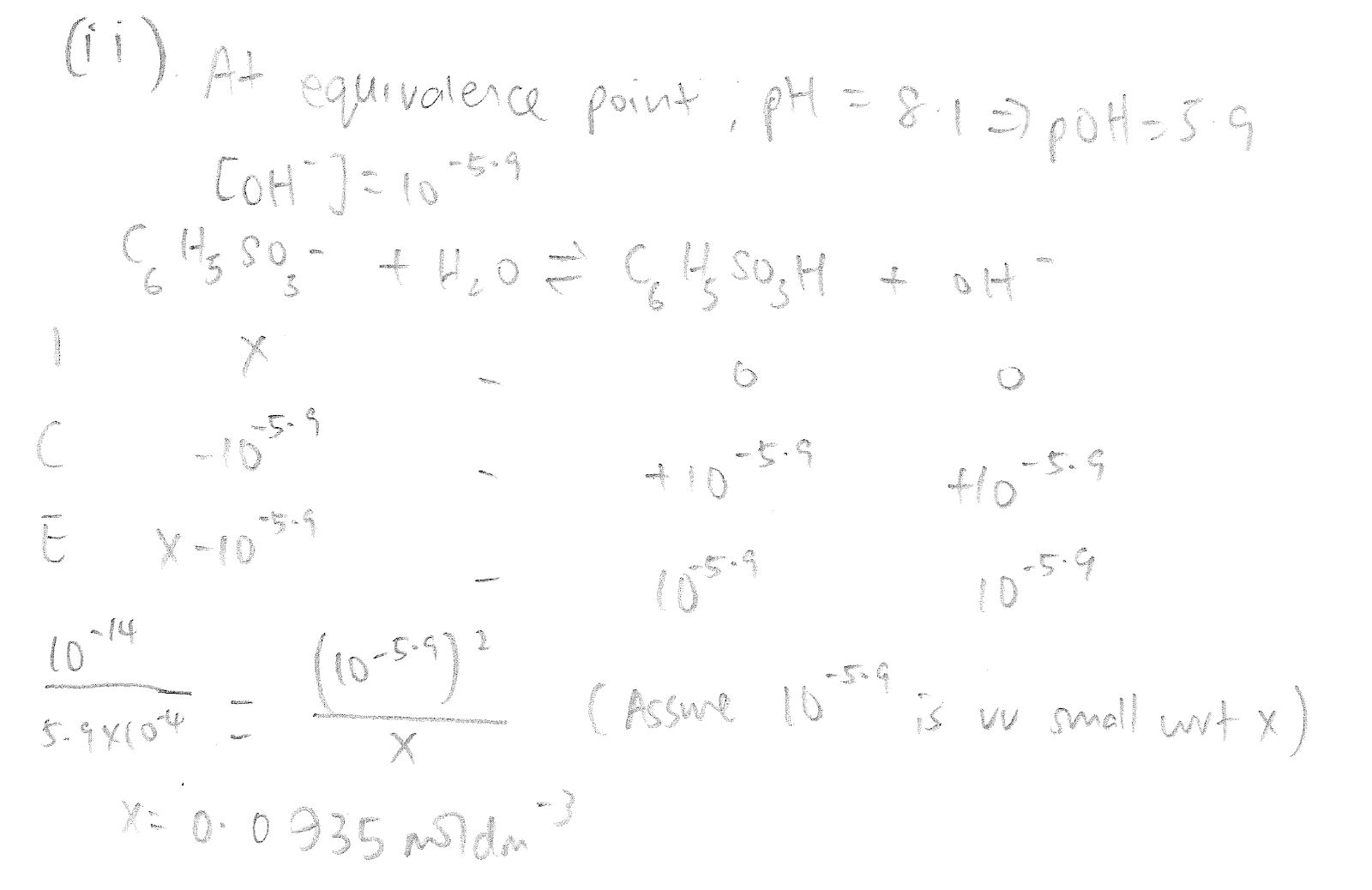
suggested by the answer. As for (ii) the answer suggests 0.0937M -
I drew the ICE table but was unable to obtain 0.0937M exact -
similar to the problem above. Is there something wrong with my
calculation method and my degree of accuracy?
Thank you once again, UltimaOnline :)
Q1. The question has to be interpreted to mean the stated
molarities of 0.1M and 0.2M are not before mixing, but after
mixing.
Q2. Question is erroneous (if taken as a new, unrelated qn to Q1)
because the molarity of *either* NaOH or CH3COOH acid has to be
given, but isn't.
(ii) If either molarity is given, then you can work out the moles,
hence new molarity of CH3COO- ions, then applying Kb, you can work
out [OH-] hence pOH hence pH.
(iii) An ICF (not ICE) table should be done to obtain the Final
(the F in ICF) moles of OH- in excess. As predicted by Le
Chatelier's principle, you can ignore the negligible hydrolysis of
the much weaker base CH3COO-, and calculate pH based on the new
moles, hence molarity, of excess OH- in solution.
Your values are close enough to the given answer. Cambridge
(depending on question and required working) may accept a
reasonable accuracy of 2 sig fig. The inaccuracy may lie with
whoever set this qn, no worries. Just ensure your students have the
correct underlying concepts.
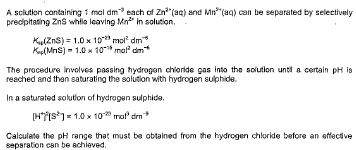
Q3. Question is erroneous. Benzenesulfonic acid is considered a
strong acid with a much larger Ka value than the question provides.
To put that aside, let's assume we change the qn to a weak acid
with the Ka you provided. Then both the answers you gave (ie. both
your own and the stated answers) appears to be wrong. If you want
to discuss this further, can you show detailed mathematical working
on how you arrived at your answer? And what is the source of this
qn? Which JC, which year?
A further problem arises : the assumption that has to be made at A
levels (which Cambridge allows so as to not require a graphing
calculator for H2 Chem) that equilibrium molarity can be
approximated to initial molarity because change in molarity is much
smaller than initial molarity for weak acid, no longer holds true
for this question. Because the initial [H+] is too large as the
initial pH is too acidic. As such, graphing calculator to solve
quadratic equation is required, and hence this question will not be
asked at A levels.
For (ii), from Ka of HA, calculate Kb of A-. Hence from Kb formula,
plugging in the [OH-] (calculated from pH read from graph), you can
work out the [A-], which solves the question. If you did this, ie.
your approach is correct, then no worries about the mathematical
discrepancy. It may likely be the question setter's fault, not
yours.