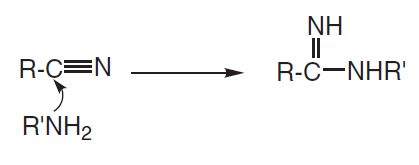
I realised my second question was incorrectly phrased and the
diagram was misleading.
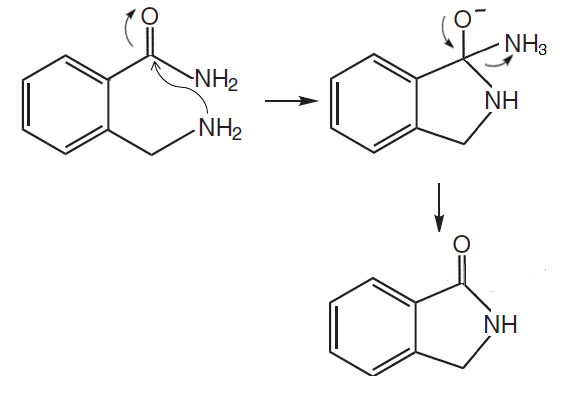
For the 2011 P1 MCQ Q27 Paper, should be NH3 not N2. Also, the
correct diagram (after some photoshop  ) would be this right? Amine attacks the
carbonyl group of amide, after protonation and deprotonation, lonen
pair on oxygen comes down to form a C=O double bond while expelling
good leaving group NH3.
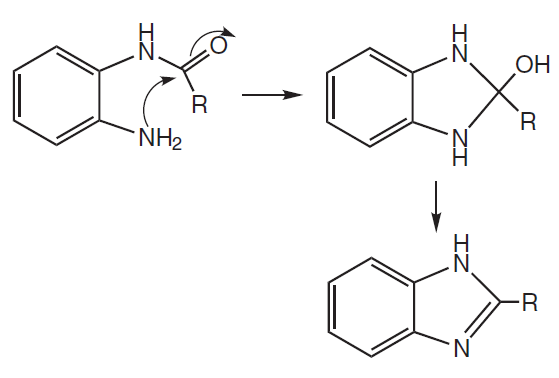
However, for this diagram, am I right to say that an amino
alcohol would be formed instead of NH3 expelling , since the -NH
group is directly bonded to the benzene ring hence it would be
impossible for a leaving group to form.
Not sure if I am going too far out of the A level syallbus, but
I have question about the nucleophilicity of the nitrogen atom in
the amide group.
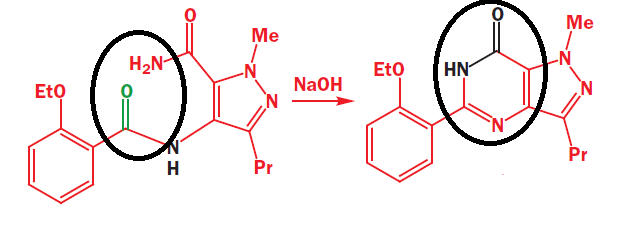
Part of the reaction scheme shows the industrial production of
Sildenafil drug (viagra). Something interesting in this scheme is
that a cyclic ring is formed for the product, which seems to imply
that the nitrogen atom of amide must have attacked the carbonyl
atom of another amide. It is really unusual,
because amides are not really electrophilic, and because the lone
pair of nitrogen atom in amide have delocalised into the system
(since amide forms resonance, which also implies why it is neutral
and not basic), the nucleophilicity of that nitrogen atom should be
significantly reduced. So how did the nucleophilic attack of
nitrogen atom to carbonyl group happen? What implications did the
base, NaOH had on the reaction?
I know this is totally out of the A level syallbus but I'm
really interested in knowing how or why such a reaction took place;
really refreshing to see such unusual reactions
Yes, your mechanism for the 2011 P1 MCQ Q27 is correct.
For the amino alcohol intermediate, it's not so much that "the
-NH group is directly bonded to the benzene ring hence it would be
impossible for a leaving group to form", for afterall the
benzene ring *is* able to stabilize the leaving group by
delocalizing the negative formal charge by resonance (over its
ortho and para C atoms). It's rather a matter of which pathway
(it's common in chemistry, just as in real-life, to have multiple
possible competing pathways) is more thermodynamically favoured,
and hence, which is the major product.
Because the -NH group is bonded to the benzene ring, eliminating it
does not afford as positive an entropy increase, as compared to
dehydration to generate the imine functional group.
There are (of course) other variables to consider, such as the
exact reagents, solvent, pH, temperature, etc. For A level H2
Chemistry purposes, it will more than suffice for the student to
appreciate how both pathways are at least possible, and the
Cambridge qn will be more than fair, giving hints and clues on
which pathway to focus on (eg. presented as an MCQ obviously
obviates the ambiguity of pathway).